Author Archives: Theryn

13: Dispatches from the Edge

Dispatches from the Edge: A Memoir of War, Disasters, and Survival by Anderson Cooper

Dispatches From the Edge

Ok, so it’s no surprise I read this. We all know I heart AC. (I just know if I’d have been rich & gone to Yale, we’d have met in the dorms and become BFFs! As it is, I’ll have to make do with those twinny moments when he says the exact thing I just said except he’s on TV and people actually hear him.) The only surprising thing is how long it took me to buy it. I meant to buy it as soon as it came out in paperback, but then I got distracted with all that directed-reading reading and visits from-and-to friends & rellies over the summer. All good, but how could I have forgotten AC? And then on a bookstore foray I saw it. eep! Immediately book was purchased so it could be read on vacay. Yes! I bought a full price new book! Second one this year! Possibly a record! (j/k)

So anyway… if you’ve read his Details columns or his posts on the AC360 Blog, then the writing style will be familiar. If you like it there, you’ll like it here and vice versa. I like the contrast of the simplicity of the writing with the chaoticness of the situations, but I realize that won’t work for everyone. When I looked at the Amazon reviews, I noticed some people think his emotions seem too subdued, but I disagree, because that uber-quiet/shutdown reaction is exactly how I get when I’m really upset (if I’m ranting/raving, I’m fine). The other nitpick is (of course) that he doesn’t discuss his present day personal life. I think those people are missing the point of this book, which is really about how his career has been a way for him to deal with the deaths of his father (when he was 10) and his brother (when he was 21). So the book flips back-and-forth between his present-day reporting and the past, making connections between the two. It’s a memoir, not an autobiography. Memoir doesn’t have to be all-inclusive; it can focus on certain events or elements of one’s life.

Because AC was only 10 when his father died, his love for his dad is that of a 10-year-old—uncomplicated by adult conflict—and it makes you think about both the good and the bad of that. Because we’re so close in age and I also have one brother (I know he has two much older half-brothers, but they aren’t mentioned here), it was hard not to do the “what if…” thing. Without the extraordinary circumstances of the deaths of two of his immediate family, he probably wouldn’t have obtained a fake press pass and headed off to a war zone. In fact, he could have led a very comfortable life without doing much of anything (or at least anything of substance—as we know many children of the very rich do). But I think not only was he on a quest to make sense of his losses, but he also had an awareness of mortality that most people in their twenties don’t have, since there was a history of early deaths on his father’s side of the family. So that probably pushed him to take more risks than the average person—and also to not wait till some magical future date to do the things he wants to (like so many people do).
12: Prodigal Summer

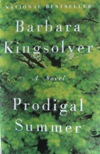
Prodigal Summer by Barbara Kingsolver

Prodigal Summer

I read Kingsolver’s epic, The Poisonwood Bible, around the time it first came out (summer of 2000, I think). I recall that it was a good read, but I certainly didn’t have that “best. book. ever!” response that so many people seemed to have at the time. Then there was the time that someone told me a writing prompt response I wrote sounded like Prodigal Summer (having now read PS, I don’t see the connection). That was years ago too. I guess I wasn’t enthralled enough with TPB to immediately seek out PS upon hearing this comment, but I did remember it when I saw the book on the shelf at The Bookshop last summer. And then it sat on my shelf for a year…

But when I finally picked it up, I read it in a couple days; it was a quick read. I think I liked it better than TPB. I say I think because TPB is a bit vague for me, plotwise, but going on gut reaction. PS immediately hooked me in a way that TPB didn’t. I read it in big gulps. And it was funny, reading PS right after writing this:

(The fact that I read the TNITL for fun should in itself have been a strong indication that I should have majored in English, but I was too busy cutting off my nose to spite my face at the time to realize this.)

because PS is the type of book that makes me happy that I majored in biology. You know, because a degree in something other than writing/English gives me something to write about. Also, it makes for quirky cocktail conversation. Like so:

Acquaintance: What’s your undergrad in?

Me: Biology.

Acquaintance: !!!

Or, alternatively: Me too! (Yes, apparently I am not alone in my weirdness.)

But I digress. PS starts out as three separate stories, but as the book progresses, we find out that all three are more or less connected. In Predators, we meet Deanna, who has parlayed her master’s degree into a job for the Forest Service (essentially discouraging hunters from poaching wildlife). In Moth Love, we have Lusa, who gave up her postdoctoral grant to marry tobacco farmer Cole and is struggling to adjust to life as an outsider in a small community. And finally, in Old Chestnuts, we have retired schoolteacher Garnett and his neighbor/nemesis Nannie. Deanna’s thing is coyotes, Lusa loves moths, Garnett’s trying to revive the American chestnut, and Nannie grows organic apples.

The book is all about sex, not in the porn sense, but in the cycle-of-life sense. The story functions as a polemic for Kingsolver. Characters frequently launch into long “as you know, Bob” monologues on the evils of hunting or pesticides or tobacco farming. If you’re a left-coasty granola (*cough*), this is pretty standard stuff, but where the story’s set (Appalachia), her views are probably less de rigueur.

I liked that the secondary characters always remained a bit of mystery (as people do) and that everything wasn’t tied up neatly in a bow at the end (life goes on…). Initially I wasn’t sure about the headhopping between chapters—just when you get hooked on Deanna’s story, it leaps to Lusa, etc. and at first I found myself reading fast so I could get back to the first storyline (and then the second & so on) because at first it’s like three separate stories. But as the three stories became entwined, the headhopping starts to make sense—they’re three different PoVs within the same setting. So in the end, I thought the strategy worked.

11: The Moon is Always Female

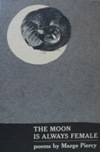
The Moon is Always Female by Marge Piercy

The Moon is Always Female

Ack. I actually finished reading this ages ago. It’s been sitting on my desk looking at me for most of the summer, as a reminder to write a post about it. Meanwhile, I’ve been otherwise occupied reading books for my directed reading course (and by extension, my thesis). But that project is nearing completion, and it’s time for some just-for-fun reading to finish off the summer. Before starting something new, here are my two cents on The Moon is Always Female.

Marge Piercy is one of the poets I first came into contact with when reading The Norton Introduction to Literature when undoubtedly I should have been doing something else. Like reading that Poli Sci textbook I never realized I owned until an hour before the final exam. (The fact that I read the TNITL for fun should in itself have been a strong indication that I should have majored in English, but I was too busy cutting off my nose to spite my face at the time to realize this.) The poem was “To have without holding.” The first stanza (p. 40):

Learning to love differently is hard,
love with the hands wide open, love
with the doors banging on their hinges,
the cupboard unlocked, the wind
roaring and whimpering in the rooms
rustling the sheets and snapping the blinds
that thwack like rubber bands
in an open palm.

Heh. I just noticed the first comment under “Most Helpful Customer Reviews” at Amazon is from my close personal friend Eden. How apropos, since I picked this up when I saw it at my favorite used bookstore last summer because of the many times she’s mentioned it. Let’s see what she had to say:

Piercy’s poems in this collection touch my every emotion. They make me laugh, cry, consider, ache, scream and everything in the spaces between. I “had” to read this for a contemporary lit course in college over ten years ago. Problem was, I couldn’t stop reading it. It was the first book I couldn’t bring myself to sell back. It’s exceptional, from the words on the pages to the typeface itself. Favorite include: “For the young who want to” “For strong women” “Poetry festival lover” and of course “The moon is always female.” After reading it, you will feel like you know Piercy. And you will also better know yourself.

Hmm, thanks for doing my work for me, E! I’d also add that it’s the kind of collection that it’s nice to leave out where you can pick it up and randomly re-read a poem or two when the mood strikes you. “For the young who want to” is one of my favorite poems (by any poet) and I never tire of re-reading it. The last stanza (p. 85):

The real writer is one
who really writes. Talent
is an invention like phlogiston
after the fact of fire.
Work is its own cure. You have to
like it better than being loved.

Will Sings “Sensitive Song”

Back in the day (as in junior high), I wanted to be an actor. That particular career ambition was discouraged, and I chose to pursue other opportunities, as they say. One of my cousins did, however, become a professional actor. Also, he can sing. Which I cannot. Here he is, singing “Sensitive Song,” which is apparently from Cops: The Musical! (bwahahaha).

Warning: may not be suitable for all audiences.

Schmap!!

One of my Flickr photos was picked for the 3rd edition of the Schmap Vancouver Guide (they emailed a couple of weeks ago saying it was shortlisted, and requesting my permission to use it if chosen, then last week I got another email saying it had been picked).

This is the photo:

False Creek

And here it is in the Schmap guide.

There’s also a widget, but we all know how WordPress feels about third party widgets 😦

What’s funny is that before Schmap looked at the photo, it had zero views. Heh. Now it has a whopping three!

And the Winners are…

Toasted Cheese Literary Journal is pleased to announce the winners of the 2007 A Midsummer Tale Writing Contest:

1st: Dena Riggs Hein, “Fear of Drowning”

2nd: Mary Wuerth, “The Final Wave”

3rd: Jinevrah Aljín, “Shopska Salad”

Honorable Mention:
Richard Ballon, “Sky”
Liz Mierzejewski, “Picasso’s Guitar”

Our thanks to all who entered. You can read the winning stories in the September issue of Toasted Cheese.

The 2008 A Midsummer Tale Writing Contest opens May 1, 2008. Toasted Cheese‘s next contest is Three Cheers and a Tiger in September. Details on all our contests can be found here. Submissions to Toasted Cheese are welcome year-round.

Mine! All Mine!

Finally got around to visiting the garden store last weekend to pick up some flowers and herbs, including, of course, catnip. Here’s P reacquainting herself with her BFF:

Catnip!

P: This stuff is teh awesome!