
A Map of Glass by Jane Urquhart
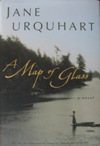
I finished this a few days ago on March 26 and I’ve been trying to figure out what I want to say about it [nb: it was “a few days ago” when I started the post!]. I feel like my remarks are likely to make it sound like I feel more negatively about this book than I actually do. In a nutshell: A Map of Glass was a pleasant (perhaps I should say pleasurable), but unsatisfying, read. It was pleasant/pleasurable while I was reading because Jane Urquhart is a lovely writer at the sentence level. The story just sort of washes over you. It’s cozy and delicious. Like curling up with a blanket and hot tea—and a book, of course—on the sofa.
It’s so pleasant that the fact it’s also unsatisfying doesn’t really hit you until you’re done. Or it could be that you were just waiting till the end, expecting the story to pay off eventually, and then it didn’t happen. Instead, you had the only firm ground in the story pulled away at the last minute, leaving you wondering if the entire thing was an illusion, a fabrication, and if so, what was the point?
Before we continue, you need to know this: A Map of Glass is structured in three parts. The first and third parts are set in the present. The second part is set in the past (and is supposed to be the reading of a set of journals):
“Eventually [Sylvia] gives Jerome Andrew’s journals, which contain a fictionalised account of his family, going back four generations to the genesis of his great-great-grandfather’s timber empire.” –The Guardian
The main characters are Andrew, who dies in the opening scene and is the alleged author of the journals read in part two; Sylvia, Andrew’s alleged lover, wife of Malcolm (a doctor with a messiah complex), and sufferer of unnamed “condition” (seems like autism/Asperger’s but treated as if it’s more Mysterious than that); and Jerome, the artist who (I think I can leave out the allegedly here…) found Andrew’s body.
There are also a bunch of characters in part 2, the section read from the journals, but that’s not the part that concerns me. That part (the filling in the sandwich, if you will) seems to be a fairly straightforward story about Andrew’s ancestors, which a lot of reviewers/readers seem to have enjoyed as a “novella” in the middle of the novel:
“In fact, a problem with Glass is that the present feels less urgent than the past.” –Powell’s
But I’m more interested in what’s wrapped around it…
Part of the problem is this:
“A year later, the dead man’s lover arrives on the artist’s doorstep, aiming not to find out how he died but to explain who he was, how he had lived, how they had loved. … When we first meet Andrew, he has Alzheimer’s and his failure to remember who or what he loved, while pathetic (in the kinder sense of the word), makes it hard to warm to him. Sylvia talks about him, but he fails to come to life, remaining unknown, distant. He’s more of an idea.” –The Telegraph
I think I was waiting the whole book for Andrew to turn into a person, but he never does. He’s just a name. Which is frustrating, because he’s the core of the book: he is what brings Sylvia & Jerome together; it is his journals we are supposedly reading. Oddly, it is the opening scene where his mind is absent that he is most present. We never do find out what he saw in Sylvia or she in him. In the present day sections, this could, I suppose, be chalked up to Sylvia’s “condition,” but in the journals we also never do get the part of the Woodman family story that links Andrew to his father and the rest of the clan, or Andrew to Sylvia for that matter.
So this is where the story feels rather hollow to me. Still, up till the end, I was taking the core elements of the story as they were presented, i.e.: Sylvia did have an affair with Andrew, and Andrew did write the journals. And that this relationship and Andrew’s death, has pushed Sylvia out of her comfort zone—as posited in this review:
“Sylvia and Andrew’s hidden love, which prompts her to redefine her relationship with the world, suggests that her grief is the wellspring for a more deeply examined life.” –The Independent
And then… near the very end of the book, Malcolm says that Sylvia imagined the affair. Screech. Rewind. If true, what does this mean? Jerome found Andrew’s body. Sylvia read about it in the newspaper. Sylvia not only imagined an affair with Andrew, but wrote an entire family history for him. Is this plausible? An imagined affair would perhaps explain the sketchiness of the details regarding their relationship, but what about the family history? Is that something Sylvia would do? It’s hard to imagine her thinking so much about Andrew’s ancestors when she has such a tenuous relationship with people (and even herself). But then you remember she’s not only steeped in her own family history, but also she volunteers at the local museum and that was where she learned about the hotel buried in sand. Hrm. Then again, Malcolm is not exactly a reliable source. Dude clearly has an agenda (though it’s unclear what that is—having Sylvia’s condition named after him, perhaps).
Ultimately, I decided that I have to believe in Sylvia’s version of the events, if only because not to would negate what I think is the best line of the entire book, and that is when Sylvia explains to Jerome her realization that after calling off their relationship years prior, Andrew re-instigated it not for any romantic reason, because he had forgotten that it ever stopped.
In the end, though, it does not matter, just as it does not matter that although I believed that he had returned because—miraculously—he wanted to begin again, he had really returned because he had forgotten that we had ever stopped.
O.M.G.
In retrospect, I think the parts dealing with Andrew losing his memory are the strength of A Map of Glass—and by extension, the linking of this personal/total loss of memory to the loss of knowledge/memories of one’s history/past—but I wonder about the choice of Sylvia as a filter, as well as the choice to call into question her reliability as a narrator.
More:
[ETA: I forgot to say where I got this book! I actually was at a loss at first; I couldn’t remember where I picked it up. But then I flipped back to the first page and saw the price marked in pencil. So, as it turns out, it was another used find from The Bookshop.]
 The Remainder Table