
[The acid of the Fug Girls is] what I want from my design blogs (among other things), but I can’t find it. I feel trapped in the vacuum of enthusiasm.
It is nice to be part of a supportive community, especially in a downturn. And there is a lot of beautiful work out there. But the economics and tempo of blogging mean that most design sites present us with pictures of up to ten beautiful things per day. The text is often just a tweaked press release. I am not sure what I am supposed to do with this, beyond a second’s admiration. If I happened to be looking for wallpaper, or tea towels, or a new poster, I might click through to buy, but most of it just passes unprocessed before my eyes.
Author Archives: Theryn
Maintain a Queue
To use an analogy from running, blogging is the daily training that prepares me for my “races.”
…
I gave up feeding the blog on a real-time, everyday basis a couple of years ago. … I maintain a queue of roughly 50-100 posts at all times, scheduling the less time-sensitive material at leisure and prioritizing the faster-moving stuff. That way I never get up in the morning dreading the task of tackling the blog. When so moved, I still write in real time, but I make that decision, not the blog. As soon as the blog stopped owning me, I finally began to master the blog form.
So that’s the secret. Huh.
Now, if only I were that organized… 😉
Seriously, a queue of 5-10 posts, I could see. But 50-100 posts?! Dude.
More realistic and down-to-earth
I tend to think of blogs as more realistic and down-to-earth about their topics than their print equivalents. Litblogs reflect how people really do read, compared to that horrid New Yorker list or the best books of the year that the New York Times vomits out. Likewise, food blogs are more how people eat on a daily basis, compared to the Gourmet cookbooks that think you have endless hours stretched out ahead of, with which you can pound pastry dough into submission.
The Writer Who Couldn’t Read
I’d heard this story before, but I hadn’t heard that he’d figured out a way to read again. Cool!
Now I have this song in my head. Click if you dare:
[/earworm]
(you’re welcome!)
Deconstruct This

Creative Inspiration
I find that whenever I start slacking off the daily exercise (“I have too much WORK to do…”), I inevitably start feeling more and more tired and uninspired. … Some days, though, I get so wrapped up in my work that it’s hard to drag myself away from the computer screen. … I find that getting some exercise outdoors does wonders for getting creative inspiration flowing plus is good for de-stressing.
12: What I Talk About When I Talk About Running
What I Talk About When I Talk About Running by Haruki Murakami
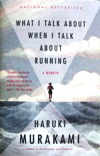
I see that reviewers really didn’t like this book (see, for example, the NY Sun, the Sunday Times, the Telegraph). Keep in mind the sharp edges are tempered due to the author being beloved.
I think this is where I’m supposed to get outraged and start ranting about people reading it wrong, and so on. But honestly? I find it rather amusing, because they’re so clearly wtf? about the whole thing. Like when Murakami writes about what he thinks about while running:
What exactly do I think about when I’m running? I don’t have a clue. … I just run. I run in a void. Or maybe I should put it the other way: I run in order to acquire a void. But as you might expect, an occasional thought will slip into this void. … The thoughts that occur to me while I’m running are like clouds in the sky. Clouds of all different sizes. They come and they go, while the sky remains the same sky always. The clouds are mere guests in the sky that pass away and vanish, leaving behind the sky. (p. 16-17)
They’re all like, “But that’s so dull!” But it’s not dull to me, because that’s exactly how it is. As is this:
I don’t even think there’s that much correlation between my running every day and whether or not I have a strong will. I think I’ve been able to run for more than twenty years for a simple reason: It suits me. … Human beings naturally continue doing things they like, and they don’t continue what they don’t like. (p. 44)
It’s a great illustration of the importance of audience. In the opening paragraph of the NY Times review, Geoff Dyer writes:
I’m guessing that the potential readership for “What I Talk About When I Talk About Running” is 70 percent Murakami nuts, 10 percent running enthusiasts and an overlapping 20 percent who will be on the brink of orgasm before they’ve even sprinted to the cash register. And then there’s me, the zero-percenter: a non-running Murakami virgin. Oh well. The supreme test of nonfiction is that it be interesting irrespective of the reader’s indifference to the subject under discussion, and a great writer’s work is obviously beflecked with greatness whatever the occasion. So the terms of the test are clear.
Well, I’d never heard of Haruki Murakami before I picked up this book. But I do run. And I also write. And, as I noted shortly after I bought the book, I have in fact actually used running as a metaphor for writing! So when I saw WITAWITAR while browsing the memoir/bio section at Chapters (where, fyi, it was displayed face-out rather than spine-out, ahem), I knew I had to read it. In other words, I think I’m an Ideal Reader for this book, one of the (apparently*) teeny number of people who both write and run. It never would’ve occurred to me that this was a rarity, but not only does Murakami comment on it (apparently he’s popular with running mags for this reason), Peter Terzian’s LA Times review makes note of how unusual it is for writers to write about running [emphasis added]:
In a 1999 essay for the New York Times, Joyce Carol Oates drew a parallel between the tireless walker-writers of the 19th century (Coleridge, Dickens, Whitman) and the contemplative present-day jogger. “In running,” she wrote, “the mysterious efflorescence of language seems to pulse in the brain.” An afternoon run allows Oates to untangle the structural problems that bedevil her fiction in the morning.
Oates’ essay aside, the literature of running is as thin as a mesh singlet. Running pops up in fiction and poetry from time to time, from Homer to John Updike, but the sport doesn’t easily lend itself to the dramatic. The vagaries of weather, the joint pains and the repetition of putting one foot in front of the other can’t compete with the traded blows of the boxing ring or a home run.
O rly?
While reading WITAWITAR, I started thinking that perhaps I should be writing about running—not just in one-offs, but in a more sustained way—but the idea that running can’t compete with boxing or baseball?! That’s like an outright challenge!
Oh, it’s on.
But back to the book. If the ideal audience for one’s book is miniscule, does that matter? Should one try for wider appeal? Murakami thinks not. Before he started writing, he ran a bar where he learned this:
If one out of ten was a repeat customer, then the business would survive. To put it the other way, it didn’t really matter if nine out of ten didn’t like my bar. This realization lifted a weight off my shoulders. Still, I had to make sure that the one person who did like the place really liked it. In order to make sure he did, I had to make my philosophy and stance clear-cut, and patiently maintain that stance no matter what. (p. 38)
I love the 1,000 True Fans concept (i.e. in order to make a living doing something creative, you don’t need a kajillion fans; you just need ~1,000 people who really love your work). Over at TC, I’ve been trying to start a discussion about self-/e-publishing and readers. The point I’ve been trying to make is that if the bulk of your readership consists of True Fans, it’s in your best interest to treat them well (i.e. not try to sell them crap just because you can). Murakami’s idea seems along the same lines.
Oddly, right after I bought WITAWITAR, I saw Kevin Hartnett’s essay about it at The Millions. Recommended. It’s a good essay and a much better summary of what the book’s about than my meanderings. Plus, he’s already sought out Murakami’s fiction, so he’s a step ahead of me.
*I don’t really buy that there’s so little crossover. Do you write & run?
I did loads of writing in trigonometry
[W]hen I have to write all the time, the last thing I want to do is write. This is true of almost every writer I know. We all love writing, but when someone makes you do it, it kind of sucks. However, I did loads of writing in trigonometry! If I had been a math major, I would have written about twelve books by the time I graduated. In retrospect, I see this is a GENIUS IDEA and encourage you all to think about it!
A surprising e-mail conversation
Two weeks ago, I saw a review on our Weddings page of a book called “Sex at Dawn: The Prehistoric Origins of Modern Sexuality” (HarperCollins). Without much thought, I blurted out in a tweet that it sounded pretty stupid to me. But that started a surprising e-mail conversation with one of the authors, Christopher Ryan. It’s interesting not only for what Mr. Ryan says, but as an example of the way patient authors can profitably engage even caustic critics[.]
Previously Rejected
How readers feel about [self-publishing] usually gets lost in the fanfare and the hand-wringing. People who claim that there are readers slavering to get their hands on previously rejected books always seem to have a previously rejected book to peddle; maybe they’re correct in their assessment, but they’re far from impartial. Readers themselves rarely complain that there isn’t enough of a selection on Amazon or in their local superstore; they’re more likely to ask for help in narrowing down their choices. So for anyone who has, however briefly, played that reviled gatekeeper role, a darker question arises: What happens once the self-publishing revolution really gets going, when all of those previously rejected manuscripts hit the marketplace, en masse, in print and e-book form, swelling the ranks of 99-cent Kindle and iBook offerings by the millions? Is the public prepared to meet the slush pile?
You’ve either experienced slush or you haven’t, and the difference is not trivial. People who have never had the job of reading through the heaps of unsolicited manuscripts sent to anyone even remotely connected with publishing typically have no inkling of two awful facts: 1) just how much slush is out there, and 2) how really, really, really, really terrible the vast majority of it is.

