
One smart friend who has read both [blog and book] said she thought the blog was process, the book was conclusion. The ideas in the book are presented in a more distilled, thoughtful way, and the book framework allows me to tell longer stories and explain more complicated ideas. I’m able to show how different ideas fit together, which can be tough to do in one blog post. The book goes deeper.
Author Archives: Theryn
The ability to imagine
Reason is ultimately guided by context. … To be un-empathetic is to be unable to transpose oneself into an unfamiliar context, and ultimately, develop blind spots (which, even worse, one does not even know they have). The fundamental misunderstanding, I believe, is the confusion between empathy and sympathy. Sympathy is about emotion- feeling sorry for someone who has cancer, for instance. Empathy is about the ability to imagine what it might be like to have lung cancer, and what effect such a state would have on that person’s outlook on the world. The former is lacking in the world, and may or may not have a place in the judicial system. However, the latter is vital and essential to a judicial system that is able to recognize the entirety of the society of which its decisions touch.
—Max Falkoff
in comments on “The Unsung Empathy of Justice Stevens” at Slate
Print vs. eBook
Earlier this week, Randy Cohen, “The Ethicist” at the NY Times, wrote a column titled “E-Book Dodge.” Of course, the interwebs freaked out. Nathan Bransford’s post “A Matter of Ethics” is representative of the “omg! what was he thinking?!” side, and John Scalzi’s post “On How Many Times I Should Get Paid For a Book (By Readers)” (appropriately enough) is representative of the “ehh, whatever” side. Both posts have 100+ comments. It’ll take you a while to read them all if you choose to do so.
Anyhow, there’s a lot of rhetoric on both sides to wade through, but what these arguments (whether it be books or movies or music) come down to–the question that we really need to address–is what are you paying for? And here I don’t mean what do the corporations say you are paying for. I mean, what is the reason you are willing to fork over $x.00 of your hard-earned money for that movie/album/novel. Are you paying for (a license to view/listen to/read) the content (intellectual property) or are you paying for the object itself (personal property aka chattels) or are you paying for both? And is there there a difference between types of intellectual property and their delivery mechanisms?
Let’s look at music. Back in the day, albums came on things called records. Records were big, flat discs with grooves. Nowadays people re-purpose them into kitschy art projects. The discs were encased in sleeves. Record album artwork and liner notes were a Big Deal. Early cassettes were inferior to records, not only because of the quality of the music (hisssss!), but because you didn’t get the album art or liner notes. There was usually a thumbnail of the record cover on the front of the cassette and inside, just a list of the songs. Cassettes like this were extremely disappointing! Nevertheless, people bought them because they were convenient: you could play them in your car (if, you know, you were old enough to drive), or on your (faux) Walkman, or in your bedroom on your “ghetto blaster” (I know, soooo ’80s). Eventually, though, I guess someone figured out that cassette-buyers felt like they were being ripped off, and album art and liner notes came to cassettes. They also started to get more creative with the cassettes themselves (e.g. different colors, transparent plastic). Those cassettes were so superior to the ones that didn’t offer anything but the music. A lesson was learned from this, apparently, because CDs always came with proper album art and liner notes.
In both cases (cassettes & CDs), though, the inserts that contained the cover art & liner notes were (because of their size) considered inferior to the sleeves that records came in. And then came mp3s, which stripped away the object entirely. Ok, yes, mp3s can have (virtual) album art and liner notes attached, but… you’re not going to ever be able to turn them into a bowl or a lamp. And, you also can’t (legitimately) sell them or trade them or give them away.
So, let’s break down what you get when you buy a…
- Record: music (IP) + cover art/liner notes (IP) + actual record & sleeve (personal property)
- Cassette: music (IP) + cover art/liner notes (IP) + cassette, case, insert (personal property)
- CD: music (IP) + cover art/liner notes (IP) + disc, case, insert (personal property)
- mp3: music (IP) + (virtual) cover art/liner notes (IP)
When you buy a record or a cassette or a CD, you take ownership of the physical objects involved, but you do not own the music or the cover art or the liner notes. What you’ve purchased is a license to listen to the music, view the cover art, and read the liner notes. Ownership of the content remains with the creator (or if it’s work-for-hire, the corporation who did the hiring). Ergo, when you buy an mp3, because there’s no tangible object involved, there is no transfer of ownership. As with the record, cassette, and CD, what you’ve purchased is a license to listen to the music, view the cover art, and read the liner notes. There is a difference, however. When you buy tangible media, you can be assured that your license is in perpetuity—forever—or at least as long as the physical medium remains in good condition. Your cassette may wear out because you overplayed it, but no one from the band or the record company or SOCAN is going to sneak into your house and take it back. They might want to! but they can’t because it would require them to take your personal property back along with the license to listen to the music. With intangible media, there is no such barrier. The license to listen might have a built-in self-destruct, or the license might be revocable at any time (who reads all that fine print anyhow ;-)).
By most measures, the mp3 is an inferior product: the music quality generally isn’t as good as a CD, you don’t get anything tangible to hold in your hand, to look at or read, and you don’t own anything. Yet, at 99c per song, you’re paying pretty much the same amount for an album in mp3 format as you would for an album on CD. And there’s no way of ever legitimately recouping any of your costs, should you ever have a need or desire to do so. You can’t sell your iTunes library at a yard sale. Plus, there’s that pesky potential that someone could just take your songs away.
So why buy mp3s? Well, we all know the answer to that. Convenience. Not only can you shop from home and get your music instantly, but you can easily play it in multiple places: your computer, your iPod, etc. The ability to carry your whole music collection with you at all times, to be able to effortlessly transfer it from one device to another when you upgrade (as you inevitably will), is, of course, the major appeal of digital media. When you think about it that way, it makes sense that people would be upset by any DRM that blocked them from transferring music from one device to another or put limits on how many devices they can listen to it on etc. People have been willing to give up the tangible aspects of a music purchase, as well as the security of that purchase (this is mine), because the benefits of digital media (when not tampered with) were a reasonable trade-off. DRM is an attempt to take away those benefits without providing anything in return. It’s lose-lose for the listener.
There’s one other issue, and that’s transferability (or convertibility). Back in the day, people would often buy the record (the superior product), then make a cassette copy to listen to in the car (or wherever portability was more important than quality). When CDs were introduced, the same thing happened. But because CDs are digital, they also had the advantage of being able to go the other way: they could also be turned into mp3s. Just like the cassette-copies, however, the mp3-copies are downgrades. I have to think that if you’re a music aficionado, the CD is still preferable to the digital download. Assuming no DRM, and the ability to transfer the CD’s contents to your iPod or whatever, the only real disadvantage is that CDs take up space. But if you’re a music lover, you probably want your collection on display, you want to be able to grab an album off the shelf and analyze the cover art and study the lyrics and all that good stuff.
I guess my point is that there’s a tendency to say that people who want the tangible object as well as the content are fetishizing the object, and I think to some extent that’s true. But dismissing that desire solely as fetishization would be a mistake because there are obviously advantages to owning the tangible object in addition to having a license to listen to the content. You might care about those things or you might not; the point is that they do exist. It comes back to: what are you paying for?
At the same time, unless you’re a collector, one tangible version is probably plenty. When you think about the fact that some people have probably purchased record, 8-track (gasp), cassette, and CD versions of the same album, it’s understandable that they’re fed up with paying again for something they’ve already paid for five times over.
Precious
When you have the kind of low-rise density that Montreal does, where it packs in a lot of people but not in towers, that means wall to wall housing. Between the endless rows of brick and stone houses, the paved streets and the concrete sidewalks, I sometimes feel as though I’m living in a cement box when I’m there. It’s like taking Gastown and spreading it out over 10 square miles. It’s so hard. (And, adding to that, so dirty — cigarette butts and litter everywhere.)
Okay, it was early spring and the trees were still bare, but I know I’ve felt the same way even in summer. In my one and only interview ever with Richard Florida, he said Vancouver surprised him because he had always supposed that urbanity couldn’t be combined with green. But he appeared to be entranced with the way this city could be both dense but filled with landscaping. We shouldn’t forget how precious that is.
Dreaded Tasks
Often, I know I’d be happier if I do something I really don’t feel like doing. … Those dreaded tasks hang over my head, though; they make me feel drained and uneasy. I’ve learned that I’m much happier, in the long run, if I try to tackle them as soon as possible, rather than allowing myself to push them off.
2: A Map of Glass
A Map of Glass by Jane Urquhart
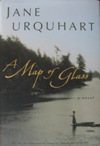
I finished this a few days ago on March 26 and I’ve been trying to figure out what I want to say about it [nb: it was “a few days ago” when I started the post!]. I feel like my remarks are likely to make it sound like I feel more negatively about this book than I actually do. In a nutshell: A Map of Glass was a pleasant (perhaps I should say pleasurable), but unsatisfying, read. It was pleasant/pleasurable while I was reading because Jane Urquhart is a lovely writer at the sentence level. The story just sort of washes over you. It’s cozy and delicious. Like curling up with a blanket and hot tea—and a book, of course—on the sofa.
It’s so pleasant that the fact it’s also unsatisfying doesn’t really hit you until you’re done. Or it could be that you were just waiting till the end, expecting the story to pay off eventually, and then it didn’t happen. Instead, you had the only firm ground in the story pulled away at the last minute, leaving you wondering if the entire thing was an illusion, a fabrication, and if so, what was the point?
Before we continue, you need to know this: A Map of Glass is structured in three parts. The first and third parts are set in the present. The second part is set in the past (and is supposed to be the reading of a set of journals):
“Eventually [Sylvia] gives Jerome Andrew’s journals, which contain a fictionalised account of his family, going back four generations to the genesis of his great-great-grandfather’s timber empire.” –The Guardian
The main characters are Andrew, who dies in the opening scene and is the alleged author of the journals read in part two; Sylvia, Andrew’s alleged lover, wife of Malcolm (a doctor with a messiah complex), and sufferer of unnamed “condition” (seems like autism/Asperger’s but treated as if it’s more Mysterious than that); and Jerome, the artist who (I think I can leave out the allegedly here…) found Andrew’s body.
There are also a bunch of characters in part 2, the section read from the journals, but that’s not the part that concerns me. That part (the filling in the sandwich, if you will) seems to be a fairly straightforward story about Andrew’s ancestors, which a lot of reviewers/readers seem to have enjoyed as a “novella” in the middle of the novel:
“In fact, a problem with Glass is that the present feels less urgent than the past.” –Powell’s
But I’m more interested in what’s wrapped around it…
Part of the problem is this:
“A year later, the dead man’s lover arrives on the artist’s doorstep, aiming not to find out how he died but to explain who he was, how he had lived, how they had loved. … When we first meet Andrew, he has Alzheimer’s and his failure to remember who or what he loved, while pathetic (in the kinder sense of the word), makes it hard to warm to him. Sylvia talks about him, but he fails to come to life, remaining unknown, distant. He’s more of an idea.” –The Telegraph
I think I was waiting the whole book for Andrew to turn into a person, but he never does. He’s just a name. Which is frustrating, because he’s the core of the book: he is what brings Sylvia & Jerome together; it is his journals we are supposedly reading. Oddly, it is the opening scene where his mind is absent that he is most present. We never do find out what he saw in Sylvia or she in him. In the present day sections, this could, I suppose, be chalked up to Sylvia’s “condition,” but in the journals we also never do get the part of the Woodman family story that links Andrew to his father and the rest of the clan, or Andrew to Sylvia for that matter.
So this is where the story feels rather hollow to me. Still, up till the end, I was taking the core elements of the story as they were presented, i.e.: Sylvia did have an affair with Andrew, and Andrew did write the journals. And that this relationship and Andrew’s death, has pushed Sylvia out of her comfort zone—as posited in this review:
“Sylvia and Andrew’s hidden love, which prompts her to redefine her relationship with the world, suggests that her grief is the wellspring for a more deeply examined life.” –The Independent
And then… near the very end of the book, Malcolm says that Sylvia imagined the affair. Screech. Rewind. If true, what does this mean? Jerome found Andrew’s body. Sylvia read about it in the newspaper. Sylvia not only imagined an affair with Andrew, but wrote an entire family history for him. Is this plausible? An imagined affair would perhaps explain the sketchiness of the details regarding their relationship, but what about the family history? Is that something Sylvia would do? It’s hard to imagine her thinking so much about Andrew’s ancestors when she has such a tenuous relationship with people (and even herself). But then you remember she’s not only steeped in her own family history, but also she volunteers at the local museum and that was where she learned about the hotel buried in sand. Hrm. Then again, Malcolm is not exactly a reliable source. Dude clearly has an agenda (though it’s unclear what that is—having Sylvia’s condition named after him, perhaps).
Ultimately, I decided that I have to believe in Sylvia’s version of the events, if only because not to would negate what I think is the best line of the entire book, and that is when Sylvia explains to Jerome her realization that after calling off their relationship years prior, Andrew re-instigated it not for any romantic reason, because he had forgotten that it ever stopped.
In the end, though, it does not matter, just as it does not matter that although I believed that he had returned because—miraculously—he wanted to begin again, he had really returned because he had forgotten that we had ever stopped.
O.M.G.
In retrospect, I think the parts dealing with Andrew losing his memory are the strength of A Map of Glass—and by extension, the linking of this personal/total loss of memory to the loss of knowledge/memories of one’s history/past—but I wonder about the choice of Sylvia as a filter, as well as the choice to call into question her reliability as a narrator.
More:
[ETA: I forgot to say where I got this book! I actually was at a loss at first; I couldn’t remember where I picked it up. But then I flipped back to the first page and saw the price marked in pencil. So, as it turns out, it was another used find from The Bookshop.]
Sharing Stories
People I know who don’t read my blog often ask me what it’s about, and why do I blog. But since you’re here, you likely already have a good understanding of the answer to those two questions. What it really comes down to is that blogging allows me to observe the human experience — in ways that I will never experience personally. There is simply no way that I can experience everything in my life. But that doesn’t mean I don’t want to soak it up and explore it a bit anyhow. And I think that’s why so many bloggers are avid blog readers. It’s all about sharing stories. Giving stories a voice.
Outward towards the world
First, what a personal essay is not: it’s not journalism. It can be about anything … but it is not written on assignment. It comes instead from the writer’s own fund of interests and obsessions, questions to be raised or answered, observations, fantasies, regrets, uncertainties, delight. It evolves from a desire to know or to understand, to make connections. It is often triggered by some sort of experience in the world. It will sometimes lead to research, always to reflection. Above all, it is engaged.
And it’s not a confessional piece. … [A] personal essay needn’t be autobiographical at all except as a kind of autobiography of mind. Memoir is okay, but the expectation is that the memoir is not just a record of dates and events; it’s more like a meditation on a time and place and what their particular conjunction reveals, in retrospect, about the world, human nature, the writer’s own emotional disposition. … So, the self, but the self isn’t all. … [T]he movement of the essay is not so much inward as outward towards the world. The personal is the conduit to something larger or more foreign.
A few steps to the sand
I like the idea that I can walk out my front door, put one foot in front of the other, and find myself at the beach. The Pacific Ocean meets Ocean Beach roughly five miles from where I’m sitting, and I often switch up my jogging routine to make my way west through Golden Gate Park, past the man-made waterfall, along the buffalo paddock, and out onto the Great Highway. From there you can see and hear the waves, and it is only a few steps to the sand. The quirky sights are rewarding, and they help inspire me to pull on my shoes on days when I might not feel like it.
Be an Innovator
Starting with the fall 2011 issue, [Shenandoah] will be entirely online. A paid subscription will be a thing of the past. “It is perhaps inevitable when we look at what has happened to other literary journals,” said [editor R.T.] Smith. “Literary magazines per se are going to have to change their way of conceiving themselves and of reaching their audiences. And this is all tied up in the deep inquiry going on in our culture about the future of print. There is time to make that transition and be an innovator.”
…
For the reader, Smith said, an online journal “also leads to more accessibility and an increased audience.” If a reader feels an immediate yen to read a literary magazine like Shenandoah, it’s just a click away.
…
“We will bring all of the very best features of a physical magazine except three-dimensionality,” said Smith. “We believe that we’re going to be gaining in terms of interactivity, accessibility, audio, the kinds of things that have made the whole concept of the Internet interesting to start with.”
—Washington and Lee University
[If Shenandoah is ”an innovator” (!), what does that make Toasted Cheese? Just asking.]

