
- Kerry Clare, “If Life Gave Me Lemons” (Joyland)
- Timothy Denevi, “The Historical Precursor to ADHD” (The Atlantic)
- Rebecca Mead, “The Pleasure of Reading to Impress Yourself” (The New Yorker)
- Matt Zoller Seitz, “Different Rules Apply” (MZS.)
- Dani Shapiro, “A Memoir Is Not a Status Update” (The New Yorker)
Author Archives: Theryn
the problem
When feminism falls short of our expectations we decide the problem is with feminism rather than with the flawed people who act in the name of the movement.
—Roxane Gay,
Bad Feminist (p. x)
I love Twitter
I love Twitter. It doesn’t keep me from writing and I think it’s a really convenient scapegoat when the truth is that the real issue is self-control. I am totally fine admitting i have none. I’m not going to blame Twitter for affecting my writing. And also, Twitter doesn’t affect my writing.
Some things I read this month
- Jessa Crispin, “An Interview with Pamela Bannos” (about Vivian Maier; Bookslut)
- Roxane Gay, “Noble Things” (fiction; A Public Space)
- Maria Konnikova, “Being a Better Online Reader” (The New Yorker)
- Sarah Menkedick, “Notes from the Milk Cave” (The Paris Review)
- Joyce Carol Oates, “To Invigorate Literary Mind, Start Moving Literary Feet” (from 1999; The New York Times)
- Vanessa Veselka, “Green Screen: The Lack of Female Road Narratives and Why it Matters” (The American Reader)
the book you write is real
What’s in your head is seemingly infinitely richer than what you finally get down on the page. I think that’s why some people never actually get the writing done. They have a dream of a book in their head, and every attempt to write it down feels impoverished. The difference used to bother me until I thought about what the tradeoff was. The book in your head may be the platonically ideal book you could write, while the book you do write may seem a poor beast indeed, Caliban to your ideal book’s Prospero. But the book you write is real. And when you finish, you can hold it in your hands.
the best kind of work
If you learn to write, learn to write well, learn to make people and events come alive in words whether fictionally or veritably. You will always have work, and it will be the best kind of work, work that uses, work that demands everything you’ve got. Who could ask for more?
go beyond
“Well, here’s the thing,” [a travel magazine editor] told me. “Many of our readers don’t actually want to travel. They just want to think of themselves as travelers.”
Wow. They don’t want to travel… they just want to pretend.
I probably shouldn’t have been so surprised. Many people say they want to write a book, but most of them don’t follow through. Maybe some of them don’t want to write—they just want to call themselves a writer. They want to have written a book.
And there’s nothing wrong with that. Might as well dream a little!
But if you really want to do something—not just dream about it—then you have to go beyond reading travel magazines or thinking about the book you’re not writing. You can’t be an impostor traveler. You can’t live your life through the lens of aspiration.
11: The Girl With the Dragon Tattoo
 The Girl with the Dragon Tattoo by Stieg Larsson (Reg Keeland, translator)
3 out of 5 stars
From the Fall 2013 VPL Book Sale.
Read in June/July 2014.
This was a lot better than I expected. The writing was clunky in places but it was definitely not a Dan Brown situation. Stieg Larsson was a bit too fond of brand names and describing “cutting-edge” technology. Tip: if you don’t want your writing to sound dated immediately, avoid detailed descriptions of tech. A whole 5GB on Blomkvist’s hard drive, lol. OTOH, he skipped details of sex and sexual violence. So that scene (you know the one) is not quite as intense in the book as in the film.
Blomkvist is a Mary Sue (or Marty Stu, if you prefer). Every woman with a pulse wants to have sex with him—and who is he to say no? (cough) Larsson tries to be a ll PC—Blomkvist reads crime novels, but only ones written by women!—but at the same time, Salander is worried about the size of her boobs (*eyeroll*). Also the characters keep talking about Salander looking “anorexic,” which no. Because of Larsson’s police-blotter descriptions, we know she is 4’11” and 90lbs, so she’s mini, not anorexic. There’s a difference.
The translation was in UK English—I kept tripping over the word ‘gaol,’ which my brain insists on pronouncing “gay-ole,” even though I know it’s just a weird spelling of jail—but all the measurements were in Fahrenheit, feet, miles, etc. which just seemed weird for Swedish characters, who for sure would be using metric. It made me wonder who this translation was supposed to be for.
The book was pretty similar to the movie except Blomkvist goes to jail, or rather gaol, for a few months (IIRC, that wasn’t in the film) and the Harriet ending was a bit different, but otherwise, I think everything was there, which is interesting because it’s a long book and movie versions of much shorter books usually leave stuff out. So I think my sense that the book was wordy and could have used another round of edits is correct. However, in this case, it’s forgivable since, aykb, Larsson unfortunately died before any of his books were published.
12: Summer Sisters

My rating: 3 of 5 stars
From the Fall 2013 VPL Book Sale.
Read in June 2014.
Victoria (Vix) is a lower middle class / working class kid in Santa Fe. Caitlin is the popular new kid in school. At the end of the year (6th grade), Caitlin asks Vix to spend the summer with her at her father’s summer home. Eventually, Vix’s parents agree to let her go.
Vix is the oldest of 4 kids. Her youngest brother has muscular dystrophy. Caitlin has a brother, Sharkey, who doesn’t talk much and hums. Also a dog. They live with her father, Lamb, year-round. (Lamb is short for Lambert. Sharkey is also Lambert. He was going to be called “Bert” but his toddler enthusiasm for sharks saved him fro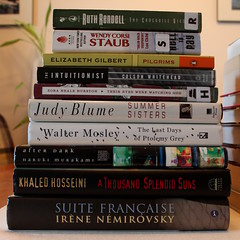 m that fate.)
Lamb’s summer home is on Martha’s Vineyard. At first, Vix thinks Lamb is struggling with money because the house is rundown and filled with shabby furniture and it smells. But obvs. he’s a trust fund kid. (He’s Lambert III, Sharkey’s IV.) Lamb and his sister were raised by their imperious and racist grandmother after their parents were killed whilst drunk-driving at age 25. Good times.
Vix makes it through the summer, unlike Caitlin’s past guests, and keeps returning year after year. After the first summer, Caitlin tells Vix she’s going to private school. Lamb and his new wife, Abby, arrange a scholarship for Vix at Caitlin’s school.
Caitlin and Vix are bffs during the summers (“summer sisters”) but during the school year C ignores V. Of course. Vix does well at school. She gets into Harvard, though she suspects it is less her grades and more her connections. Caitlin gets accepted at Wellesley, but goes traveling instead.
There are boys. Natch. Sharkey turns out well (my favorite bit!). V’s family falls apart. C is an asshat. Not sure why, really. That was my main quibble. I guess some people just are. No reason.
Some things I read this month
- Nadia Bozak, “Last Word: Nadia Bozak on writing intuitively” (Quill & Quire)
- Jared Gottlieb, “The Art of Mindful Photography” (Intelligent Travel)
- Blanche Howard, “The Stories We Tell” (guest post at Allyson Latta’s blog)
- Leslie Madsen-Brooks, “On fear at 39” (The Clutter Museum)
- Anne Helen Petersen, “Why You Should Read Like A Teen Again” (Buzzfeed)
- Kate Petersen, “Lives in Letters” (The Millions)
- Robert Reid, “The Ultimate Digital Detox: Walking” (Intelligent Travel)
- Sam Sacks, “Absent Friends: Lean Years of Plenty” (on Katherine Mansfield’s book reviews; Open Letters Monthly)
- Brittani Sonnenberg, “Home as a Verb: Writers on Choosing to Live Overseas” (The Millions)
- Sam Stephenson, “An Absolute Truth: On Writing a Life of Coltrane” (The Paris Review)
- James Wood, “On Not Going Home” (London Review of Books)
 The Remainder Table