Remodelista: an endless source of entertainment

Or, another overpriced item to add to my future Etsy shop.

$58 monkey’s fist knots. If you went to summer camp or are a sailor, you may have made these yourself. But, you know, these ones have a bit of paint on them. (This things-that-are-half-painted trend has to be nearly over, don’t you think?) So that clearly makes a knot (a knot!) worth nearly 60 bucks.

I think my future knot line will include a $27 bowline and a $5 reef knot 😉

25: Certainty

CertaintyCertainty by Madeleine Thien

My rating: 4 of 5 stars (4.5)

From the Fall 2010 VPL Book Sale.

Read in September/October 2013

View all my reviews

This was my favorite book so far this year. I contemplated giving it a 5. Let’s call it 4.5 stars.

Ansel’s significant other Gail died suddenly six months earlier. She was a freelance radio producer. He’s a doctor, works at a TB clinic. He’s still close with her parents, Matthew and Clara. They all live in Strathcona, Vancouver’s oldest residential neighborhood.

Matthew is originally from Sandakan (in North Borneo prior to WWII; now part of Malaysia), which was occupied by the Japanese during WWII, when he was a child. After the war, he and his mother leave Sandakan, and later he goes to Australia to study at the University of Melbourne. There he meets Clara, who grew up in Hong Kong. Together they move to Vancouver, because at the time Canada was accepting Asian immigrants and Australia was not.

Clara has an English degree but ends up starting her own business as a seamstress when she can’t find work as a teacher. Matthew has a history degree but ends up working in a restaurant, becoming a cook.

More 55-cent BooksThe summer before Gail died, Ansel had an affair when Gail was away. He eventually broke it off and told Gail about it. She is not sure why he confessed, how he wants her to react to this information. Now, he finds it hard to believe the affair actually happened.

When Matthew was 18, just before he moved to Melbourne, he returned to Sandakan for a visit, reunited briefly with his childhood friend Ani. While Matthew moves first to Australia and later to Canada, Ani moves to first to Indonesia and later to Holland. Once, Gail sees a letter from Holland in her parents’ home. She doesn’t understand its significance but when she’s in Holland doing research for a story she’s producing, she contacts Ani’s husband Sipke and meets up with him.

Certainty is a non-linear story of family and love and migration. The story moves back and forth through time, slowly revealing information. Relationships are always uneven; one person always loves more. There’s a lot of restraint in the writing. Everything is not spelled out; you need to read between the lines.

Thien’s dialogue—the way that the characters talk about things, real things, not the weather—reminds me of Madeleine L’Engle’s.

I need to open an Etsy shop

First, it was these. A bag of “story stones”—aka 12 rocks each painted with a different simple image to use as storytelling prompts. Price? $42. Shipping unknown.

Then, it was this. A crocheted “pan mat”—aka six (6!) rounds of single crocheted hemp. Price? $59 + $9 shipping.

Apparently neither of these is a joke. The first one was mentioned at Apartment Therapy; the second at Remodelista.

I’m not protesting the concept of either of these items. I am gasping at the fact that people are apparently willing to pay outrageous amounts for items that can be DIYed in minutes with inexpensive and/or free materials.

This is the kind of thing that makes me kick myself for not pursuing crafting-as-a-career. If only Etsy had come along 5 years sooner, I could have skipped all this back-to-school business and made a fortune selling crafts. Although, I suppose it’s never too late. Forget writing! I need to open an Etsy shop.

24: Leaving Atlanta

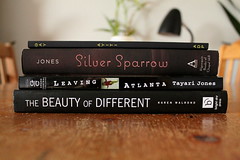
Leaving AtlantaLeaving Atlanta by Tayari Jones

My rating: 4 of 5 stars

Purchased from Amazon.

Read in September 2013.

View all my reviews

Leaving Atlanta is Tayari Jones’s debut novel. Previously, I read The Untelling (her second novel) and Silver Sparrow (her third). Now I’m officially out of Tayari Jones books and shall have to wait for her to finish writing her next one.

Leaving Atlanta is, obviously, set in Atlanta. It’s the late seventies/early eighties. Early in the book, it’s mentioned that the (1976) Olympics was two years past, so I initially thought the story began in the fall of 1978, but later I decided it was actually 1979. This fits with the events that the story is based on, the Atlanta child murders of 1979-81.

The story focuses on one fifth grade class and how the murders affect them. There are three parts, each with one of the classmates as the point-of-view character. Jones chooses to focus on three of the least popular children in the class (loved this). “Tayari Jones” is a minor character in the story—she’s one of the other classmates and gets mentioned now and then by the three protagonists. (This makes me want to read some Somerset Maugham ;))

Tasha is the main character in Part 1. Her part is told in third person. Tasha is unpopular but not the least popular. She’s caught in between her more popular frenemies and the really unpopular kids. Tasha’s parents separate at the beginning of the story but her dad comes back because of the murders. Both Tasha’s parents work and, at the beginning of the school year, Tasha was just starting to be allowed some freedom / responsibility (getting her own key to let herself and her little sister in after school). However, as the murders escalate, her parents decide they need to go a neighbor’s house after school instead of being home alone. All the other kids in her neighborhood do the same.

In the second part, Rodney is the protagonist. His part is told in second person. Rodney also lives with his parents and little sister, but his mom doesn’t work, which leads the other characters to think the family is well-off. In reality, his mom’s a bit nutty. She does her kids’ homework (including glitter art projects!) for them. Rodney unwittingly bolsters the image of the family being well-off by shoplifting candy; the other kids don’t know he steals it and think he must have lots of spending money. Rodney is very smart, but an underachiever. When his dad is angry with him, he beats him. Rodney’s even more unpopular than Tasha.
New Books

Octavia, who everyone in her outside-of-school life calls Sweet Pea, is the main character in Part 3. Her part is told in first person. Octavia lives with her mom, who works nights. Her dad lives with his wife and baby daughter in South Carolina. Octavia is the least popular in the class. Her classmates’ view of her and her family’s and neighbors’ view of her is completely different. Octavia seeks out Mrs. Grier, the second grade teacher, when she needs comfort. Mrs. Grier is the teacher with school supplies and snacks in her desk, the one that all the kids gravitate to even when they’re not in her class.

The child’s point-of-view throughout the book—what they know/understand and what they don’t—is so good. For example, as a reader, it’s clear Octavia’s dad is a university professor, but she doesn’t grasp this (she thinks he’s a teacher) or its significance. She wonders why people call him ‘Dr. Ray’. Because of the child’s pov, the story lacks the sentimentality (and judgment) that might be present if it was told from an adult’s point-of-view (e.g. by one of the parents or teachers or one of the children as an adult looking back). In a kid’s world, things just are. This leaves the reader to do the work of interpreting the events. Refreshing.

The choice to write the first part in third-person, the second in second-person, and the third in first-person might seem a bit gimmicky but it didn’t feel that way reading it. What it felt like was each part drew you in closer to the characters.

I think I’ve said this with all her books, but I don’t know if there’s anyone who’s quite as good at depicting the Gen-X child/teen/YA era—at least as I remember it—as Jones. All the little details are so perfect.

23: The Singer’s Gun

The Singer's GunThe Singer’s Gun by Emily St. John Mandel

My rating: 4 of 5 stars

Bought at The Book Warehouse.

Read in September 2013.

View all my reviews

I discovered Emily St. John Mandel via The Millions, where she’s a staff writer. Like me, she grew up in BC with an American parent. Unlike me, she was eligible for American citizenship via that parent and now lives in Brooklyn. The Singer’s Gun is her second novel. Her background—she originally thought she was immigrating illegally to the US—informs the story.

The main character of The Singer’s Gun is Anton Waker. Anton’s parents sell stolen goods (such as architectural bits pilfered from buildings being renovated or torn down) for a living. Anton’s cousin Aria, who is six months older, moves in with them after her mother gets deported and her father goes after her. After high school Aria and Anton start selling fake social security cards and passports. Aria is the leader; Anton is the follower.

BooksEventually, Anton decides he wants out. After seeing an Anton Waker who just graduated from Harvard quoted in a newspaper, he requests a copy of “his” diploma, and with it begins living his dream life as an office drone. That’s not sarcasm—it actually was his dream to work in an office—he just didn’t want to bother taking the normal steps it would take to get there.

He becomes engaged to Sophie, a cellist who has no idea about his past. She does, however, seem to have cold feet about their wedding. For his part, Anton seems to care more about his one-eyed rescue cat than he does Sophie. (Not that there’s anything wrong with that ;)) If the wedding ever takes place, Anton and Sophie are scheduled to go to Ischia, Italy on their honeymoon. Meanwhile, Aria hasn’t gotten over the fact that Anton abandoned their business and Anton’s employer has obtained a big contract that requires it to do background checks on all its employees. Uh-oh.

Anton’s the center of the book, but there’s a secondary protagonist, Anton’s secretary, Elena James. Elena grew up in Inuvik (a place so far north it makes Oslo look sunny and toasty by comparison), and came to New York after high school on a full scholarship to Columbia University. Unfortunately, she dropped out after one semester, putting her in an awkward position immigration-wise. She doesn’t want to return to Canada, especially not to Inuvik. At one point, she tries to explain why to another character:

“There’s nothing up there.”

“You’re talking about a lack of employment?”

“No, I’m talking about a lack of everything. A loss of potential. It’s hard to explain. There’s just… it’s a narrowing of possibilities,” she said. “Even the smartest people end up doing nothing much with their lives, because there’s nothing to do. It’s not just Inuvik, it’s everywhere in the world that’s small and remote. Fewer things are possible in places like that.” (230)

That may be the best explanation I’ve come across of the feeling I had growing up in very small towns, why I couldn’t wait to escape, why I always raise my eyebrows at stories where the protagonist realizes the life they’ve built in The City is empty! and the only place where their life will be complete! is the Quirky Hometown they never should have left. 🙄 I was in a simmering panic for years, first worrying that I wouldn’t get out, and then when I did, worrying that it wouldn’t last, that eventually I’d end up forced back to some small, narrow place. Which maybe seems crazy, but I guess it’s a bit like leaving a cult. You have to reprogram yourself to believe that it’s ok to do things like (gasp) live in a city.

Of course, there’s a bit of irony to Elena’s remark in that some of the key characters do end up in a smallish, remote-ish place. Not nearly as small and remote as Inuvik, though.

With its themes of identity, (im)migration, and dislocation, this was one of my favorites so far this year. I’ll definitely be reading Mandel’s other novels.

22: The Bean Trees

The Bean TreesThe Bean Trees by Barbara Kingsolver

My rating: 4 of 5 stars

Purchased at Beacon Books in Sidney last August.

Read in September 2013.

View all my reviews

Previously at The Remainder Table, I read Prodigal Summer. (I’ve also read The Poisonwood Bible, but that was before I started writing book posts.)

Apparently this is quite a well-known book, but I didn’t know anything about it prior to reading it. After checking out the reviews at Goodreads (as I enjoy doing after finishing a book), I’m going to guess it’s assigned reading in high school English classes. The one-star reviews offer such gems as: “I didn’t much enjoy this book, mostly because of its inability to relate to me through the predominantly female cast of characters.” Oh noes! Not, gasp, female characters! By that logic I should stop reading every book(/watching every movie) with a predominantly male cast of characters. Oh, wait. That’s most of them.

Marietta, called Missy, works for a few years after high school. She saves up and leaves her hometown in Kentucky in a VW bug (that has no side windows and that she has to push start) and heads west. She decides a fresh start needs a new name and picks Taylor when the car runs out of gas in Taylorville.

I still felt kind of awful about leaving her, and changing my name just seemed like the final act of betrayal, but Mama didn’t see it that way. She said I was smarter than anything to think of Taylor, that it fit me like a pair of washed jeans. She told me she’d always had second thoughts about Marietta. (85)

(The funny/ironic thing here is that her original name was also a place name—Marietta for Marietta, Georgia.)

Along the way, Taylor stops for something to eat and a woman foists a small child on her. She takes the child, who she discovers has been abused, and continues west. She names the child Turtle on account of her grip. A lot of the reviews I read had issues with these two elements. Why wouldn’t she turn the child into the police? Why would she name her Turtle? Oh, I don’t know. Because it’s fiction? In fiction, characters make strange choices. If they didn’t, stories wouldn’t be very interesting. Sure, if you were in Taylor’s place, you’d probably call the police. But would you really want to read a story where the main character only makes good, safe choices? zzz.

Meanwhile, Lou Ann from Kentucky is living in Tucson. Despite (or perhaps because of) her being pregnant with their first child, her husband, Angel, leaves her. On Halloween. Trick or treat!

Taylor and Turtle stop in Tucson when the VW gets two flat tires Taylor can’t afford to replace. Lou Ann places an ad for a roommate and Taylor answers it. They bond over both being from Kentucky.

Taylor gets a job at the tire shop she went to her first day in Tucson. The owner, Mattie, offers sanctuary to refugees. Taylor becomes close to two of them, husband-and-wife Estevan and Esperanza. Estevan has this exchange with Taylor:

“This is how Americans think.” He was looking at me in a thoughtful way. “You believe that if something terrible happens to someone, they must have deserved it.”

I wanted to tell him this wasn’t so, but I couldn’t. “I guess you’re right,” I said. “I guess it makes us feel safe.” (123)

This sentiment feels so current. And yet, The Bean Trees was published in 1988, when the North American obsession with safety wasn’t nearly as frenzied as it is now. It’s crazypants how people think they can minimize risk to the point that nothing bad will ever happen and that if something does happen to you, it must be because you did something wrong. This just isn’t true.

I loved the horticulture bits, of course. That’s one of my favorite things about Kingsolver’s writing. (Thinking I need to start a biology-in-fiction tag.)

In the end, this was a story about family, how families are not always the conventional kind, but are sometimes created in unexpected and unusual ways.

a singular life transformed into a signifying life

Because memoir at its very best is the start of a conversation. It makes its interest in readers explicit, offering not just a series of life events, but a deliberate suggestion of what it is to be a human being – to experience confusion, despair, hope, joy, and all that happens in between. True memoir is a singular life transformed into a signifying life. True memoir is a writer acknowledging that he or she is not the only one in the room.

Beth Kephart