Project 366 – Week 7

43/366
rolling in the deep
with Adele at the Grammys
woman with a voice

44/366
wondering why I
have never made quiche before
easy and tasty

45/366
my valentine is
small, orange and furry and likes
to snuggle and purr

46/366
a power outage
alarm bleats repeatedly
at the disruption

47/366
baking sticky bread
on a gray and rainy day
the smoke alarm wails

48/366
tomatoes, basil
melty mozzarella on
a thin crust pizza

49/366 (a Friday FUM response)
this chicken sandwich
looks familiar. I guess all
fast food looks the same.

Miss Suzy

Miss Suzy
by Miriam Young, pictures by Arnold Lobel
read by Tara Rose Stromberg

(via Crooked House)

Had to post this because I had this book! (I think my parents still have it.) I always thought it was one of those random things we had that no one else has heard of, but after a quick look around the interwebs it appears lots of people have fond memories of this book. And if you have 10 minutes, you can have it read to you 🙂

2: The Beauty of Different

The Beauty of DifferentThe Beauty of Different by Karen Walrond

My rating: 4 of 5 stars

View all my reviews

I’ve been reading Karen Walrond’s blog, Chookooloonks, for a long time. If I remember correctly, I found it via BlogHer when she was writing for them and I was researching blogs. I searched my archives and this was the earliest post I found that mentions her. (It’s a long post; the quote’s at the very bottom.) And, aha! that quote is from BlogHer, not Chookooloonks, so there you go.

Anyway, no remainder table this time around. I found myself with an Amazon gift certificate so I decided to use it to pick up a few of the books by writers whose blogs I read and whose books I haven’t been able to find locally. (I wrote about this topic a couple years ago.)
New Books

So, The Beauty of Different. It’s a coffee table book, so let’s talk about the format first. It’s a squarish hardcover with a dust jacket. The size is nice—big enough to show off the photographs, but small enough to hold in your lap. And the quality is good–thick pages, with a shiny-matte finish. Hmm, that sounds like an oxymoron, but nope. Not glossy (that would show fingerprints) and not rough-matte (textured). Shiny-matte. The photographs are clear and bright and the typeface is easy to read. There’s more than the usual amount of text for this type of book, so that’s important.

Onto the content. Like I said, I’ve been reading Chookooloonks for a long time, so I knew what to expect. If you want negativity, you’ve come to the wrong place. Not that there’s anything wrong with that. No, really. Karen has addressed this issue, noting that while her life isn’t perfect, on her blog (etc.) she chooses to focus on good things. I understand this. As I think I’ve mentioned before, I’ve come to realize that when I’m feeling sad/angry/[insert negative emotion here], doing something nice for someone or being grateful for something makes me feel hella better than stomping around ranting about whatever’s pissed me off. Anger is overrated. (Which is not to say you should bottle it up but, you know, let it out, then move on.)

/digression

Chookooloonks showcases a wide range of photographs: nature (flowers and leaves and rocks and things), places/travel, still-lifes (shots at home, at cafes, etc.), people (in action), portraits (self and otherwise). One of her ongoing projects is to photograph 1000 faces. These are very up-close (face only) portrait shots. Many of the photographs in the book are this type of photograph. In the book format, many of the faces are larger than life-size.

I enjoy the variety of the photography on her blog and would’ve liked to see that reflected more in the book. The up-close portraits are not my favorite. This is not a comment on the quality; they’re lovely photographs. But– well, there are a couple things. With so many portraits, it’s a bit like looking at someone else’s photo album—if people kept albums of 8×10 head shots. I do understand that the portraits fit with the book’s theme, but I prefer the shots that are pulled back a bit, that show a bit more of the person and their surroundings and aren’t just FACE! While I think the just-face shots are probably very meaningful for readers who know the individuals, pulling back a bit lets those of us who don’t in.

For example, one of the extended profiles is of Patrick (on page 54ff.). His portrait shot is pulled back a bit further than most, showing his neck and shoulders and some trees and sky in the background. I think this was probably done to show his collar (he’s a priest), but this photograph seems more approachable to me than some of the others because his face doesn’t take up the entire shot. But even better are the additional shots that accompany his profile: an action shot of him boxing, a close-up of his hands in boxing gloves, and a shot of the items on his desk (I assume). There is more of a story in these photographs than the just-face shots and I think that’s why I like them better. They give me more reason to linger.

Despite the format and number of photographs, I think the focus of The Beauty of Different is really the text. The book is divided into eight chapters, each focusing on a different quality (individuality, spirituality, imperfection, anxiety, heartbreak, language, adventure, agelessness). Each chapter includes an introductory personal essay, several portraits of different people (each with a quote starting “I’m different because…”), and an extended profile of one person that takes the form of an interview/conversation. There are also a few briefer ruminations at the end of each chapter.

On p. 118, there’s a list (Eight Things I’m Afraid of, but Other People Probably Aren’t). Number 2 is clowns—because they’re horrifying. Indeed. Number 7 is geese. Because one tried to attack her car. I can best that: I was actually attacked by geese and had to beat them off with a magazine. I managed to escape to the car, but not before one bit me. So yeah. Geese = evil. I also liked the bartender-generated list of things to do on a Really Bad Day (p. 150), because it sounds like a list I’d make. The book is like that. It’s like… an affirmation rather than a revelation.

Project 366 – Week 6

36/366
my old nemesis
strikes again. grading essays
procrastination

37/366
for dinner: homemade
turkey chili, cornbread, beer
life tastes delicious

38/366
grading grading grad-
ing grading grading grading
grading grading… aughh.

39/366
z z z z z
zz zz zz zz zz zz zz
zzz zzz zzz zzz zzz

40/366
slept thirteen hours and
all I’ve wanted today is
to go back to bed

41/366
dude in front of me
tells his wife it’s ok if
she goes commando

42/366
memory: my high
school bedroom, singing along
to “How Will I Know

WTF

So I’m scrolling through my feeds this morning and I see this (first photo). It’s a hot water bottle cover. Exciting, I know. So I would’ve just continued on my way except… wtf? $105?! Are you kidding me?

This gives me pause because I recently made this:

More Craftiness

Keep in mind, this was my first attempt at something like this and I freehanded it. (So far in my my crocheting adventure, I haven’t used any patterns. 100% winging it.) I thought it would be a bit of a challenge to figure out how to get around the angles and such. Cost? Maybe $5 for the yarn (100% wool, probably not organic), but I didn’t use the whole skein, so a little less than that. Time? I think it took me an afternoon. While watching movies.

So, basically on the $105 item above, we’re talking $100 profit. Assuming there are people who would actually pay $105 for a hot water bottle cover (who are you?), I clearly should give up this PhD thing and open up an Etsy store.

3: Silver Sparrow

Silver SparrowSilver Sparrow by Tayari Jones

My rating: 4 of 5 stars

View all my reviews

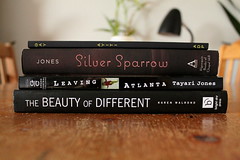
This was one of the books I ordered from Amazon:

New Books

(You’ll see I also bought Leaving Atlanta, her first novel. I’ve been saving that one.)

I was eager to read this (too eager to wait for it show up in my usual haunts) because I followed its entire progress from tentative first drafts to book tour on Tayari’s blog. I poked through her archives to see if I could find where she first mentions it. I think this is it:

Today, I sat down to work on my new novel after three weeks on the road. This novel feel alive within me. I think about it when I lie down at night. I have to force myself to sleep and the only way I can do that is to remind myself that I have to sleep to do any decent writing in the morning. So, this is good. I don’t quite know what to do with myself when I am not working on a project.

That was May 29, 2005. Silver Sparrow was published May 24, 2011.

Six years.

Let’s just pause for a moment and let that sink in.

Do you find it disheartening? I don’t. Everyone’s so impatient these days sometimes I think we’ve forgotten how long it can take to do good work.

Silver Sparrow was originally called The Bigamist’s Daughters. Later it was called The Silver Girl. I can’t remember why the first change was made, but the second one was a last-minute change because another book called Silver Girl was due to launch around the same time. So it was a marketing decision by her publisher. Initially, she was unhappy about this (who wouldn’t be?) but she ended up being happier with the final title. So you never know! It’s good to be flexible.

The premise is that one man marries two different women. He doesn’t do it for any sort of nefarious reason; it’s more like he feels it’s the right thing to do (vs. the usual alternatives). He has one daughter with each wife, and the girls are basically the same age—born a few months apart. His first wife and daughter (Chaurisse) know nothing about his second family. His second wife and daughter (Dana Lynn) do know about his first family. In the beginning, the sisters don’t know each other, but that changes as the story progresses.

Aside: I kept going Day-na? Dan-ah? throughout, but in this conversation she has with Judy Blume, I believe she says Day-na.

The first part of the book is told from Dana’s pov; the second part from Chaurisse’s pov. This switch really shakes you out of your comfort zone and is very effective in this particular story. Just when you’re really comfortable with Dana and her perspective on the situation, you’re asked to identify instead with Chaurisse, and think about how she feels about it.

The main thing about this book is that everyone is shown with empathy. Everyone is flawed, but no one is demonized, portrayed as the “bad guy.” It’s more about how people get caught up in circumstances and how they deal with it. I liked that she didn’t try to tie everything up neatly or make everything right at the end. She’s a real storyteller, I think.

On a more trivial note, I really love that the Dana/Chaurisse parts of the book are set in the eighties. It’s fun seeing what parts of that eighties high school experience were universal. I’ve been scooped on the appearance of electric blue liquid eyeliner (I had a friend I literally never saw without hers from 7th grade—when I first met her—until the morning after our grad party. I almost didn’t recognize her.) and feathered roach clips (but did they get them from the carnies at the fall fair?). Still going to use that detail, though. In my high school, the store chicks always wore them clipped to their store-chick purses. Classic.

I used to quote from Tayari’s blog all the time. She hasn’t been blogging as much recently, which I understand, she’s only doing like a million different things and something has to give, but I miss it. On the bright side, I still have Leaving Atlanta to read.

By the way, the book she was on the road publicizing when she started Silver Sparrow was The Untelling, which I wrote about here.

Project 366 – Week 5

29/366
misty air heavy
with other people’s dinners
woodsmoke and damp earth

30/366
fiction, poetry
creative nonfiction, flash
reading submissions

31/366
daily to-do list
always much too ambitious
one item, crossed off

32/366
…have any spare change?
T3s anybody? I
got T3s. Do you…

33/366
he touches her hip
she leans away. PDA
on the number 3.

34/366
nocturnal beasts live
below me. music & food
one a.m. nightly

35/366
so clear I can see
The Eye of the Wind at the
top of Grouse Mountain

A symbiotic relationship

Taking care of the reader isn’t merely a matter of dispensing appropriate facts as necessary. It’s a commitment on a writer’s part to maintain the reader/writer relationship, and to honor the fact that readers co-create the work with their own voices and imaginations. Our works reach fruition through a symbiotic relationship with readers that we must attend to and maintain. If we offer them only a murky, imprecise experience, have we really held up our end of the bargain as writers?

Steven Wingate

1: Complete Your Dissertation or Thesis in Two Semesters or Less

Complete Your Dissertation or Thesis in Two Semesters or LessComplete Your Dissertation or Thesis in Two Semesters or Less by Evelyn Hunt Ogden

My rating: 3 of 5 stars

Ok, so this book’s title is hilarious, but it got you to read it, right? Given university timelines that basically require you to be done an entire semester before defending, there is zero chance anyone is completing their dissertation in two semesters (or less!). That said, one of the best pieces of advice in this book is to decide when you want to graduate and work backwards to create a timeline. That’ll light a fire under ya. There are also some good ideas for structuring your research proposal (and dissertation), which is what I was looking for when I picked this up.

View all my reviews

9 Writing Tips

1. Write every day.
2. Even fifteen minutes is long enough to write.
3. Remember that good ideas often come during the revision stage.
4. Don’t binge-write.
5. Keep a commonplace book, inspiration board, scrapbook, or catch-all box to keep track of ideas and images.
6. Consider physical comfort.
7. Down with boredom.
8. Stuck? Go for a walk and read a good book.
9. Have something to say!

Gretchen Rubin