
It’s important to have space in which to think. Yesterday, I overheard someone complain, “I left my Blackberry at home, so I was so bored during my cab ride home. I just had to sit there.”
There are few things that I love more than looking out the window of a car, train, or bus. One day, when I was gazing out of a bus window, I was struck by a thought: “What do I want out of life?” “Well,” I thought, “I want to be happy.” … If I’d been checking my emails, I might never have had the idea for the happiness project.
Category Archives: Life
In the Morning
Always good to remember…
[T]he internet will be there in the morning, I don’t have to read everything now.
Workcrastination
You know how sometimes you read something and it’s like, wait, did I write that?
[Workcrastination] is when you blow off your novel for important stuff that needs doing, not fun stuff, but neccesary stuff. For example, right now. I know I need to be working on my novel, but I am doing things like grading student papers. (It must be done! It’s my job!), paying bills (It’s the first of the month!), etc.
Way Too Scary
Enlightened sexism is feminist in its outward appearance (of course you can be or do anything you want) but sexist in its intent (hold on, girls, only up to a certain point, and not in any way that discomfits men). While enlightened sexism seems to support women’s equality, it is dedicated to the undoing of feminism. In fact, because this equality might lead to “sameness”–way too scary–girls and women need to be reminded that they are still fundamentally female, and so must be emphatically feminine.
Thus, enlightened sexism takes the gains of the women’s movement as a given, and then uses them as permission to resurrect retrograde images of girls and women as sex objects, still defined by their appearance and their biological destiny.
See, for example, commentary here, here, and here on the ridiculous tabloid stories about Shiloh Jolie-Pitt’s clothing choices. She’s a three years old, people. Also, for everyone whose memory and judgment has been clouded by the past decade’s onslaught of pinnnnkkkk, that’s how all little kids used to dress in the seventies and eighties. In other words, there are most likely pictures of you dressed just like Shiloh in your family photo albums.
Be a Rebel
March 8 is International Women’s Day.
The 2010 IWD theme is: Equal rights, equal opportunities: Progress for all.
This year’s Canadian theme is: Strong Women. Strong Canada. Strong World.
“For Canadians, equality means women and men sharing in the responsibilities and obligations, as well as in the opportunities and rewards, of life and work.”
I wrote a draft of this post several months ago. Seems appropriate to post it today, particularly considering this year’s IWD theme.
*
Grrr. I am so tired of hearing people say that feminism is “about choice.” Feminism is not “about choice.” Feminism is about equality. The choices you have today are a consequence of equality. They follow from it.
This is not semantics; it’s huge.
Why does it matter?
When feminism is presented as “about choice” it becomes me-centered. It means a woman can “choose” stereotypically female things without any thought for how her “choice” is affecting women as a group. Why should she? According to the “about choice” school of feminism, she is being a feminist simply by making a choice. Even if that choice is ridiculous. (Flashing one’s boobs in a Girls Gone Wild video so Joe Francis can get rich? Not a feminist act.)
When we remember that feminism is about equality, it changes how we act (or, at least, it should). Equality means thinking about how our actions—our choices—affect others, as well as ourselves.
Let’s say there are two choices: A and B. If women always choose A and no one ever chooses B, then is B a real choice? Maybe some women really want to choose B, but at the same time, no one wants to be the Weirdo Who Chose B, so in the end, succumbing to peer/societal pressure, most, if not all, end up choosing A (albeit reluctantly).
This goes on for a time until the next generation doesn’t know anyone who ever chose B. Until B is taken off the market, so to speak, as a choice for women. As an A-chooser, would this upset you? After all, you chose A—so why would you care that there’s no B any more? You—and your sisters and daughters and nieces and granddaughters—can still “choose” A.
But, but, but…
Yes. But. The point is, for B to stick around as a real (and not just theoretical) choice, someone has to choose it some of the time. And that “some of the time” has to be non-trivial. If 99/100 “choose” option A, that is not a real, legitimate choice. It discounts societal pressures to conform.
Example! Statistics I see quoted on the rate of women “taking their husband’s surname” after marriage range from 80-90% or higher! In 2010. Articles abound on the topic (just google; here’s one from last month). And every time I see one, I am gobsmacked. I cannot believe this is still a topic for discussion in the 21st century.
Go back to the example above and insert “take husband’s surname” for A and “keep own name” for B. Now think about how you would feel if A (take husband’s surname) was automatic upon marriage and B (keep own name) was not an option. As in not allowed. Illegal. As in that’s how it used to be. Before feminism. Before equal rights.
I like to use this as an example because so many unconventional choices are hard. They require financial sacrifice or the ability to withstand harassment, and it’s simply not possible for everyone to make them. But keeping one’s surname is effortless. It is, in fact, the easier (and cheaper!) choice. It’s likely the only time you can be a rebel simply by doing nothing!
I’m not saying that women should always choose the unconventional over the traditional. My point is that we mustn’t forget the choices we have today are a consequence of the equal rights that women fought for in the past. But for there to be true equality between men and women, there needs to be more than just formal equality (i.e. under the law, everyone, male or female, has the option to choose A or B), there needs to be substantive equality. And you don’t have substantive equality if all women “choose” A and all men “choose” B.
The way people speak without listening
How to define the timeless, seductive allure of Chekhov? Part of it lies in his elusiveness, subtlety, adroit dialogue, precise descriptions and confident use of understatement. Unlike Dostoyevsky and Tolstoy, there is no sermonising, no extremes. He never tells us what to think. There are no heroes. There is little action. Chekhov instead makes telling use, as Eudora Welty once noted, of the way people speak without listening to each other. No one grasps the relevance of the untidy present better than Chekhov.
By-products
I was having a conversation with a writer the other day, and he stated that the best things are always by-products. Happiness is a by-product, and I loved that he said that. You can plot your journey to success or happiness or wealth or whatever it is you’re looking for, but if you’re too focused on the end result, you’re going to miss anything good going on around you.
Regardless of what story you believe
Personality is not who you think you are, it’s who you are. Some people think by definition that we are the experts on our personality because we get to write the story, but personality is not the story – it’s the reality. So, you do get to write your own story about how you think you are, and what you tell people about yourself, but there still is reality out there, and, guess what? Other people are going to see the reality, regardless of what story you believe.
Someone is Wrong on the Internet!
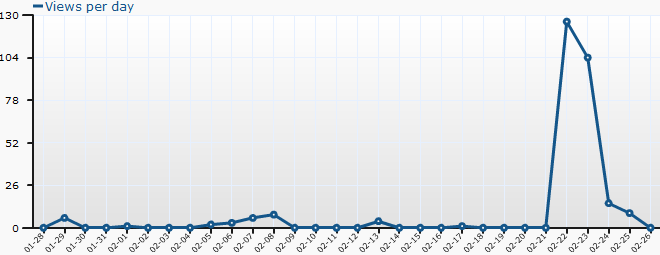
I wanted to post this screenshot of my stats to illustrate a couple things:
- My blog has never seen so much traffic. I see all is back to normal, now, though, and I can go back to talking to myself 😉
- Even though I had 250+ visitors in two days, only four people commented. And one of those people I know. So three people who’d never been to my blog before said something. This isn’t a complaint; it’s an observation. Way more people just read than read and comment; if you’ve ever looked at your site stats you know this to be true.
Perhaps the strangest and most interesting thing about #creepythesis is the way people talked about it, about me. As if I was never going to see what they said. (More on this later.) As if Twitter were a private chatroom.
Which it most definitely is not.
While you were following #creepythesis on the weekend, an SFU staffer who monitors Twitter was following keywords of interest to him. You know, like SFU.
(You see where this is going, right?)
#creepythesis may have blown up and burned out faster than ’70s child star, but whether anyone actually intended to follow through on the twitterstorm is moot, because said staffer-who-was-monitoring-SFU-tweets emailed the dean about it anyway.
Anyhow. This isn’t about me, per se. It’s more a heads up for the next time someone is wrong on the internet.

This is fair warning that I am totally turning #creepythesis into a paper. I’ll be posting some of my initial thoughts as I have time. I’ll tag everything with #creepythesis, so you can just follow that if you want to keep apprised but don’t want to read my other posts.
Stories have formed us all
I was reminded of Carolyn Heilbrun yesterday when someone mentioned writers who committed suicide.
What matters is that lives do not serve as models; only stories do that. And it is a hard thing to make up stories to live by. We can only retell and live by the stories we have read or heard. We live our lives through texts. They may be read, or chanted, or experienced electronically, or come to us, like the murmurings of our mothers, telling us what the conventions demand. Whatever their form or medium, these stories have formed us all; they are what we must use to make new fictions, new narratives.
—Carolyn Heilbrun
Writing a Woman’s Life (1988, p.37)

