Category Archives: Reading

2: The Beauty of Different

The Beauty of DifferentThe Beauty of Different by Karen Walrond

My rating: 4 of 5 stars

View all my reviews

I’ve been reading Karen Walrond’s blog, Chookooloonks, for a long time. If I remember correctly, I found it via BlogHer when she was writing for them and I was researching blogs. I searched my archives and this was the earliest post I found that mentions her. (It’s a long post; the quote’s at the very bottom.) And, aha! that quote is from BlogHer, not Chookooloonks, so there you go.

Anyway, no remainder table this time around. I found myself with an Amazon gift certificate so I decided to use it to pick up a few of the books by writers whose blogs I read and whose books I haven’t been able to find locally. (I wrote about this topic a couple years ago.)
New Books

So, The Beauty of Different. It’s a coffee table book, so let’s talk about the format first. It’s a squarish hardcover with a dust jacket. The size is nice—big enough to show off the photographs, but small enough to hold in your lap. And the quality is good–thick pages, with a shiny-matte finish. Hmm, that sounds like an oxymoron, but nope. Not glossy (that would show fingerprints) and not rough-matte (textured). Shiny-matte. The photographs are clear and bright and the typeface is easy to read. There’s more than the usual amount of text for this type of book, so that’s important.

Onto the content. Like I said, I’ve been reading Chookooloonks for a long time, so I knew what to expect. If you want negativity, you’ve come to the wrong place. Not that there’s anything wrong with that. No, really. Karen has addressed this issue, noting that while her life isn’t perfect, on her blog (etc.) she chooses to focus on good things. I understand this. As I think I’ve mentioned before, I’ve come to realize that when I’m feeling sad/angry/[insert negative emotion here], doing something nice for someone or being grateful for something makes me feel hella better than stomping around ranting about whatever’s pissed me off. Anger is overrated. (Which is not to say you should bottle it up but, you know, let it out, then move on.)

/digression

Chookooloonks showcases a wide range of photographs: nature (flowers and leaves and rocks and things), places/travel, still-lifes (shots at home, at cafes, etc.), people (in action), portraits (self and otherwise). One of her ongoing projects is to photograph 1000 faces. These are very up-close (face only) portrait shots. Many of the photographs in the book are this type of photograph. In the book format, many of the faces are larger than life-size.

I enjoy the variety of the photography on her blog and would’ve liked to see that reflected more in the book. The up-close portraits are not my favorite. This is not a comment on the quality; they’re lovely photographs. But– well, there are a couple things. With so many portraits, it’s a bit like looking at someone else’s photo album—if people kept albums of 8×10 head shots. I do understand that the portraits fit with the book’s theme, but I prefer the shots that are pulled back a bit, that show a bit more of the person and their surroundings and aren’t just FACE! While I think the just-face shots are probably very meaningful for readers who know the individuals, pulling back a bit lets those of us who don’t in.

For example, one of the extended profiles is of Patrick (on page 54ff.). His portrait shot is pulled back a bit further than most, showing his neck and shoulders and some trees and sky in the background. I think this was probably done to show his collar (he’s a priest), but this photograph seems more approachable to me than some of the others because his face doesn’t take up the entire shot. But even better are the additional shots that accompany his profile: an action shot of him boxing, a close-up of his hands in boxing gloves, and a shot of the items on his desk (I assume). There is more of a story in these photographs than the just-face shots and I think that’s why I like them better. They give me more reason to linger.

Despite the format and number of photographs, I think the focus of The Beauty of Different is really the text. The book is divided into eight chapters, each focusing on a different quality (individuality, spirituality, imperfection, anxiety, heartbreak, language, adventure, agelessness). Each chapter includes an introductory personal essay, several portraits of different people (each with a quote starting “I’m different because…”), and an extended profile of one person that takes the form of an interview/conversation. There are also a few briefer ruminations at the end of each chapter.

On p. 118, there’s a list (Eight Things I’m Afraid of, but Other People Probably Aren’t). Number 2 is clowns—because they’re horrifying. Indeed. Number 7 is geese. Because one tried to attack her car. I can best that: I was actually attacked by geese and had to beat them off with a magazine. I managed to escape to the car, but not before one bit me. So yeah. Geese = evil. I also liked the bartender-generated list of things to do on a Really Bad Day (p. 150), because it sounds like a list I’d make. The book is like that. It’s like… an affirmation rather than a revelation.

3: Silver Sparrow

Silver SparrowSilver Sparrow by Tayari Jones

My rating: 4 of 5 stars

View all my reviews

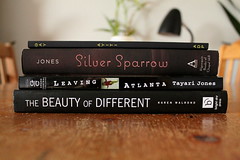
This was one of the books I ordered from Amazon:

New Books

(You’ll see I also bought Leaving Atlanta, her first novel. I’ve been saving that one.)

I was eager to read this (too eager to wait for it show up in my usual haunts) because I followed its entire progress from tentative first drafts to book tour on Tayari’s blog. I poked through her archives to see if I could find where she first mentions it. I think this is it:

Today, I sat down to work on my new novel after three weeks on the road. This novel feel alive within me. I think about it when I lie down at night. I have to force myself to sleep and the only way I can do that is to remind myself that I have to sleep to do any decent writing in the morning. So, this is good. I don’t quite know what to do with myself when I am not working on a project.

That was May 29, 2005. Silver Sparrow was published May 24, 2011.

Six years.

Let’s just pause for a moment and let that sink in.

Do you find it disheartening? I don’t. Everyone’s so impatient these days sometimes I think we’ve forgotten how long it can take to do good work.

Silver Sparrow was originally called The Bigamist’s Daughters. Later it was called The Silver Girl. I can’t remember why the first change was made, but the second one was a last-minute change because another book called Silver Girl was due to launch around the same time. So it was a marketing decision by her publisher. Initially, she was unhappy about this (who wouldn’t be?) but she ended up being happier with the final title. So you never know! It’s good to be flexible.

The premise is that one man marries two different women. He doesn’t do it for any sort of nefarious reason; it’s more like he feels it’s the right thing to do (vs. the usual alternatives). He has one daughter with each wife, and the girls are basically the same age—born a few months apart. His first wife and daughter (Chaurisse) know nothing about his second family. His second wife and daughter (Dana Lynn) do know about his first family. In the beginning, the sisters don’t know each other, but that changes as the story progresses.

Aside: I kept going Day-na? Dan-ah? throughout, but in this conversation she has with Judy Blume, I believe she says Day-na.

The first part of the book is told from Dana’s pov; the second part from Chaurisse’s pov. This switch really shakes you out of your comfort zone and is very effective in this particular story. Just when you’re really comfortable with Dana and her perspective on the situation, you’re asked to identify instead with Chaurisse, and think about how she feels about it.

The main thing about this book is that everyone is shown with empathy. Everyone is flawed, but no one is demonized, portrayed as the “bad guy.” It’s more about how people get caught up in circumstances and how they deal with it. I liked that she didn’t try to tie everything up neatly or make everything right at the end. She’s a real storyteller, I think.

On a more trivial note, I really love that the Dana/Chaurisse parts of the book are set in the eighties. It’s fun seeing what parts of that eighties high school experience were universal. I’ve been scooped on the appearance of electric blue liquid eyeliner (I had a friend I literally never saw without hers from 7th grade—when I first met her—until the morning after our grad party. I almost didn’t recognize her.) and feathered roach clips (but did they get them from the carnies at the fall fair?). Still going to use that detail, though. In my high school, the store chicks always wore them clipped to their store-chick purses. Classic.

I used to quote from Tayari’s blog all the time. She hasn’t been blogging as much recently, which I understand, she’s only doing like a million different things and something has to give, but I miss it. On the bright side, I still have Leaving Atlanta to read.

By the way, the book she was on the road publicizing when she started Silver Sparrow was The Untelling, which I wrote about here.

A symbiotic relationship

Taking care of the reader isn’t merely a matter of dispensing appropriate facts as necessary. It’s a commitment on a writer’s part to maintain the reader/writer relationship, and to honor the fact that readers co-create the work with their own voices and imaginations. Our works reach fruition through a symbiotic relationship with readers that we must attend to and maintain. If we offer them only a murky, imprecise experience, have we really held up our end of the bargain as writers?

Steven Wingate

1: Complete Your Dissertation or Thesis in Two Semesters or Less

Complete Your Dissertation or Thesis in Two Semesters or LessComplete Your Dissertation or Thesis in Two Semesters or Less by Evelyn Hunt Ogden

My rating: 3 of 5 stars

Ok, so this book’s title is hilarious, but it got you to read it, right? Given university timelines that basically require you to be done an entire semester before defending, there is zero chance anyone is completing their dissertation in two semesters (or less!). That said, one of the best pieces of advice in this book is to decide when you want to graduate and work backwards to create a timeline. That’ll light a fire under ya. There are also some good ideas for structuring your research proposal (and dissertation), which is what I was looking for when I picked this up.

View all my reviews

It just sounds good

[A]ll I could tell you was that I liked its sound. I didn’t have any idea what the poem was about. I just liked letting the words fall off my tongue when I read it aloud. It was elemental, and I think almost every poem I love is like that for me. At a base level it just sounds good.

Ta-Nehisi Coates

This is what I always say:

With poetry, the most important thing for me initially is how it sounds.

🙂

Edges

What may be more insidious is the pressure to fiddle with books for commercial reasons. Because e-readers gather enormously detailed information on the way people read, publishers may soon be awash in market research. They’ll know how quickly readers progress through different chapters, when they skip pages, and when they abandon a book.

The promise of stronger sales and profits will make it hard to resist tinkering with a book in response to such signals, adding a few choice words here, trimming a chapter there, maybe giving a key character a quick makeover. What will be lost, or at least diminished, is the sense of a book as a finished and complete object, a self-contained work of art.

Not long before he died, John Updike spoke eloquently of a book’s “edges,” the boundaries that give shape and integrity to a literary work and that for centuries have found their outward expression in the indelibility of printed pages. It’s those edges that give a book its solidity, allowing it to stand up to the vagaries of fashion and the erosions of time. And it’s those edges that seem fated to blur as the words of books go from being stamped permanently on sheets of paper to being rendered temporarily on flickering screens.

Nicholas Carr

There is so much to unpack here! It seems so weird that there are laws that keep private what library books you borrow (i.e. the titles), yet, if you’re an ebook reader, someone’s analyzing how long you pause on each individual page. I suppose it’s analyzed in the aggregate, but still. Somewhere, someone knows what you, individually, are doing. I guess that’s also true of the library info, but again, they only know the titles of the books you read, and again, laws.

Beyond privacy or the lack thereof, how accurate is that kind of info anyhow? Maybe you just got distracted by something. You know, like when you leave a browser window open for a half a day. You’re not actually spending 12 hours reading a 500-word article. You just haven’t got around to reading it yet.

And the rest gets into the whole literary vs. commercial work, especially when you’re talking about fiction. Everything I’ve read about ebooks makes it seem like people are more keen on fiction ebooks than nonfiction ebooks. This just seems backward to me. I totally see the benefits of ebooks for books that are frequently updated (guidebooks, textbooks, etc.). There’s also the convenience. Physical textbooks are heavy/bulky; with ebooks you can have them all with you at once. Same for guidebooks. These kinds of books are about the content, not the form. They’re also, frequently, works for hire, written by multiple authors working for a corporation.

But fiction? Fiction is an art. It’s a creative work. There’s an emotional investment in the work on the part of the author. While it’s true that some authors have revised work after publication, this is their own choice. Suggesting that writers revise their completed/published work on the basis of market research (i.e. reader feedback), changes the whole artistic process. No longer would the writer whose name is on the work be the sole author, whether or not this acknowledged. This is not to say this can’t (or hasn’t) been done; it’s just that it’s a different creative process.

You can see this how this happens by looking at the evolution of blogs. Early blogs were clearly the product of individual writers, but at this point, the voice of any blogger who has a substantial readership and continues to blog, has been drastically affected by their readers (& sponsors/advertisers). What they write and how they write it is a collaborative, not individual, process. (It might be a subconscious effect, but it’s still there.)

Revising published fiction based on reader feedback would be like an artist revising a painting after reading the comment cards from the gallery where the painting hangs, then rehanging it, so that the visitors who see the revised painting are seeing something different than the original visitors did, even though the painting has the same title. Would this change be acknowledged? Or would it be something that is not mentioned unless a visitor happens to return and notice the difference? And would the changes continue? Would the process be repeated again and again? And what happens when the artist dies? Would someone else continue the revisions? And how does all this revising affect new output? Is the artist so busy revising things already created that s/he has no time to create anything new? Shouldn’t an artist’s energy be put into new projects?

So many questions.

Different experiences that nestle comfortably alongside each other

We adults live in a linear world in which we grew up with pen and paper and printed books and now wait impatiently (eagerly or with trepidation), wondering when digital is going to replace all of that. As if the flow is all one way and inevitable. But Josie lives in the world of now. In her world, people use fountain pens to write for recreation. They use phones to talk and text and email. They gather for family dinners and talk about their dreams and desires. Printed books and digital books are different experiences that nestle comfortably alongside each other. Live theater is as thrilling as a 3-D movie. Sometimes you sing and dance and sometimes you listen to your iPod.

Josie teaches me to live in the land of Now. To be grateful for the ways that I can reach out electronically without giving up nestling in front of the fire with a hardcover novel. When I read the debates between Kindle lovers and the devotees of printed books, I think of Josie and think that we are being very foolish.

T. Scott Plutchak