Category Archives: Thesis

18: Writing a Woman’s Life

Writing a Woman’s Life by Carolyn Gold Heilbrun

Writing a Woman’s Life

I read this for my directed reading course this summer. At the top of my notes I wrote: “This might be worth buying.” That was in June. Then in July, on my annual Book Shop spree, I stumbled upon a copy of the book. Fate?

Heilbrun (1926-2003) was an English professor at Columbia when female professors were rarities and she was pissed off at how male academics treated their female colleagues. It probably would have made her life easier if she had publicly hidden that anger (and ranted in private, as one does) but she felt it was important that women express anger so that other women could learn from their experiences (or realize they are not alone):

The expression of anger has always been a terrible hurdle in women’s personal progress. Above all, the public and private lives cannot be linked, as in male narratives. … [W]omen are therefore unable to write exemplary lives: they do not dare to offer themselves as models, but only as exceptions chosen by destiny or chance. (p.25)

What matters is that lives do not serve as models; only stories do that. And it is a hard thing to make up stories to live by. We can only retell and live by the stories we have read or heard. We live our lives through texts. (p.37)

I like that last bit especially. Quote for my thesis, perhaps.

This has nothing to do with my thesis but I did find it amusing/sad in light of recent news articles:

In the last years of the twentieth century, it is unclear whether women who refer to themselves as, for example, Mrs. Thomas Smith know what servitude they are representing in that nomenclature. The same might be said today of women who exchange their last name for their husband’s. … Any possible ambivalence about this matter should surely have ended by the beginning of the 1980s at the latest. (p.85)

The 1980s! Haha! Heilbrun would no doubt be chagrined to learn that name-giving-up is more popular now than it was in the ’80s and that a Gen-Yer in Quebec (where “married names” have been legally prohibited since 1981) is suing so she can take her husband’s name. Gah. (Of course, the irony of Heilbrun’s position is that she adopted her husband’s name. That was, however, 40+ years prior to her writing this book, so I guess she had time to change her mind πŸ˜‰ )

So anyway… after I finished the book, I looked Heilbrun up (ironically because I was curious about this series of detective novels she’d written—the Kate Fansler mysteries, as Amanda Cross) and that’s when I discovered that she quit her position at Columbia (age 66) because she felt unwelcome. Then she committed suicide (age 77) apparently because she felt her life had been completed.

Ack. Everything I’ve read tries to put a positive spin on this, in the vein of she wrote her own ending to her own story. But I can’t help but thinking: isn’t that classic cutting off your nose to spite your face? From what I’ve read a lot of women looked up to her as a role model. And she said herself that people need stories to follow. So for those who were following her story—they’re left with what? The jerks of the world will always win (or at least they’ll wear you down so you get tired of fighting) so you may as well kill yourself?

Ugh.

I really liked this book—but this coda left me conflicted. Lots to think about anyhow. Here are a few more links:

14: S is for Silence

S is for Silence by Sue Grafton

S is for Silence

So I finished the final paper of my coursework (thesis, here I come) and wanted to read something fast and fun. The Kinsey Millhone series is a holdover from another era; I read some of the early books when they first came out (A, B, etc.) and while I haven’t kept up with the series, I’ll read them if they fall into my lap. My mom passed this one on to me.

S is set in 1987; Kinsey is 37. Out of curiosity, I looked up when A is for Alibi was first published—1982 (hmm, that really was another era!). Since Kinsey was 32 in the first book, this means that the initial book of the series was set in the present, but now the series is set firmly in the past. Nothing against setting stories in the past, but this is kind of weird for a series, don’t you think? To have it be contemporary to begin with, but become historical? I mean, this book reads very differently to me now than A did when I read it in the early 80s.

I imagine there are two reasons Grafton might have decided to do this. One, had the books remained contemporary, Kinsey would now be 57. While she certainly could still be a PI at 57, it seems likely that other aspects of her life would have changed in that period of time. Like she might not be living in a garage apartment, her landlord (who was 80-something in A) would probably not be still living, and Chardonnay might no longer be her drink of choice. And we all know that genre books like to maintain their worlds once they’ve been established. Two: the Internet & cell phones. Kinsey is still using payphones, answering machines, and doing research at the library. And while I can see plenty of reasons why an author might want to set a story pre-Internet & cell phone, in a series this long, I think it would have been more interesting for readers to see Kinsey adapt to these changes (as real PIs have had to do if they have been in business over the past 25 years).

In S, Kinsey investigates a cold case. A woman hires her to investigate her mother’s disappearance in 1953. The story flips between Kinsey’s 1987 world and flashbacks to 1953 (various characters). Since Kinsey is not a party to the 1953 flashbacks, the reader always knows more than she does. I’m not thrilled with this device. In a detective story, I think it’s best if we stick to the detective’s PoV—this is the only way the reader can play along (and isn’t that what a detective story is about?). Also not thrilled with the ending; while not quite a deus ex machina, the baddy turns out to be peripheral character (it is foreshadowed, but it still seems lame). It’s a soap opera ending, the easy way out. Overall, the story was kind of plodding. The flashbacks contributed to this, I think, but also the overly long description. Everything was described in great detail! (Were the earlier books like this? I don’t remember.) Too much. And I like description.

Random tidbit: Grafton’s pet word is “ease”: people are forever easing onto stools, cars easing out of driveways, etc. etc.

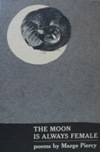
11: The Moon is Always Female

The Moon is Always Female by Marge Piercy

The Moon is Always Female

Ack. I actually finished reading this ages ago. It’s been sitting on my desk looking at me for most of the summer, as a reminder to write a post about it. Meanwhile, I’ve been otherwise occupied reading books for my directed reading course (and by extension, my thesis). But that project is nearing completion, and it’s time for some just-for-fun reading to finish off the summer. Before starting something new, here are my two cents on The Moon is Always Female.

Marge Piercy is one of the poets I first came into contact with when reading The Norton Introduction to Literature when undoubtedly I should have been doing something else. Like reading that Poli Sci textbook I never realized I owned until an hour before the final exam. (The fact that I read the TNITL for fun should in itself have been a strong indication that I should have majored in English, but I was too busy cutting off my nose to spite my face at the time to realize this.) The poem was “To have without holding.” The first stanza (p. 40):

Learning to love differently is hard,
love with the hands wide open, love
with the doors banging on their hinges,
the cupboard unlocked, the wind
roaring and whimpering in the rooms
rustling the sheets and snapping the blinds
that thwack like rubber bands
in an open palm.

Heh. I just noticed the first comment under “Most Helpful Customer Reviews” at Amazon is from my close personal friend Eden. How apropos, since I picked this up when I saw it at my favorite used bookstore last summer because of the many times she’s mentioned it. Let’s see what she had to say:

Piercy’s poems in this collection touch my every emotion. They make me laugh, cry, consider, ache, scream and everything in the spaces between. I “had” to read this for a contemporary lit course in college over ten years ago. Problem was, I couldn’t stop reading it. It was the first book I couldn’t bring myself to sell back. It’s exceptional, from the words on the pages to the typeface itself. Favorite include: “For the young who want to” “For strong women” “Poetry festival lover” and of course “The moon is always female.” After reading it, you will feel like you know Piercy. And you will also better know yourself.

Hmm, thanks for doing my work for me, E! I’d also add that it’s the kind of collection that it’s nice to leave out where you can pick it up and randomly re-read a poem or two when the mood strikes you. “For the young who want to” is one of my favorite poems (by any poet) and I never tire of re-reading it. The last stanza (p. 85):

The real writer is one
who really writes. Talent
is an invention like phlogiston
after the fact of fire.
Work is its own cure. You have to
like it better than being loved.

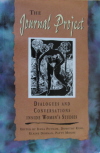
8: The Journal Project

The Journal Project: Dialogues and Conversations Inside Women’s Studies edited by Dana Putnam, Dorothy Kidd, Elaine Dornan & Patty Moore

The Journal Project

This was another VPL Booksale find. It’s a collection of journal entries from Women’s Studies classes at Langara College.

I found it interesting from a public/private space perspective. On the one hand, the journals were kept as a class assignment (for completion marks, not grades); the entries were written with the understanding that the instructor would read them. On the other hand, the idea of publishing them as an anthology came after the fact, so a wider audience was not anticipated. In this sense, I guess you could say they were more comparable to letters than to traditional diary entries in that the writers knew for certain that at least one person would be reading their words.

One thing that I found problematic with the selection of pieces is that the majority of them seemed to be written by women who had suffered physical/sexual/emotional abuse. My difficulty with this is that emphasizing worst-case scenarios makes it easy for those women who have not experienced such extreme discrimination to distance themselves and deny that there’s a problem with patriarchy. But just because you haven’t personally been abused or no one’s ever told you that you’re stupid or you’ve never faced extreme poverty (or whatever) doesn’t mean that there aren’t systemic problems with society. I would have liked to have seen more pieces like the one by the woman who was told that she couldn’t be the “head of household” because she was a SAHM. That’s the kind of systemic discrimination that you’ll probably never even be aware exists until it happens to you. It will never be a cause du jour. Yet, it’s addressing those kinds of issues, the ones that seem trivial (but aren’t), that leads to real change.

The Journal Project was published in 1995. The journals were traditional paper notebooks. It was interesting, in the context of my research, to read what they thought journals had the power to do.

[J]ournal writing itself assists social change. When our thoughts are spoken or recorded, they become part of the revolution. Writing it down is powerful and dangerous. –Dana Putnam

I wonder if any of the women are still journaling. I wonder if any of them are blogging.

5, er 10, Reasons Why I Blog

  1. For my #1 Fan.
  2. Writing posts is more productive (for a writer) than endlessly tweaking site design (which is what I mostly did with my old Web 1.0 website).
  3. I’m optimistic that this blog is more interesting than the aforementioned old website.
  4. Even sporadic journal entries add up over time. Who knows? It might turn into… something. Or not. As the case may be. It’s the possibility that’s intriguing.
  5. It encourages me to write more than I would otherwise.
  6. It’s good practice for figuring out what I am and am not comfortable writing about.
  7. It’s satisfying to keep track of the books I read and taking photos of the food I make entertains me. (The flower photos are an homage to Georgia O’Keeffe and Imogen Cunningham.)
  8. It’s far easier to write one interesting blog entry than it is to write 5 or 6 interesting emails. So if I owe you an email, here’s something for you to read whilst I procrastinate.
  9. People (relatives) who don’t know me that well (read: at all) could perhaps get to know me better should they ever express a desire to do so.
  10. I’m writing my thesis on blogging, so I’d be a big ignoramus/hypocrite if I did not have one myself. πŸ˜€

Inspired by Erin & Debbie.

Everything’s Unoriginal

Mediocre writers borrow; great writers steal. –T.S. Eliot

*

Back in the day, I didn’t worry about getting accused of “plagiarism” because my paraphrase of some source (which I’d cited) was insufficiently original. Just how “original” do we expect undergrads to be, anyhow? And more importantly, isn’t the real test of originality whether the writer has synthesized pre-existing works in a new way (or at least tried to)? Or, to put it another way, shouldn’t we also be looking at the big picture—what is the writer trying to do here—not simply dissecting the individual bits and pieces?

*

Do we really believe that a novelist who paraphrased 50 words from a technical source is a plagiarist? Because I think we may have lost sight of what a novel is if that’s the case.

*

Read this: The Ecstasy of Influence: A plagiarism by Jonathan Lethem (via Maud Newton).

*

While I was writing this post, I saw this on the university’s plagiarism page:

In academic culture new ideas ‘belong’ to their creator. Proper and complete citations assist individual creators to retain ownership rights to their work. When sources are not properly acknowledged, a creator’s right of ownership is threatened.

Let me first say that I believe what the university is really trying to say is that creators own expressions of ideas (ideas set down in a fixed form, i.e. writing), as indicated by the references to citations and sources. However, immediately after they assert that ideas “belong” to their creators, they use the phrase “ownership rights.” Therefore, the implication of this paragraph is that “ideas can be owned.” Which they can’t.

At least, not yet.

*

It has long been acknowledged that when you put an idea out into the world, it is no longer solely yours:

If nature has made any one thing less susceptible than all others of exclusive property, it is the action of the thinking power called an idea, which an individual may exclusively possess as long as he keeps it to himself; but the moment it is divulged, it forces itself into the possession of every one, and the receiver cannot dispossess himself of it. Its peculiar character, too, is that no one possesses the less, because every other possesses the whole of it. He who receives an idea from me, receives instruction himself without lessening mine; as he who lights his taper at mine, receives light without darkening me. —Thomas Jefferson

6: Star Gazing

Star Gazing: Charting Feminist Literary Criticism by Andrea Lebowitz

06_img_2146.JPG

This was mentioned in my Methods class. At only 69 pages, it’s closer to a booklet than a book, but as far as the yearly book tally goes, it counts!

I got a few good ideas for my thesis from it.

On collaborative work:

[A]nother constant of feminist literary criticism is the success of collaborative work. Feminist literary criticism has put to rest the cliche that good writing must be the work of one person. (p. 6)

And the Other:

[F]eminists have questioned the binary opposites of our culture which see so many things as opposed and mutually exclusive … This type of thinking sees one thing as ‘other’ and inferior to its binary opposite. (p. 7)

Oh, and interestingly: Lebowitz writes that “the two most important precursors” to feminist literary criticism are Virginia Woolf and Simone de Beauvoir. A Room of One’s Own and The Second Sex “have formed the basis of feminist literary critics’ thinking about gender and writing.” (p. 11) I guess this is not particularly surprising, but what’s interesting about it is that I went through that whole de Beauvoir / Woolf phase and I’ve read AROOO and parts of TSS (it’s long!). I mean, it’s sort of vindicating that some of the stuff I read during that time fits with what I’m doing now. Now that everything is starting to tie together, it feels like there really is a point to it all.

Once I wrote up a list of “books that changed my life.” Meet the Austins (the book that hooked me on Madeleine L’Engle) was on it, as was Writing Down the Bones (the book that got me started writing again). Also on the list: de Beauvoir’s Memoirs of a Dutiful Daughter.

But I digress. On alternative/indie press:

[Feminists] have created alternative publishing and distribution networks and have founded many presses, journals and magazines. Some of these address an academic audience, while others speak for and from alternative cultural spaces. (p. 15)

On the novel:

[A]re there limits to what stories the novel can tell? … Does its structure, plot, narrative and closure keep women from writing stories other than the old familiar plots? (p. 19)

vs. “sub-literary” forms:

[L]etters, diaries, journals, sketches … have been widely used by women … studies into secondary forms have raised another fundamental question about evaluation. Why are some forms seen as superior? Conversely what makes a form inferior? (p. 20)

[I]dentity is not determined and fixed once and for all, but is rather in process. More fluid and fragmentary forms may offer ways of expressing this condition. … In autobiography and life writing more generally, the author is often not expressing a life already shaped and complete as she is using the writing as a way to express and make a life. (p. 21)

[I]t is not sufficient to use the old forms for new knowledge. We cannot simply reverse male stories, literary forms or critical criteria. Rather, language and form have become places for revision and experimentation. Most notably the private, fragmentary and intimate forms of expression have found a place alongside the public, completed and logical modes of expression. (p. 41)

Ooh. Well, that gives me something to chew on for a while.

Blogging: Motivations & Responsibilities

In class on Tuesday, at one point the discussion turned to blogs and why people blog, the consequences of blogging (is it okay to mention other people in your stories?), and what a blog is (does it have to be personal to be a blog?).

As a writer, I find it hard to separate “why blog?” from “why write?” Telling one’s own stories and writing about issues from one’s personal viewpoint are nothing new to writers. The same material you find in personal blogs is also found in memoirs, autobiographies, columns, editorials, personal essays, etc.

What’s different about personal blogging is not the content, but the fact that anyone can do it, that bloggers don’t generally have editors, and the accessibility of it (anyone can read it).

So I suppose in any discussion of personal blogging, you have to start from the premise that there are two kinds of bloggers: writers and non-writers. For the writers, writing is the essence of blogging—it’s another format to try, a way to hone their craft, etc. They blog because blogging is writing. They wrote before blogs existed and if blogs vanished tomorrow, they’d still write.

But for non-writers blogging (writing) is a means to an end. It might, for example, be a way to keep in touch with family or meet friends or promote a product/service. For non-writers, blogging is just a vehicle that might get them to whatever their goal is. Their motivations are entirely different from those of writers.

A couple other things: I found the comment about thinking a blog had to be personal interesting because it’s such a reversal of traditional thinking (if anything to do with blogs can be “traditional” haha). My research into blogs indicates that a lot of early bloggers think that personal blogs (online diaries) aren’t really blogs at all; to their minds, blogs are only blogs if they have traditional “links plus commentary” posts. Also, most mainstream media attention has focused on issues-oriented, alternative media-type blogs written by male bloggers, not personal blogs (even though the majority of bloggers are teenage girls keeping online diaries).

Of course, even if you’re just posting links, you’re personalizing. The links you choose and what you say about them say something about you, even if you never say anything about your personal life per se. On a related note, sometimes bloggers will make explicit what they will/won’t write about on their blogs. One common off-limits subject is politics. I always thought this was strange because everything is political. (You know: “The personal is political.”) You don’t have to explicitly state who you vote for to involve politics. I don’t know how you’d write about anything substantive without involving what you agree with/believe inβ€”and that’s politics.

One more thing: in The Subject of Semiotics, Kaja Silverman discusses Laura Mulvey’s “Visual Pleasure and Narrative Cinema” and she says this:

Laura Mulvey argues that the classic film text distinguishes sharply between the male and the female subjects, and that it does so on the basis of vision. The former of these is defined in terms of his capacity to look (i.e. as a voyeur) and the latter in terms of her capacity to attract the male gaze (i.e. as an exhibitionist). This opposition is entirely in keeping with the dominant cultural roles assigned to men and women, since voyeurism is the active or “masculine” form of the scopophilic drive, while exhibitionism is the passive or “feminine” form of the same drive. (222-223)

Okay, so why is this interesting. Well, first, one of the comments made in class with respect to motivations for blogging was that if a blogger wouldn’t write if s/he wasn’t blogging, then s/he was motivated by exhibitionism. Second: this is entirely circumstantial, but it does seem to me that women are far more likely to blog about highly personal subjects than men are. So you could go the direct route and say women are acting in keeping with their culturally-defined role and acting as exhibitionists in keeping personal blogs. But, I think that would be missing an important point. It’s not men who are reading these uber-personal blogs; it’s other women. And the uber-personal information shared is not designed to attract the male gaze; rather, much of the content would probably have the opposite effect. So… it’s more like using the voyeur/exhibitionist dichotomy as a means of resistance against the cultural norm.

*

Some posts I had clipped on the motivations and responsibilities of writers/bloggers (emphasis added):

Writers write for their ideal reader, for their loved ones, for themselves or for no one. All this is true. But it is also true that today’s literary writers also write for those who read them.

It is because all writers have a deep desire to be authentic that even after all these years I still love to be asked for whom I write. But while a writer’s authenticity does depend on his ability to open his heart to the world in which he lives, it depends just as much on his ability to understand his own changing position in that world.

There is no such thing as an ideal reader, free of narrow-mindedness and unencumbered by social prohibitions or national myths, just as there is no such thing as an ideal novelist. But a novelist’s search for the ideal reader – be he national or international – begins with the novelist’s imagining him into being, and then by writing books with him in mind. —Orhan Pamuk via MoorishGirl

*

I find that I don’t care as much about story or plot or action as I do about getting inside someone’s head. Usually the author’s head. In this case, inside the subject’s head. But that’s what’s interesting to me. The chance to get a glimpse of an inner monologue, to see how someone else’s wheels turn.

In effect, this is what blogs let you do, or at least I’d like to think so. I started blogging almost exactly 4 years ago, right before I started law school. I just wanted a place to store thoughts, and a way to force myself to write every day. But I found that once I started, it’s hard to stop. I got addicted to the instant connection with people out there in the world, the immediate feedback, the feeling like someone out there cares about what you’re thinking. And as I started reading other people’s blogs, I found that sometimes, even if you can’t articulate why you’re reading, you start to get hooked. A blog β€” a good blog β€” lets you inside someone’s head, and if you like being there, it can become awfully compelling. —Jeremy Blachman

*

I think it’s the first book that uses a blog as a narrative vehicle, and in doing so Jeremy explores a question I find pretty compelling — how do we know who to trust? What makes someone authentic, believeable, truthful? … In the book, there’s an active tension between the blog persona and the “real” persona (as evidenced by emails).


Blogs are private, and public. As a vehicle for an unreliable narrator the blog is very interesting, and I am not sure the cultural conversation about blogs has really started to embrace the complexity of the way people are exploring, sharing, and creating their identities online. I think the book begins that conversation in an interesting way. —Sherry Fowler

*

I am interested in the question of what the implied promises are between blogger and blog reader. … I agree that there is a pact of sorts, in almost any writing, between writer and reader. I aspire to be a good blogger, and I have some ideas about what that means. I’ve never put them down explicitly, though. Let’s see if I can unpack them.

The Blog Author promises to:

* write truthfully
* write as un-self-consciously as possible — avoid contrivances
* write about subjects that move her
* write about things about which she has personal knowledge, direct experience, some investment
* tell her own story, not other people’s stories
* avoid complaining
* not use the blog as a prop or a crutch or a shield
* not use the blog to avoid having direct conversations with specific people
* post thoughts, and leave them up. Disclose edits, and if I change my mind, annotate and link rather than delete or modify the original posts. —Sherry Fowler

*

Does it really matter whether or not this video was truly created by a teenager or not? And if it does matter, what does it say about our own obligations to remain honest on our personal sites? …

Personally, I’m of the belief that the theory of caveat emptor applies to anything available on the internet — let the reader beware, everything may not be as it seems. That said, I do see an argument which says that for those of us who have loyal readers who visit our sites daily, common decency mandates that we not betray their trust by being dishonest about who we are. But does that mean I have to be forthcoming about everything?

What say you — do we, as authors/artists/citizen journalists/whatever, have an obligation to (a) reveal all and/or (b) reveal honestly? —Karen Walrond