Tag Archives: Books

6: Dogs and Goddesses

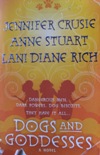
Dogs and Goddesses by Jennifer Crusie, Anne Stuart & Lani Diane Rich
I picked up a passel of books at the VPL’s Spring Book Sale. Check it out. This was Thursday’s stack:

VPL Spring Book Sale

And this was Saturday’s stack:

VPL Spring Book Sale

Yes, I went twice! Why not? Novels were 55 cents! 55 cents, people! At that price, you can’t lose. Or can you…?

(insert ominous movie music here)

My first read was Dogs and Goddesses, a mass market pb that I picked up because Lani was one of the authors. Back in the day, Lani was also a member at the writing site where the original TCers met. Her first novel originated as a NaNo. I want to like her books!

But I’m not going to lie. This book was bad. I never thought I’d say this, but I paid too much for this book. I want my 55 cents back! j/k 😉

Lest you think that I just didn’t like it because this genre of book is just not my thing, do check out the Amazon One Star reviews. They’re like the nicest One Star reviews ever. Unlike the usual vitriol-filled one-star reviews, it’s pretty clear that these reviewers are fans of at least one of the three authors and the one star was given reluctantly.

Most of the reviewers seem to be more familiar with the other two authors (Jennifer Crusie & Anne Stuart). I haven’t read either of them. I have read Lani’s first book (the one that began as a NaNo): Time Off For Good Behavior. I didn’t really like it, but I attributed it to “not my thing.”

Dogs and Goddesses, otoh? Ahhhhh! I only finished it because I think it’s good to read something bad occasionally.You know, as a refresher course on what not to do. Bullet points of commentary:

  • Too many characters. Way, way too many characters! Names would pop up and I’d have no idea who they were. There were three protagonists (each one written by one of the 3 authors; reviewers who were more familiar with the authors said they could tell who wrote what, but the styles seemed indistinguishable to me), plus three love interests, plus the antagonist, plus the antagonist’s minion, plus three other secondary characters, plus several named tertiary characters, plus approximately 10 talking dogs.
  • Why is everyone yelling? I felt like the opening of the book was written in ALL-CAPS. It wasn’t. It just felt that way.
  • Similarly, what’s with the excessively irritable responses to fairly innocuous situations? I think it was supposed to be ramping up the tension. It didn’t work. (Damn it!)
  • Absolutely no getting to know the characters before they are tossed into the plot. I have no idea why I should care about these people. And I don’t.
  • I can’t tell the protagonists apart. I can’t tell the love interests apart. I can’t tell the secondary characters apart. These characters aren’t cardboard; they’re paper. Paper dolls with interchangeable outfits.
  • One character is named “Bun.” There’s no shortage of smart remarks in this book, but no one comments on this. Bun. Seriously.
  • I think this book is supposed to be funny. It’s not. The most amusing thing is the talking dogs.
  • We’re supposed to believe that these three sets of characters are in love. We know this because they keep saying “I love you/him/her!”
  • Their love is instigated by eating magic cookies. They eat so many cookies in this book that I start to feel like I’ve eaten an entire batch by myself: over-full and about to crash down from a sugar high. Blech.
  • There’s a scene where one of the characters paints a wall with a paintbrush (nooooo!). Also she dips the same brush into two different colors without rinsing in between (nooooo!). That is just so, so wrong.
  • WTF was up with those sex scenes? You’ve this silly, silly plot where people are running around scarfing cookies and listening to talking dogs and then all of a sudden we’re being told who’s sticking what body part where. Total discord.
  • What genre is this book supposed to be anyway? Is it Chick Lit (funny)? Romance (sexy)? Paranormal (scary)? I can’t figure it out.

4: More Watery Still & 5: What I Remember from My Time on Earth

More Watery Still and What I Remember from My Time on Earth
by Patricia Young

For poetry month, I decided to read all the poetry books on my to-read shelf.

The first two are by Patricia Young, and are used finds from The Bookshop in Penticton. Both are signed by the author. More Watery Still (1993) says: “For Sharon / with best / wishes / patricia young” and What I Remember… (1997) says: “For Pati / with best wishes / patricia young.” I wonder if Sharon and/or Pati bought the books or if they were gifts?

PY is from Victoria. She was my creative writing 100 seminar instructor way back in my 1st year at UVic when I was a creative writing major!

The weird thing about her poetry is how familiar it seems, even though I’ve never read a book of hers before, and I’m not even sure if I’ve read any individual poems (it’s possible I have seen some in a lit journal or anthology—I’d have to look). But I think it’s more her sensibility that’s triggering that feeling of recognition. I was struck, reading MWS and WIRFMTOE, how much she influenced my own poetry (back when I was writing poetry). I mean stylistically, not content-wise. It’s weird because after the CW fiasco there was quite a long gap before I started writing again (so you’d think any influence would have been mitigated). But I guess if there was going to be a lasting influence coming out of that class, it makes sense that it would be with respect to poetry (we also did fiction and drama).

Last week The Literary Type posted a recording of her recent reading at the University of Waterloo (um, coincidence?!). Even her voice sounded so familiar—like I’d heard it days or weeks ago instead of years. Strange what sticks with you…

My relationship with that class was fraught. The lecture, taught by three men, remains the biggest disappointment of my undergrad. The seminar I loved—but it was love tinged with melancholy and angst because I knew PY didn’t like my writing. Not that I blame her; it was typical 18yo crap.

One of my most vivid memories of the class is PY gushing over a poem that one of my classmates wrote. It was about tomato soup and grilled cheese.

At the end of year, she had us all over to her house for a party. It was a Craftsman in Fairfield that I was terribly covetous of (and let’s face it, still would be). I think she still lives there.

The poems in MWS seem centered around the theme of family, while those in WIRFMTOE seem more focused on a sort of fantastical history (though there are still lots of family mentions). I think I preferred MWS. It was hard to read many of the poems without seeing parts of Victoria. For example, when I read this part of “The Adulters” (MWS):

Someone knocked

on my office door; startled,
I played dead. In the courtyard—
talk and laughter, students gathered round
the fountain, textbooks open
on their laps.

I couldn’t help picturing the fountain in front of the library at UVic:

UVic Fountain Prank
Photo credit: Rick Scott (philosophergeek)

Autumn Leaves at UVic
Photo credit: Lawrence Wong (el dubb)

This bit from “Geese and Girls” (MWS) made me laugh, for reasons some TCers will understand (butter knife!):

And if I said,
ok, but carry this bread knife,
for protection take this small axe?

Also liked this bit from “Beginning of a Terrible Career” (MWS):

Families

are like that, they don’t notice what you’re doing
unless they think you’re going to burn
the house down.

Oh, and this! From “Skipping Song” (MWS):

and is that me
beneath the dogwood, kitchen
scissors shoved inside my cardigan?

Every kid knows—

one cut and the whole  tree dies.
I snip off a twig because
it’s forbidden, because it’s against
the law, because it will serve them all right
if I go
to jail.

Reminded me of my first day of school in Campbell River (also on Vancouver Island) and being lectured by the kids about the illegality of picking dogwoods (it’s the provincial flower). I didn’t know whether to believe them or not, but it was too late! because I’d already picked one (which I promptly hid in my pocket).

In WIRFMTOE, there’s a scotch broom (the invasive pest counterpoint to the indigenous dogwood) poem, “Walk in the Broom Stand”:

Or would you take her hand, walk into the stand
of late summer broom—every wildflower
choked out, nothing alive
but the orchard grass beneath you?
Would you accept as your own
each of her small, selfish acts,
ask her to accept each of yours,
dried pods bursting open like coiled springs?

Oh, and I liked this from “The Dress”:

My daughter is too much like me.
She does not give her love to what lies ahead.

If I saved things
I wold have saved her the dress.

But then I didn’t know, I just didn’t know.

And this, from “In the Museum the Hominid Speaks to Her Lover”:

The experts have determined many things—
that we lived in moss-laden hagenia trees
but when the earth cooled and the forests thinned,
we travelled upright, in small bands, onto the savannah.

What they cannot know: our dreams by firelight,
digging nuts together in the shadow of Rusinga Island.
Memories like the slow vanishing of seeds and berries.
What they cannot know is that you and I
walked onto those sun-drenched plains hand in hand.

3: Super Natural Cooking

Super Natural Cooking by Heidi Swanson

I’ve been reading Heidi’s blog, 101 Cookbooks, for a few years now. I must be particular when it comes to food blogs, because I’ve got a pretty short list of ones that I love and that I’ve stuck with for any length of time (in addition to 101 Cookbooks, there’s Rasa Malaysia, Simply Recipes, Smitten Kitchen, and Steamy Kitchen).

101 Cookbooks appeals because of Heidi’s photography, the way she puts each recipe in context (what inspired it or how it came about or who it was made for), as well as her recipes, which are frequented by salads, soups, bowls of grains and veggies—and baked goods, esp. cookies! (sounds familiar…)

She’s more granola than I am (not really going for the whole canola oil = evil thing), but in general, I’m on board with the fresh/unprocessed/whole foods approach. And why not? I grew up eating fruit and vegetables grown in our yard (my parents always had a garden), so this is all SOP for me. It’s why I can’t help but be amused that growing one’s own food is now trendy. It’s green! It’s organic! It’s zen! Uh, okay. Y’all know people used to grow their own food because it was cheap, right? A few packets of seeds (+ a lot of labor) and your freezer and cold room were full for a year.

We’ve been watching Jamie Oliver’s Food Revolution the past few weeks, and it’s got me thinking a lot about the current tendency to frame people who grow their own food (or buy from farmer’s markets, etc.) as yupsters while framing people who eat fast and/or processed food as poor/rural, when not so long ago, it was reversed: people with money got to indulge in modern convenience foods, while people without had to grow & cook their own food.

The “revolution” in Food Revolution is essentially the attempt to get people cooking from scratch instead of relying on packaged convenience foods for every. single. meal. Not exactly radical—and yet, many people are upset/offended by the program. It’s gobsmacking imo, the lengths people will go to defend egregious food choices. My “favorite” was the commenter who posited that maybe the woman featured in episode 1 was deep-frying donuts and dipping them in chocolate and serving them to her kids for breakfast because that was the most budget-friendly choice available to her. Are you kidding me, person-who-actually-said-this? Ever heard of oatmeal? Neither do I buy that the woman was making donuts because it was “convenient,” as she claimed on the show. Let’s be serious. No one is deep-frying breakfast because it’s more convenient than eating cereal or toast. They’re doing it because Yum! Donuts!

It doesn’t matter how obvious or simple the suggested change is, someone always has an excuse why the bad choice has to be chosen. A good example is plain milk vs. flavored milk in the Food Revolution schools. None of the standard defenses of unhealthy eating make sense. No one can argue that flavored milk is cheaper than plain. Or easier to access. Or more convenient. But wait! They have to serve flavored milk because (drum roll) kids will drink more sugary milk than plain! As Jamie said, duh. And also: not if you don’t give them the sugary option.

It’s a bit ironic, because I think the target audience for Super Natural Cooking would be people who are already cooking, but who want to incorporate a wider variety of ingredients into their repertoire. But maybe the lesson is that you need to learn the basics of healthy eating before you can go on adventures.

It seems appropriate, given that 101 Cookbooks is built on the idea of recipes inspired by other recipes, that rather than making one of Heidi’s recipes, I share an inspired-by-Super Natural Cooking recipe. First, my basic muffin recipe (from ye olde flour cookbook):

  • 2 cups flour
  • 1/4 – 1/2 cup sugar
  • 3 1/2 tsp baking powder
  • 1/2 tsp salt
  • 1 cup milk
  • 1/4 cup oil
  • 1 egg

I always use this basic recipe, but every time I make it I add different stuff (spices, fruit, etc.), so it’s never the same muffin twice. With that in mind, I give you:

Blueberry Muffins inspired by Super Natural Cooking / 101 Cookbooks:
Blueberry Muffin

  • 2 cups whole wheat pastry flour
  • 6 tbsp dry demerara sugar
  • 3 1/2 tsp baking powder
  • 1/2 tsp salt
  • 1 tsp cinnamon
  • 1 1/2 cups blueberries (frozen, bought at farmer’s market last summer)
  • 1 cup skim milk
  • 1/4 cup walnut oil
  • 1 free-run egg
  • 1 tsp organic vanilla

To make: mix dry ingredients together. Add in berries. Mix wet ingredients together. Add wet ingredients to dry ingredients. Stir just till everything is mixed. Spoon into muffin tin. Bake at 400°F for 18-20 min. Makes 6 big muffins.

Notes: The things that were different than usual were the types of flour, sugar, and oil used.  Our regular grocery store has started to carry more variety in such staples (nice side effect of the whole green/organic trend). I decided to try whole wheat pastry flour because Heidi said it was less-heavy than regular whole wheat (it was). The walnut oil I had, but I’d mostly been using it for salad dressing.

Typically I’d use: unbleached all-purpose flour, white sugar, and canola in muffins (I know, gasp, right? ;-)). Since I was trying out the new flour/sugar, I decided to use a different oil as well. The other ingredients are all what I normally  use.

The extra half-cup of berries I threw in because it didn’t seem worth it to stick them back in the freezer made them very-berry. I think next time I’ll try 1 c. whole wheat pastry + 1 c. unbleached all-purpose to experiment with texture.

Tip 1: Freezing berries is easy. (And also cheap, if you buy in season.) Wash berries. Place in single layer on cookie sheet. Freeze. Once berries are frozen, scoop them into a plastic container, and stick them back in the freezer. Done.

Tip 2: The Himalayan blackberry may be an invasive pest, but it’s also an excellent source of free fruit—as long as you’re willing to get a few scratches.

Print vs. eBook

Earlier this week, Randy Cohen, “The Ethicist” at the NY Times, wrote a column titled “E-Book Dodge.” Of course, the interwebs freaked out. Nathan Bransford’s post “A Matter of Ethics” is representative of the “omg! what was he thinking?!” side, and John Scalzi’s post “On How Many Times I Should Get Paid For a Book (By Readers)” (appropriately enough) is representative of the “ehh, whatever” side. Both posts have 100+ comments. It’ll take you a while to read them all if you choose to do so.

Anyhow, there’s a lot of rhetoric on both sides to wade through, but what these arguments (whether it be books or movies or music) come down to–the question that we really need to address–is what are you paying for? And here I don’t mean what do the corporations say you are paying for. I mean, what is the reason you are willing to fork over $x.00 of your hard-earned money for that movie/album/novel. Are you paying for (a license to view/listen to/read) the content (intellectual property) or are you paying for the object itself (personal property aka chattels) or are you paying for both? And is there there a difference between types of intellectual property and their delivery mechanisms?

Let’s look at music. Back in the day, albums came on things called records. Records were big, flat discs with grooves. Nowadays people re-purpose them into kitschy art projects. The discs were encased in sleeves. Record album artwork and liner notes were a Big Deal. Early cassettes were inferior to records, not only because of the quality of the music (hisssss!), but because you didn’t get the album art or liner notes. There was usually a thumbnail of the record cover on the front of the cassette and inside, just a list of the songs. Cassettes like this were extremely disappointing! Nevertheless, people bought them because they were convenient: you could play them in your car (if, you know, you were old enough to drive), or on your (faux) Walkman, or in your bedroom on your “ghetto blaster” (I know, soooo ’80s). Eventually, though, I guess someone figured out that cassette-buyers felt like they were being ripped off, and album art and liner notes came to cassettes. They also started to get more creative with the cassettes themselves (e.g. different colors, transparent plastic). Those cassettes were so superior to the ones that didn’t offer anything but the music. A lesson was learned from this, apparently, because CDs always came with proper album art and liner notes.

In both cases (cassettes & CDs), though, the inserts that contained the cover art & liner notes were (because of their size) considered inferior to the sleeves that records came in. And then came mp3s, which stripped away the object entirely. Ok, yes, mp3s can have (virtual) album art and liner notes attached, but… you’re not going to ever be able to turn them into a bowl or a lamp.  And, you also can’t (legitimately) sell them or trade them or give them away.

So, let’s break down what you get when you buy a…

  • Record: music (IP) + cover art/liner notes (IP) +  actual record & sleeve (personal property)
  • Cassette: music (IP) + cover art/liner notes (IP) + cassette, case, insert (personal property)
  • CD: music (IP) + cover art/liner notes (IP) + disc, case, insert (personal property)
  • mp3: music (IP) + (virtual) cover art/liner notes (IP)

When you buy a record or a cassette or a CD, you take ownership of the physical objects involved, but you do not own the music or the cover art or the liner notes. What you’ve purchased is a license to listen to the music, view the cover art, and read the liner notes. Ownership of the content remains with the creator (or if it’s work-for-hire, the corporation who did the hiring). Ergo, when you buy an mp3, because there’s no tangible object involved, there is no transfer of ownership. As with the record, cassette, and CD, what you’ve purchased is a license to listen to the music, view the cover art, and read the liner notes. There is a difference, however. When you buy tangible media, you can be assured that your license is in perpetuity—forever—or at least as long as the physical medium remains in good condition. Your cassette may wear out because you overplayed it, but no one from the band or the record company or SOCAN is going to sneak into your house and take it back. They might want to! but they can’t because it would require them to take your personal property back along with the license to listen to the music. With intangible media, there is no such barrier. The license to listen might have a built-in self-destruct, or the license might be revocable at any time (who reads all that fine print anyhow ;-)).

By most measures, the mp3 is an inferior product: the music quality generally isn’t as good as a CD, you don’t get anything tangible to hold in your hand, to look at or read, and you don’t own anything. Yet, at 99c per song, you’re paying pretty much the same amount for an album in mp3 format as you would for an album on  CD. And there’s no way of ever legitimately recouping any of your costs, should you ever have a need or desire to do so. You can’t sell your iTunes library at a yard sale. Plus, there’s that pesky potential that someone could just take your songs away.

So why buy mp3s? Well, we all know the answer to that. Convenience. Not only can you shop from home and get your music instantly, but you can easily play it in multiple places: your computer, your iPod, etc. The ability to carry your whole music collection with you at all times, to be able to effortlessly transfer it from one device to another when you upgrade (as you inevitably will), is, of course, the major appeal of digital media. When you think about it that way, it makes sense that people would be upset by any DRM that blocked them from transferring music from one device to another or put limits on how many devices they can listen to it on etc. People have been willing to give up the tangible aspects of a music purchase, as well as the security of that purchase (this is mine), because the benefits of digital media (when not tampered with) were a reasonable trade-off. DRM is an attempt to take away those benefits without providing anything in return. It’s lose-lose for the listener.

There’s one other issue, and that’s transferability (or convertibility). Back in the day, people would often buy the record (the superior product), then make a cassette copy to listen to in the car (or wherever portability was more important than quality). When CDs were introduced, the same thing happened. But because CDs are digital, they also had the advantage of being able to go the other way: they could also be turned into mp3s. Just like the cassette-copies, however, the mp3-copies are downgrades. I have to think that if you’re a music aficionado, the CD is still preferable to the digital download. Assuming no DRM, and the ability to transfer the CD’s contents  to your iPod or whatever, the only real disadvantage is that CDs take up space. But if you’re a music lover, you probably want your collection on display, you want to be able to grab an album off the shelf and analyze the cover art and study the lyrics and all that good stuff.

I guess my point is that there’s a tendency to say that people who want the tangible object as well as the content are fetishizing the object, and I think to some extent that’s true. But dismissing that desire solely as fetishization would be a mistake because there are obviously advantages to owning the tangible object in addition to having a license to listen to the content. You might care about those things or you might not; the point is that they do exist. It comes back to: what are you paying for?

At the same time, unless you’re a collector, one tangible version is probably plenty. When you think about the fact that some people have probably purchased record, 8-track (gasp), cassette, and CD versions of the same album, it’s understandable that they’re fed up with paying again for something they’ve already paid for five times over.

2: A Map of Glass

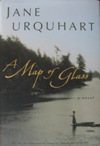
A Map of Glass by Jane Urquhart

I finished this a few days ago on March 26 and I’ve been trying to figure out what I want to say about it [nb: it was “a few days ago” when I started the post!]. I feel like my remarks are likely to make it sound like I feel more negatively about this book than I actually do. In a nutshell: A Map of Glass was a pleasant (perhaps I should say pleasurable), but unsatisfying, read. It was pleasant/pleasurable while I was reading because Jane Urquhart is a lovely writer at the sentence level. The story just sort of washes over you. It’s cozy and delicious. Like curling up with a blanket and hot tea—and a book, of course—on the sofa.

It’s so pleasant that the fact it’s also unsatisfying doesn’t really hit you until you’re done. Or it could be that you were just waiting till the end, expecting the story to pay off eventually, and then it didn’t happen. Instead, you had the only firm ground in the story pulled away at the last minute, leaving you wondering if the entire thing was an illusion, a fabrication, and if so, what was the point?

Before we continue, you need to know this: A Map of Glass is structured in three parts. The first and third parts are set in the present. The second part is set in the past (and is supposed to be the reading of a set of journals):

“Eventually [Sylvia] gives Jerome Andrew’s journals, which contain a fictionalised account of his family, going back four generations to the genesis of his great-great-grandfather’s timber empire.” –The Guardian

The main characters are Andrew, who dies in the opening scene and is the alleged author of the journals read in part two; Sylvia, Andrew’s alleged lover, wife of Malcolm (a doctor with a messiah complex), and sufferer of unnamed “condition” (seems like autism/Asperger’s but treated as if it’s more Mysterious than that); and Jerome, the artist who (I think I can leave out the allegedly here…) found Andrew’s body.

There are also a bunch of characters in part 2, the section read from the journals, but that’s not the part that concerns me. That part (the filling in the sandwich, if you will) seems to be a fairly straightforward story about Andrew’s ancestors, which a lot of reviewers/readers seem to have enjoyed as a “novella” in the middle of the novel:

“In fact, a problem with Glass is that the present feels less urgent than the past.” –Powell’s

But I’m more interested in what’s wrapped around it…

Part of the problem is this:

“A year later, the dead man’s lover arrives on the artist’s doorstep, aiming not to find out how he died but to explain who he was, how he had lived, how they had loved. … When we first meet Andrew, he has Alzheimer’s and his failure to remember who or what he loved, while pathetic (in the kinder sense of the word), makes it hard to warm to him. Sylvia talks about him, but he fails to come to life, remaining unknown, distant. He’s more of an idea.” –The Telegraph

I think I was waiting the whole book for Andrew to turn into a person, but he never does. He’s just a name. Which is frustrating, because he’s the core of the book: he is what brings Sylvia & Jerome together; it is his journals we are supposedly reading. Oddly, it is the opening scene where his mind is absent that he is most present. We never do find out what he saw in Sylvia or she in him. In the present day sections, this could, I suppose, be chalked up to Sylvia’s “condition,” but in the journals we also never do get the part of the Woodman family story that links Andrew to his father and the rest of the clan, or Andrew to Sylvia for that matter.

So this is where the story feels rather hollow to me. Still, up till the end, I was taking the core elements of the story as they were presented, i.e.: Sylvia did have an affair with Andrew, and Andrew did write the journals. And that this relationship and Andrew’s death, has pushed Sylvia out of her comfort zone—as posited in this review:

“Sylvia and Andrew’s hidden love, which prompts her to redefine her relationship with the world, suggests that her grief is the wellspring for a more deeply examined life.” –The Independent

And then… near the very end of the book, Malcolm says that Sylvia imagined the affair. Screech. Rewind. If true, what does this mean? Jerome found Andrew’s body. Sylvia read about it in the newspaper. Sylvia not only imagined an affair with Andrew, but wrote an entire family history for him. Is this plausible? An imagined affair would perhaps explain the sketchiness of the details regarding their relationship, but what about the family history? Is that something Sylvia would do? It’s hard to imagine her thinking so much about Andrew’s ancestors when she has such a tenuous relationship with people (and even herself). But then you remember she’s not only steeped in her own family history, but also she volunteers at the local museum and that was where she learned about the hotel buried in sand. Hrm. Then again, Malcolm is not exactly a reliable source. Dude clearly has an agenda (though it’s unclear what that is—having Sylvia’s condition named after him, perhaps).

Ultimately, I decided that I have to believe in Sylvia’s version of the events, if only because not to would negate what I think is the best line of the entire book, and that is when Sylvia explains to Jerome her realization that after calling off their relationship years prior, Andrew re-instigated it not for any romantic reason, because he had forgotten that it ever stopped.

In the end, though, it does not matter, just as it does not matter that although I believed that he had returned  because—miraculously—he wanted to begin again, he had really returned because he had forgotten that we had ever stopped.

O.M.G.

In retrospect, I think the parts dealing with Andrew losing his memory are the strength of A Map of Glass—and by extension, the linking of this personal/total loss of memory to the loss of knowledge/memories of one’s history/past—but I wonder about the choice of Sylvia as a filter, as well as the choice to call into question her reliability as a narrator.

More:

[ETA: I forgot to say where I got this book! I actually was at a loss at first; I couldn’t remember where I picked it up. But then I flipped back to the first page and saw the price marked in pencil. So, as it turns out, it was another used find from The Bookshop.]

To covet books as objects

Poetry collections are some of the most beautiful books in my library. They have gorgeous cover designs, seductive embossments, such carefully chosen fonts, wonderfully fibrous paper that sets off the white space,  cut with such crisp edges. A lot of this, I think, is because so many of these books come from independent presses and reflect the care that these presses put into each detail of their books.

It’s shallow, I know, to love poetry for its packaging, to covet books as objects, but I can’t help it if I do. It’s only the beginning of the story, of course, but it’s an important part, and it’s fortunate that so many poets and publishers think seem to feel the same.

Honestly, e-books will never hold a candle.

Kerry Clare

Creatures set down here bewildered

Why are we reading, if not in hope that the writer will magnify and dramatize our days, will illuminate and inspire us with wisdom, courage and the hope of meaningfulness, and press upon our minds the deepest mysteries, so we may feel again their majesty and power? What do we ever know that is higher than that power which, from time to time, seizes our lives, and which reveals us startlingly to ourselves as creatures set down here bewildered? Why does death so catch us by surprise, and why love? We still and always want waking. If we are reading for these things, why would anyone read books with advertising slogans and brand names in them? Why would anyone write such books?

Annie Dillard

Something to Say

There are people in this strange little world of ours who have romantic notions about being a writer, and that, to them, is much more important than actually writing. This is the order in which people like that think. “How do I get a book deal” comes before “How do I become someone who has something to say?” Writing is an act of ego, but your ego should not be the only part of your personality involved.

Jessa Crispin

With the Wider World

[S]ome of my favourite bloggers are mothers and write about their mothering experiences, among other things … And what unites the blogger/mothers that I do read and enjoy is, for the most part, how they engage with motherhood and with the wider world at the same time.

This is what I’m looking for in books about motherhood as well … How motherhood can be addressed in literature so as not to alienate anyone who isn’t a mom. And to understand why mothers are so reviled, in real life, on the internet, in general. Because they are a bit, and that’s a funny thing.

Kerry Clare