
And yet there is and will always be some beauty in books. And there will always be people who appreciate that beauty. Even if books eventually become the province of collectors and the peculiar few who fetishize them as objects, there will be attractive qualities to them. They are something like snowflakes or at least stamps, so many and so few alike.
Tag Archives: Books
Time for Books
Just about everyone I know complains about the same thing when they’re being honest—including, maybe especially, people whose business is reading and writing. They mourn the loss of books and the loss of time for books. It’s no less true of me, which is why I’m trying to place a few limits on the flood of information that I allow into my head.
…
There’s no way for readers to be online, surfing, e-mailing, posting, tweeting, reading tweets, and soon enough doing the thing that will come after Twitter, without paying a high price in available time, attention span, reading comprehension, and experience of the immediately surrounding world. The Internet and the devices it’s spawned are systematically changing our intellectual activities with breathtaking speed, and more profoundly than over the past seven centuries combined. It shouldn’t be an act of heresy to ask about the trade-offs that come with this revolution. In fact, I’d think asking such questions would be an important part of the job of a media critic.
1: Secret Son
Secret Son by Laila Lalami
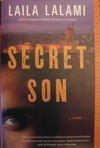
I have a basic policy of trying to read books written by bloggers with whom I have interacted. I don’t really know these people, and perhaps it is a form of wanting a connection with the famous (used loosely), but I find it interesting to see how their writing works in long from as opposed to blogging. —From review of Secret Son at Collected Miscellany
For several years now, I’ve taken to scanning the shelves each time I hit a bookstore, looking for books by people I’m familiar with via their blogs (or forums). Partly it is wanting to see how book-form writing compares to blogging. And partly it’s my way of supporting fellow writers whose writing I have enjoyed for x years. Should I ever complete and publish a novel, I would hope my fan (I do have one!) would do the same.
Anyhow, it’s often easier said than done.* Want Dan Brown? No worries. Want Laila Lalami or Tayari Jones? Er… So let me tell you, I was shocked when I saw Secret Son on the shelf in the Chapters on Robson in December. One copy. Hardcover. Y’all know I never buy hardcovers unless they’re on the remainder table. But then, in continuing to browse, more shock! I also found Jaden Hair’s Steamy Kitchen Cookbook and Heidi Swanson’s Super Natural Cooking. So then I decided it must be my day and bought all three. Solstice prezzie to self! Hurrah!
Cookbook reviews to follow. For now, Secret Son.
I’ve read Laila Lalami’s blog for a long time. Since back when it was called Moorish Girl. Since before she published her first book (Hope and Other Dangerous Pursuits, which I have yet to find), when she was just another book blogger. One of the the things she’s written about is her decision to write in English (her third language). Part of it is that English is not fraught with the connotations that Arabic and French have for her. But as well, she’s writing for a predominantly English-speaking audience. I think translations can sometimes have the effect of erasing the language difference, i.e. you forget that you’re reading a translation and impose your own language-view on the text.
Here are excerpts from a couple reviews:
“Secret Son” gives us an insider’s view of the underlying turmoil of Morocco, access we probably wouldn’t have if she had written in another language. But something has been lost in her attempt to bypass translation: perhaps it’s the cadences of the inner courtyards of her upbringing. Her English prose, although clean and closely observed, lacks music, and her similes can be predictable, as when Youssef’s half sister, returning from California to Casablanca, feels “like a fish that had been taken out of water and put back.” —New York Times
Lalami’s portrayal of indecision, abetted by her characters’ plainly outlined conflicts, lacks tension. When she does successfully transcend her own stylistic shortcomings, which happens in two scenes that revisit key events from different characters’ perspectives à la Rashomon, such structural cunning is deadened by the same rhythmless style, where rage is always “blinding” and a character’s regret is expressed by the narrator’s asking, “What had he done with his life?” —Quarterly Conversation
What these criticisms of her writing style seem to be missing is that she’s made a deliberate choice to write that way, and I think it’s an important one. The way it’s written, to me, is designed to not let the reader slip into the mistake of thinking that the characters are native English speakers. It’s written the way a non-native English speaker, who is fluent in English, but for whom writing in English is still not the main way they communicate, writes in English. It’s one of the first things I noticed. Of course, the story is being told about the characters, but still, I think taking this approach of writing like the characters would in English makes sense because you don’t lose the sense of them being Moroccan.
The other thing is that its written in close third person. Multiple povs, yes, but close third. It’s not omniscient. Which means the writer is limited to what the characters know. She can’t break into a soliloquy on the Moroccan condition. So true, it’s not a “big” novel; it’s an intimate one. It’s looking at the world from the perspective of the characters, not looking at the characters from the perspective of The World. I actually loved the scenes that were seen from the perspectives of two characters, seeing the subtle differences between their remembrances. Really important for a novel so focused on truths and lies. I liked the ideas explored here: identity/family, dual loyalties, the old “education will set you free” trope ;-), choices (or lack thereof). I like that while the characters’ secrets are revealed, their problems aren’t solved.
It did seem like the pacing really sped up in the last quarter or so of the book, and I was wishing it would slow down a bit. But I’m going to have to think about whether or not that is a flaw or not. Although it felt like there was a rush to the ending, I can see how that might be intentional, designed to mimic how the MC, Youssef, was feeling.
Other Links:
- First Chapter
- Book Notes “In the Book Notes series, authors create and discuss a music playlist that relates in some way to their recently published books.“
- Interview with Laila Lalami about Secret Son.
*Yes, I’m fully aware I could just order from Amazon. However, one of my great pleasures dating from pre-internet life is haunting bookstores new and used, looking for somewhat obscure titles. Nothing beats the heart-skip you get when you see a long sought-after book sitting on the shelf in front of you. Buying online does not provide the same thrill.
Thinking, Drafting and Re-drafting
The coming into existence of the paper-and-print book has many accomplishments, two of which, it seems to me, were scarcely foreseeable in 1455. They are entirely remarkable. One was to enable the emergence and wide appreciation of novels and short-stories: forms in which authors spend months and years on a work, thinking, drafting and re-drafting, so that they can reach all the way down into the subjects they treat. The other has been the possibilities for readers to enter into relationships—quite intimate relationships—with books, with authors, with fictional characters.
11: Projecting Canada
Projecting Canada: Government Policy and Documentary Film at the National Film Board by Zoë Druick
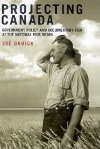
Zoë Druick’s Projecting Canada: Government Policy and Documentary Film at the National Film Board of Canada is part of the Arts Insights: Challenging Ideas for the Future series from McGill-Queen’s University Press. Projecting Canada developed out of Druick’s doctoral thesis in the School of Social and Political Thought at York University. She is currently associate professor in the School of Communication at Simon Fraser University where she teaches media and cultural studies.
Projecting Canada is an analysis of National Film Board of Canada (NFB) documentary film from the NFB’s inception in 1939 to the present. While there is no shortage of commentary on the NFB, it is Druick’s novel approach that makes her book a welcome addition to the subject. The tendency has been to view the NFB positively due to its non-commercial nature, focus on everyday subjects and ordinary Canadians, and, more recently, support of filmmakers from historically disadvantaged groups. However, in Projecting Canada, Druick chooses to set aside preconceptions and instead take a critical look at what the NFB has done over the past seventy years and why. Drawing on Michel Foucault’s concept of governmentality (the relation between the citizen and the state) as well as Mikhail Bakhtin’s theory of dialogism (dialogic texts ‘ask and answer’—they both build on previous texts and invite a response from future ones), Druick argues that NFB documentary films are not neutral records of Canadian lives, but rather, intentional constructions designed to support the NFB’s mandate.
Druick notes that her study is one of ‘visual culture’ rather than film. Because of this approach, Projecting Canada should appeal to those interested in cultural studies and government policy, as well as film scholars. The genesis for her approach is her insight that NFB documentaries are neither cultural (high art) nor popular (commercial) films. Instead, she chooses to think of documentary film in terms of statistics about the population of Canada. Using timelines, she illustrates how, throughout the NFB’s history, shifts in dominant documentary film forms have paralleled key periods of social scientific study. This becomes the framework of the book.
Projecting Canada is organized roughly in chronological order. In each chapter, Druick adds a new layer to her framework. Throughout the book, she supports her argument with reference to numerous NFB documentary films, as well as government publications and archival materials (production notes, letters). By providing solid evidence of the NFB’s intent, the archival materials in particular add to the persuasiveness of Druick’s argument.
The first four chapters focus mainly on the early years of the NFB. In chapter 1, Druick outlines the origins of the NFB, as well as how governmentality links social science to the NFB’s documentary films. Druick calls this style of filmmaking ‘government realism’ (23), a term that succinctly encapsulates both the state-sponsored and documentary aspects of these films. She notes that realism is often tied to radicalism, but that this is not the case with government realism. Instead, the NFB’s mandate is to use documentary film to support existing Canadian policies, processes, and programs (explicitly or implicitly). Druick posits that documenting the population may actually produce it, that is, project Canada.
In chapter 2, she explains how the NFB is “rooted in an empire communications strategy” (44) imported from its British counterpart. Thus, the early goal of the NFB was nation building, as well as resisting the threat of Americanization posed by radio. Documentary film gave Canadians of all backgrounds and from all regions of the country a unified view of Canada. In chapter 3, she contends that the NFB films are a form of “welfare state technology” (72). That is, the NFB uses documentary film to educate people and mold them into the type of citizens the state wants them to be. Many early films used difference to promote unity, for example the idea that all Canadians are immigrants or that Canadians from different regions each contribute something essential to the country as a whole. In chapter 4, she discusses how, as World War II ended and the Cold War began, the NFB’s vision changed from educating immigrants about Canada to positioning Canada with respect to the rest of the world.
In chapters five through seven, Druick illustrates how, even though the output of the NFB has changed over the years, its underlying mandate—to support and promote state policy—has remained the same. In chapter 5, she looks at how NFB documentaries were used to model citizenship to the population during the 1950s. NFB films were designed to consciously manipulate the public into being good citizens. In chapter 6, she discusses how NFB documentary discourse shifted from nation building to identity politics in the 1960s. The new program Challenge for Change / Société nouvelle was developed with the idea of empowering disenfranchised groups by encouraging their participation in filmmaking. While the shift in tone was significant, Druick argues that it was consistent with the shift in policy at the federal level, that is, from a discourse of assimilation in the 1950s to one of multiculturalism as Canada moved into the 1980s.
In chapter 7, she links the shift in filmmaking in the 1980s to the simultaneous shift in the social sciences toward autobiographical methods. The NFB’s mandate became giving filmmakers from disadvantaged groups a place to work without having to worry about commercial pressure. Druick argues that giving voice to different groups of Canadians served a dual purpose from the state’s perspective: it suited the tolerant, non-discriminatory image of Canada that the government wished to project to the world and it neutralized potential radicalism because marginalized groups could use film to comment on their situations instead of physical protest.
The idea that governmentality pervades all the NFB films, even ones that appear radical, is perhaps the most controversial aspect of Druick’s argument. While it would be relatively easy for today’s viewer to pick up on the manipulation of the population embedded in the early films, this is because the 2009 perspective of Canada is quite a different view of the country than that of 1949 or 1959. As Druick ably demonstrates in Projecting Canada, government policies change. By 2039, Canadians may be able to see the presence of governmentality in 2009 films as easily as in films from the 1940s and 1950s.
While it may be questionable whether today’s NFB mandate is as effective at manipulating the population as the mandates of the mid-twentieth century, nevertheless Druick opens up a space for dialogue on Canadian culture and film policy by positioning the NFB as an agent of governmentality, rather than a neutral agency. Just as important is that, like her theoretical muses Foucault and Bakhtin, Druick has developed an interpretive framework that can be adapted to other state-sponsored cultural projects and other countries.
10: On Her Majesty’s Secret Service
On Her Majesty’s Secret Service by Ian Fleming
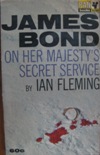
Previously in Books Read: Casino Royale.
So, as mentioned in the CR post, this book has the same provenance. The reason I picked up this one is because OHMSS is J’s favorite Bond movie. It’s also the only one that starred… yes! George Lazenby! Thus, it’s the controversial one and tends not to get the love that some of the other Bond movies (esp. ones starring Sean Connery) do. Wikipedia has a good round-up of opinions on this matter.
The major criticism of Lazenby seems to be that he’s wooden, which he kind of is, but… if you read the books, you realize James Bond is kind of a wooden character. Oh, sure, he comes up with the occasional wisecrack, but his core characteristic is that he’s excruciatingly methodical. I think because of the movies we have this image of Bond as this rash, devil-may-care risk-taker, whereas Original Bond is pretty much the opposite of that. He takes risks, but they’re always calculated.
It turns out that the film is a pretty faithful rendition of the book, so if you’ve seen the film, you know what happens in the book. I guess I’ve seen OHMSS a few too many times, because I kept picturing Lazenby-as-Bond while reading.
I think I’ve had my Bond fill for now, but I may read more in the future.
8 & 9: Jack & Reading In
Jack: A Life with Writers by James King

Jack is a biography of Jack McClelland, who ran McClelland & Stewart (Canadian publisher that his father founded) for many years (1950s – 80s). McClelland championed Canadian literature and started the New Canadian Library series. As biographies go, this is a pretty entertaining one. You learn (if you didn’t already know!) how close to bankruptcy publishing firms have always operated as well as all sorts of gossip about famous Canadian writers. Be prepared for the usual sexism of the era.
Reading In: Alice Munro’s Archives by JoAnn McCaig
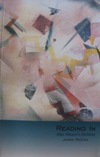
Reading In is an exploration of Alice Munro’s archives, that is, the papers (primarily business letters) she has donated to the University of Calgary. It’s based on McCaig’s PhD dissertation. Here’s the fascinating part: Prior to publishing the book, McCaig published an article based on her research. Munro (& others) gave their permission for letters to be quoted in the article, however Munro was displeased with the article and subsequently denied McCaig permission to further quote or paraphrase her letters. This means that the book is a truncated version of what McCaig originally intended it to be.
Bizarre, right? Why would a university pay an author for her papers but not make her sign a standard agreement giving researchers permission to quote from the materials as necessary? Don’t universities do this? If they don’t, what’s the purpose of buying this stuff then? In any case, copyright issues with quoting aside, I really don’t see how legally Munro could deny McCaig permission to paraphrase the letters she donated to a university library. It’s like how there is no expectation of privacy with respect to stuff you put in the garbage. She can’t have an expectation of privacy with respect to stuff the public can access.
Reading In had an interesting premise, but I had difficulty with some of the conclusions that McCaig came to. As noted above, Munro only donated her business correspondence. Because the collection is an incomplete record, I think it’s difficult to draw any overarching conclusions about a correspondence or the relationship it documents. Munro obviously kept her personal correspondence (which may include some letters from people she also exchanged business letters with) and there’s also evidence that she likely retained letters that contained editorial suggestions. And of course there’s no record of conversations that took place on the phone or in person (which would seem pertinent when you’re talking about the nature of a relationship). So, ultimately, I’m thinking that perhaps the more valuable discoveries to be made in such an archive will be smaller—more contained—findings that rely less on assumptions.
6 & 7: Anne of Green Gables & The Selected Journals of L.M. Montgomery
Anne of Green Gables by L.M. Montgomery

Hey! A children’s—and Canadian—classic I actually read as a child. Quel shock!
[Note: If you want to read Anne for pleasure, I don’t recommend this (the Norton) version. It’s great if you’re analyzing the text for an English class (there are lots of assorted extras—essays and such—included), but the footnotes were really weird and distracting. There were all these definitions of common words (e.g. “dinner-time” and “bewitched” !!!) and expressions. I couldn’t figure out who they were targeted at. Surely the target audience of the Norton version (university students) of a book written for 10-year-olds has the sophistication to figure out the gist of words/expressions they’re not familiar with from the context. The only thing I could think of that made sense was perhaps it was aimed at an ESL audience who wouldn’t be familiar with English idioms. But that didn’t really explain including the definitions of words that could be looked up in a dictionary.]
Re-reading a book is often as much about the memories of past readings it’s tied up with as the contents of the book itself. My first encounter with L.M. Montgomery was via a boxed set of the first three Anne books that I received as a 10th birthday gift. Because I actually owned them, I re-read those three books over and over, but my most distinct memory of reading them is the first time: in August heat on the upper bunk of our camper as we made our way home from Ontario where I’d spent the summer.
One odd thing I remember is that whenever I re-read AoGG, I always started with chapter 4. Re-reading the book now I’m not sure why I did that. Maybe I found them too slow-paced or perhaps too focused on the grown-ups (chapter 1 starts with Rachel Lynde!). Another uber-geeky memory: the public library didn’t have the other books in the Anne series so I ordered them through inter-library loan. Don’t ask me how I knew to do this. I must’ve asked about them and the librarian suggested it.
Because they were all library books, I never re-read any of the other Montgomery books until one summer in undergrad when I decided to work my way through her entire oeuvre (holy geek summer project, batman!). So the remainder of the Montgomery books I have date from that summer.
Another weird thing: though once I read the Emily books, I preferred her to Anne (because Emily was the real writer), I don’t have a distinct memory of reading Emily of New Moon for the first time, the way I do with Anne of Green Gables. Probably because I just read it in the usual places (you know: in bed when I was supposed to be asleep, under my desk when I was supposed to be doing schoolwork, on the way home from school when I was supposed to be paying attention to where I was walking…) I do know when it was, though, because I wrote it down in my journal. In the same entry I wrote that was going to be a writer when I grew up. I was 12.
Which leads me to…
The Selected Journals of LM Montgomery, Volume I: 1889 – 1910, edited by Mary Rubio & Elizabeth Waterston
I was enthusiastic about reading this, the first volume of Montgomery’s journals. I like reading artists’ and writers’ journals/memoirs/biographies just in general, but having read most of Montgomery’s fiction, I was curious to see “behind the scenes” in her writing process and in particular, how her self-representation matched her fictional representation, particularly in the Emily books.
To be clear: Emily writes about writing: her process, her failures, her successes. So, I guess I went into this expecting a real-life version of Emily’s journal (not the same events/people, obviously, but the same style). What I got was cognitive dissonance, because Maud hardly writes about writing at all. Mostly she writes about her friends and relatives, school and work—the everyday stuff that anyone who’s kept a journal has written about. She doesn’t even mention AoGG until she announces that it is going to be published!
While it’s fun to guess at who she modeled various characters after and to recognize stories and anecdotes that she recycled into her fiction, the fact that she doesn’t write more about writing is perplexing. From the beginning, she intended for the journals to be published after her death (because she anticipated that she would by then be a famous writer), and clearly, as the Emily books demonstrate, she knew people are interested in a writer’s writing process. So why isn’t it there?
My theory is this: a few years before she wrote the Emily books, Maud apparently took all her old journals and transcribed them into new notebooks, ostensibly so all her journals would be in books of a uniform size. There is speculation, however, that she didn’t just copy her old journals word for word (as she claimed), but that in fact, she edited them at this time (she was famous by then and knew for sure that her journals would be published). Thus, my (completely unprovable!) theory is that when she did this she excised all the writing-about-writing parts and then used those in the Emily books. I think that she did this because then she could use those experiences as Emily’s without having to deal with Emily = Maud speculation. Of course, that happened anyway ;-).
Links:
5: Legends of Vancouver
Legends of Vancouver by E. Pauline Johnson (Tekahionwake)
Pauline Johnson was from Six Nations in Ontario (her father was a Mohawk chief). After a career performing her poetry on stage, she ended up in Vancouver. The legends (with one exception) are Squamish and were told to Johnson by Chief Joe Capilano (also with a few exceptions). Most of the stories consist of a present-day (her time, of course; about 100 years ago now) framework where Johnson sets herself up as a listener, followed by the legend. At the end of legend, she brings the reader back to the present with a closing thought.
Johnson was clearly a gifted storyteller, and I think a good part of the reason people continue to find the stories so compelling is the way she tells them. However, I think the way the stories came about and are credited brings up some interesting questions/issues with respect to written vs. oral storytelling, as well as the weight we place on the importance of the book. None of the oral storytellers are given co-author credit, and while Joe Capilano is at least mentioned by name, some of the stories are told to Johnson by a woman (or women? it’s unclear whether it’s the same woman or different ones) who isn’t identified. Of note:
- The legends included in the book are actually just a few of the ones Johnson wrote up; many more were published in newspapers/magazines. One early version of the book includes three additional legends.
- In some cases, the person who Johnson attributes the story to changes from the original periodical version to the one published in the book.
- The book was compiled by a group of Vancouverites in order to raise money to provide for Johnson when she was dying. It’s unclear who chose the stories or what order they would appear in.
Johnson is always respectful of the oral storytellers, and, of course, legends are meant to be shaped and adapted with each re-telling, but it does make you think about what responsibilities a person has when they put someone else’s story into print. Print solidifies things, especially when it’s in book form. We like books in part because they’re finite and it’s possible to get a grasp on the whole thing. Thus, book versions end up being thought of as definitive, which may or may not be true, and may or may not be a good thing.
(I think this can be related to the blog to book trend. It’s hard/impossible to to feel like you’ve finished reading a blog in its entirety; even if you’re an avid long-term reader, it’s unlikely you read every comment or follow every link. Hence, the book. The book cuts out all the tangents and turns the blog into a comfortable narrative that allows the reader the satisfaction of reaching the last page and closing the book.)
Links:
- Pauline Johnson ebooks @ Project Gutenberg.
- Miss604 on Pauline
- Johnson’s Wikipedia entry
- Pauline Johnson Archive @ McMaster University
4: Roughing It in the Bush
Roughing It in the Bush by Susanna Moodie

Roughing It in the Bush is often cited as an early Canadian classic. At the same time, its Canadian-ness has also been questioned. For one thing, Moodie started writing about Upper Canada (now Ontario) in the 1830s, thirty-plus years before confederation (so maybe it’s not an early Canadian book, but a late British North American colonial book). As well, Susanna Moodie was an immigrant who wrote about her experiences from that perspective (so maybe she should be thought of as an English ex-pat writer, not a Canadian writer). Of course, “what does it mean to be Canadian?” is the quintessential Canadian-dilemma, so I think she qualifies on that count 😉 Really, I think she can be thought of as either—or both. Just depends on what you’re looking for.
Roughing It is an account of the middle-class Moodies’ first years in North America. Susanna and her husband John were woefully unprepared for life in the “bush,” which made for lots of good material for Susanna to write about. Although it’s supposed to be non-fiction, it seems pretty clear that the character “Susanna Moodie” is a lot ditzier than the writer Susanna Moodie was, i.e. that the stories were embellished to make them more funny and entertaining. While the writer Susanna Moodie was writing by candlelight and sending her stories and poems to magazines and newspapers (when she could afford stamps), the character “Susanna Moodie” was busy acting clueless and getting into scrapes to provide fresh material.
Which… you know… sounds a lot like a present-day memoir! Actually, my immediate reaction after I finished reading the book was that if Moodie were around today she’d be a blogger. Think about it: the book is a collection of anecdotes and poems and other ephemera, with the occasional chapter contributed by her husband or brother (guest posts!). Throw in a fish-out-of-water scenario, add a dash of hyperbole and a pinch of drama, and voila! Recipe for a successful personal blog. And of course, she was a mother, so you might even call her the first Canadian mommyblogger 😉
Links:
- Susanna Moodie ebooks @ Project Gutenberg
- Susanna Moodie’s Wikipedia entry
- Susanna Moodie archive @ Trent University
 The Remainder Table