Tag Archives: Books

18: Eating Dirt

Eating Dirt: Deep Forests, Big Timber, and Life With the Tree-planting TribeEating Dirt: Deep Forests, Big Timber, and Life With the Tree-planting Tribe by Charlotte Gill

My rating: 4 of 5 stars

Bought new at Chapters.

Read in July/August 2013.

View all my reviews

I learned about Eating Dirt via Emily St. John Mandel’s review at The Millions  (which, btw, is hands-down my favorite literary site / online magazine that is not TC). I was hooked by the opening paragraph: “My father was a treeplanter. It isn’t a job that very many of my fellow New Yorkers seem to have heard of—” Wait. There are people who haven’t heard of treeplanters?! Oh, but of course there are. Undoubtedly the same people who think “every” fledgling writer grew up with the ambition to be published in The Paris Review or The New Yorker. Meanwhile, many of the fledgling writers who grew up knowing all about treeplanters had never even heard of The Paris Review or The New Yorker. Perspective!

I never treeplanted, but it would be a lie to say I didn’t consider it. I certainly did. it was a good-paying job! But I’d spent plenty o’ time in the forest and I was terrified of the boredom that I knew awaited me. It practically drove me mad just thinking about it. (To be honest, just reading this revives that anxious feeling, even though I know I don’t feel the same way now about repetitive tasks without distractions (that’s writing-in-my-head time!). In fact, now I’d probably deal just fine with the monotony; I am the person who runs without music, after all. Back then, an iPod may have made all the difference. Too bad they didn’t exist when I was in university.)

Anyway, it’s a bit weird reading a book where you can picture everything so clearly. The landscape, the little towns, the shabby motels, all the forestry stuff. I always think it’s funny when someone says they’re from a “small town” (population 50k). Haha! 50k, small. Good one!

Aside: I’ve started wondering how many people have actually spent much time outside of cities. Like, even amongst people who have moved/traveled a lot, the impression I get is that it’s mostly jumping from one big city to another big city. Which… would give you a really different impression of the world than seeing the spaces in between.

Eating Dirt starts out in early spring (February) on northern Vancouver Island, in places like Holberg and Port McNeill, where the planters stay in cheap motels and rental houses. Scenes of the crew are interspersed with passages about forests and forestry.

Another aside:  the area of Vancouver Island is 31,285 km2  / 12,079.2 sq mi. The area of Oahu is 1,545 km2 / 596.7 sq mi. That’s less than 5% of the size of VI. It’s so… little! Is it really as covered in freeways as Hollywood would have me believe? Where are they going?!

After early spring on Vancouver Island, the crew moves to the Sunshine Coast (which is the mainland, but inaccessible by land) to Jervis Inlet and Seymour Inlet where they stay at a logging camp and on a boat. This is middle-of-nowhere. There are bears. Naturally. Gill writes about cedar—natural history, early history.

She dips into summer planting in the interior and up north (Mr. PG!) and back to the coast in fall, but then returns to spring on the coast, her frame for the book. The foray into summer planting ties back to how her career as a treeplanter began—with the university students arriving for the summer.

She writes in plural first person. There are occasional “I” references, but it’s mostly “we.” It’s composed as if she’s describing a single season, one year, but likely it’s a compilation of all the years she spent planting. This is her goodbye to that part of her life.

From the descriptions I’d read, I expected more of a memoir. I’m not sure I’d describe this as a memoir. It is based on her personal experience and she’s writing from that perspective, but it’s not about her. It’s personal in a “this is important to me” kind of way, but it’s not personal as in “here are all the tmi details of my life” kind of way. Her partner is also a planter but we learn no more about him than any of the other characters. It’s about treeplanters (“we”) and treeplanting, not about Charlotte-the-Treeplanter. And also, as mentioned above, the crew parts of the book are only about half of the text. The other half is natural history, biology, ecology: all about trees and forests, which makes sense seeing as it was published by the David Suzuki Foundation.

I am realizing that I really like narrative—fiction and non—with nerdy biology stuff in it.

17: The Science Writers’ Handbook

The Science Writers' Handbook: Everything You Need to Know to Pitch, Publish, and Prosper in the Digital AgeThe Science Writers’ Handbook: Everything You Need to Know to Pitch, Publish, and Prosper in the Digital Age by Writers of SciLance

My rating: 5 of 5 stars

Bought new at Chapters on Robson.

Read in July 2013.

View all my reviews

In the event that the never-ending dissertation does eventually come to an end (positive thinking!), I’ve been thinking about the future. If you pay attention at all to academic things, you’ll have heard some variation on the theme that doing a PhD is crazypants because traditional academic jobs (tenured professorships) are going the way of the dodo and the majority of new PhDs are doomed (doomed!) to careers as underpaid adjuncts.

I guess I’d find this more alarming if a) it wasn’t the story of my entire life (Jobs? What jobs? I once got rejected by McDonald’s. McDonald’s! Doesn’t get much more deflating than that.) and b) I’d actually started this with the expectation that I’d end up a tenured professor. See a). At no point did I ever have that expectation. I’m an optimist (I’m doing the PhD!) but I’m also a realist (some may say cynic). Temporary is the new permanent.

Which is the tl;dr way of saying I went into this open to any possibility afterward. Apparently this is odd. I’ve since learned that for PhDs, any non-tenure-track job is considered “alternative.” Oookay. Pretty narrow view of what you can do with a PhD, in my opinion, but I’ve always been a bit of an oddball, so I’m happy to roll with it.

So I’ve been making a list of possibilities to pursue. And one of the things that’s bubbled to the top is science writing. Why science?

  • In part it’s because I’ve become increasingly annoyed by intelligent people, people with advanced degrees, joking about being innumerate. That’s not ok.
  • In part it’s because of the general lack of understanding of science—you don’t  get to choose to “believe” in evolution or climate change. It’s not ok to teach creationism in biology class or to deny climate change because you want to keep driving your gas guzzling SUV without feeling bad about it.
  • In part it’s because of the current Canadian federal government’s muzzling of scientists. Grrr. #standup4science

On the one hand, all you hear is STEM, STEM, STEM. And on the other hand, non-scientists’ understanding of science and math is regressing. Right now, it seems like science needs all the voices it can get that can translate it into everyday language even the innumerate 😉 can understand. And why not me? Science writing = science, writing, educating, communicating… even law. Perfect fit, right? (The only thing I can’t figure out is why I didn’t have a eureka moment post-undergrad when I spent all my time at the library reading university course catalogs—were science writing programs not a thing back in the day?)

The Science Writers’ Handbook is written by a group of science writers who call themselves SciLance (science + freelance). They have an excellent blog that I’ve been reading for a while so I knew the book would be worth buying. After reading it, I’d call it an essential reference if you’re interested in science writing/communication, and useful for any freelancer (a lot of the material is applicable to any kind of freelance writing).

Miscellaneous notes:

  • Be able to distinguish between topics and stories. A story has:
    • characters
    • journey or conflict
    • series of linked events (beginning middle end)
    • discovery or resolution
    • hook –> why now?
    • connection to a larger idea
  • Play first, write later. In other words, get out in the world and do stuff and meet people and you will find ideas. At the same time, you’re always working because anything can become a story idea (but same is true for all writers).
  • Pitch = story idea + relevance + timeliness + execution + extras + author.
  • As an editor, I enjoyed this: “Distaste for email attachments just may be the one thing all editors have in common.” (Thomas Hayden, p. 29). 🙂
  • Interview one source for every 250 words.
  • Notetaking: remember not to just write down quotes, but describe people, surroundings, sounds and smells, overheard dialogue, etc. so you can set the scene.
  • Toolkit for field reporting: digital recorder, notebook, camera—take photos for notetaking purposes, video clips of subjects… but you probably won’t be able to listen to all the recordings you make.
  • The one-sentence pitch!
  • Story anatomy—newspaper-style:
    • headline (hed) – clear sense of story
    • news lede – who what where when how
    • most important point – fleshes out lede
    • substantiating points – decreasing order of importance
    • background / context / reactions
  • Story anatomy—magazine-style:
    • headline – catchy
    • dek/standfirst – subtitle/clear sense of story
    • lede – lures reader into story
    • billboard/nutgraf – partially summarizes the story
    • body 1 – context / history / explanation
    • body 2 – what happened?
    • etc.
    • kicker – ending that ties the story together
  • Multilancing = reporting a story in more than one medium.
  • Creative procrastination (necessary, productive) vs. distractive procrastination.
  • Business: Start as sole proprietor, see how it goes. Incorporate if all is going well and you want to continue.
  • Email, email, email… you also have to talk on the phone and go to conferences and such but lots o’ email. (good for introverts)
  • Contracts: if you are uncomfortable with the language in a clause, speak up, suggest an alternative that would be acceptable, especially re: liability, rights, payment.
  • Ethics. If you’re reporting on a topic you shouldn’t also be doing PR for same topic. But you could report on Topic A and do PR for Topic B. Also disclose existing relationships, etc.
  • Blog. Just do.
  • Science communication (vs. journalism-style writing): companies, universities, nonprofits.
  • Look for mix of work: good pay but not as interesting balanced with stuff that excites you.

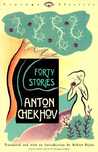
16: Forty Stories

Forty StoriesForty Stories by Anton Chekhov

My rating: 5 of 5 stars

Bought new (at Chapters).

Read in June 2013.

View all my reviews

I’ve read Chekhov stories before, but never a whole book of them. I picked this up a while ago; I don’t remember the exact impetus, but I’m going to guess that it was probably something I read whilst blog/twitter-grazing.

So it was sitting on my to-read shelf. Meanwhile, I read that Frank O’Connor book, with its offensive chapter on Katherine Mansfield, and The Sky is Falling, in which the narrator was obsessed with Chekhov. That was it. The time was right to read this. I’ve long wanted/planned to read more Chekhov because he’s always described as being a big influence on Katherine Mansfield, whose work I love.

Trivia: both Chekhov and Mansfield died young of tuberculosis. A cause of death I realize wasn’t unusual back in the day, but hey! thank science that same fate won’t befall you, present-day-writers!

The stories are arranged in chronological order, starting in 1880, when Chekhov was 20 years old—nice from a writer-reader standpoint because you can see how his writing progressed. A lot of the early stories are very short, flash fiction length. The later stories are longer, more developed. His early work tended toward punchlines (I’m not usually a fan of this style of short story, but some of these were ok. I liked “The Threat” :)), but got more subtle as he grew as a writer.

It includes the well-known stories, of course: “Death of a Government Clerk,” “The Huntsman,” “The Lady with the Pet Dog.”

Some of the other titles I made note of:

  • “Joy,” in which a young man gets mentioned in the newspaper for drunkenly falling under a horse. He’s thrilled because he thinks he’s famous. (This one just seems so… prescient, ya know?)
  • “Who is to blame?” in which a tormented kitchen kitten grows up to be a sleek outdoor cat… who’s afraid of mice.
  • “Sleepyhead,” in which a young nursemaid’s sleep-deprivation leads to tragedy.

I noticed he seemed to have a fondness for the name Pelageya. I looked it up and it means “open sea.” (doh! pelagic!) Cool name. I think I’ll steal it. Now I just need a character to give it to…

15: The Sky is Falling

The Sky Is FallingThe Sky Is Falling by Caroline Adderson

My rating: 4 of 5 stars

From the Fall 2012 VPL book sale.

Read in May/June 2013.

View all my reviews

This story takes place in two time periods: 1983-84 and 2004.

In 1983: Jane Z. is a second-year UBC student originally from Edmonton. She spent her first year living at her aunt’s in Burnaby, but now she wants to live closer to campus. She ends up moving into a communal house in Kitsilano. Her new housemates are Sonia, Pete, and Dieter. They are into peace and anarchy and protesting. They, esp. Sonia, think there is going to be a nuclear war and everyone is going to die.

I have to interject here and say this story totally reminded me why/how I spent my high school years thinking nuclear war was an inevitability. To the point I didn’t worry much about long-term consequences not because I thought I was invincible, but because I thought we were all going to be vaporized sooner or later. It’s weird, how this doesn’t get mentioned much, if at all, anymore. So when I started reading this book and realized that’s what it was about (in part), I was hooked. Well, that and the fact it’s set in Vancouver 😉

Jane is taking Russian and reading Chekhov*, so her housemates assume that she’s Russian (they’re in love with this idea, of course), but she’s actually not. She just had a professor in first year who encouraged her to continue on in his department, and in classic “I can’t decide what to major in” fashion, she floated into Slavic Studies.

In 2004: Jane is now 39. She’s married to Joe, who’s a doctor, and has a 15yo son, Joe Jr. She works as a freelance copy-editor.

One morning there is a story in the newspaper about Sonia being released from prison after serving a 20-year sentence for her part in an attempted bombing in 1984. This gets Jane thinking about the events of twenty years ago, although it turns out that she never really stopped thinking about them. Her whole life has basically been haunted and shaped by how she remembers what happened in the spring of 1984.

I don’t want to say any more about the plot, but I was impressed by how the ending of this one worked out. It felt like all the pieces fell into place but at the same time Adderson resisted tying up all the loose ends.

VPL Fall Book Sale

*Because of all the Chekhov discussion, I decided that would be my next read.

14: Room

RoomRoom by Emma Donoghue

My rating: 4 of 5 stars

From the fall 2012 VPL book sale.

Read in May 2013.

View all my reviews

Here’s one I probably don’t need to say much about. You’ve either read it or you’ve read about it. My question going in was “will it live up to the hype?” The answer: yes.

Jack, the narrator, is five years old. His mother, who he calls Ma, is 26. They live in a 12×12 room, which turns out to be a garden shed (spoiler? I think that horse has left the barn). Jack thinks Room is the whole world and everything else is “TV” (imaginary). Jack calls everything by proper nouns: Bed, Wardrobe, Door. This is partly because there is only one of each of these things in his world. But also, I wondered if it didn’t partly come from the children’s shows he likes to watch. For example, he’s a big fan of Dora, and Dora’s backpack is called Backpack.

Ma has managed to shelter Jack from the reality of their situation, but now that he’s five, he’s starting to ask questions. She decides to tell him the truth. Events start snowballing from there.

What I thought was particularly impressive about Room was the pacing. It starts off at an almost oppressive pace, detailing the minutia of a day in the room. But then just when you start to think “I’m not sure how much more this I can take” Donoghue shifts gears, and the story speeds up to an almost frenetic pace. Finally, she slows it down again, letting readers catch their breaths.

I know some readers didn’t like the story being told in Jack’s voice—they find kid-voices annoying or question the authenticity of his thoughts—but I think to tell this particular story, it had to be from his pov. If it were told from Ma’s pov, it would be a story we’ve heard before. We also have no trouble imagining how we’d feel if we were kidnapped/falsely imprisoned. So telling the story from Ma’s pov sets up a very different narrator/reader dynamic. Jack’s situation is outside the realm of our experience . Readers have to work harder to understand his perspective, not because he’s a child, but because we (with few exceptions) didn’t start off life like Jack did.

tl;dr: It is easy for us to empathize with Ma; we have to work to empathize with Jack.

And that’s why I think the last part, when Jack is suffering from sensory overload, when he wants to go back, is so important. This story is not about freedom, as it would be if it was told from Ma’s pov, but about adjustment. Jack has to adjust the entire framework of his life experience.

VPL Fall Book Sale

13: The Flying Troutmans

The Flying TroutmansThe Flying Troutmans by Miriam Toews

My rating: 4 of 5 stars

From the Spring 2011 VPL book sale.

Read in April 2013.

View all my reviews

Hattie Troutman was living in Paris with her boyfriend, but returns home to take care of her sister Min’s kids when Min has a psychotic break and is hospitalized. Hattie is 28; her nephew Logan is 15 and niece Thebes (short for Theodora) is 11.

Hattie is unsure about taking on this responsibility and decides to take the kids and go look for their father, Cherkis, who left years before. Which means… road trip! Yes, this is a road trip book. Love. Most of the story takes place on the road. Naturally, they have a crumbling van and stay at cheap motels in dusty towns populated by quirky characters.

They start in South Dakota, where Hattie knows Cherkis used to live. There, they get a lead that he moved to California, so they head off cross-country. On the way, they have adventures (of course).

I’m not sure when this is supposed to be set, but they drive across the border without showing ID and Hattie keeps making calls to the hospital to check on Min’s condition from pay phones, so I’ll assume back at least a decade (it was published in 2008).

I think I’ll stop here lest I say anything spoilery. I loved this book.

VPL Spring Book Sale

12: The Cottage Builder’s Letter

The Cottage Builder's LetterThe Cottage Builder’s Letter by George Murray

My rating: 3 of 5 stars

From the Book Shop in Penticton.

Read in April 2013.

View all my reviews

Since it was poetry month, I thought I’d read some poetry. This one’s been on my to-read shelf for a while (how long? not sure. I think it’s probably from my 2009 trip to the Book Shop). You may be familiar with George Murray as the proprietor of the (sadly no-longer-updated) book blog Bookninja.

Most of the poems in The Cottage Builder’s Letter are narrative poems (stories in poetry), many of them multi-part. A number of the poems are semi-formal in construction, e.g. poems consisting of all 3-line stanzas or all 2-line stanzas, poems where a phrase/word sequence is repeated in each line or stanza.

This was one of those books that I wanted to like more than I did. The writing was good; the poems skillfully composed, but for whatever reason, I didn’t really connect with them. Maybe it was that there were too many unfamiliar references. I’m not sure.

I did like this one, especially the last stanza:

LIBRARY

Maybe you know how
to live in a way
that isn’t just about breathing,
but I don’t —
so please: reserve this
space for me.

(Rest here a moment
without thinking)

In what manner you choose
to keep your books:
I know this little part of you,
hold it sacred —
it’s your other secrets,
if any, that are not safe with me.

The Cottage Builder’s Letter, 55

11: Why is Always About You?

Why Is It Always About You? : The Seven Deadly Sins of NarcissismWhy Is It Always About You? : The Seven Deadly Sins of Narcissism by Sandy Hotchkiss

My rating: 3 of 5 stars

This one was passed along to me.

Read in March/April 2013.

View all my reviews

Part I describes the 7 deadly sins of the title:

  1. Shamelessness (shame = personal flaw)
  2. Magical Thinking (fantasy world)
  3. Arrogance (value = relative)
  4. Envy (need to be superior)
  5. Entitlement (expect to get what they want)
  6. Exploitation (lack of empathy)
  7. Bad Boundaries (violate others’ boundaries)

The boundaries one is worth thinking about—helps to understand why certain gifts can be so uncomfortable—these types of gifts are not about doing something nice, really thinking about the receiver, but about molding them in the shape of the giver (narcissist).

Part II discusses where narcissism comes from. Hotchkiss claims narcissism originates in toddlerhood—occurs when child doesn’t develop healthy sense of self. Adolescent narcissism is also a normal stage, but people can get stuck there. Children of narcissists often become narcissists themselves; those who don’t are shame-driven, drawn to people who resemble their narcissistic parent(s).

Part III discusses strategies for defending yourself from narcissists: know yourself, embrace reality, set boundaries, cultivate reciprocal (i.e. healthy) relationships. I thought this section wasn’t as helpful as it could have been. Sort of, “yes, and…?”

Unfortunately, there’s not a lot you can do to help/change narcissists because the first rule of being a narcissist is not admitting you’re a narcissist. It’s like Fight Club. So someone you know is a narcissist, you have two choices: a) flee! or b) tolerate them. (Here’s the moment where you wonder “I don’t think I’m a narcissist. Does that mean I am one?” Well, if you’re questioning whether you are, you’re probably not. Self-awareness!)

Part IV describes narcissism in different scenarios (e.g. love, work, family). Narcissists, of course, consider themselves “special” so if you know someone like that (and you probably do), they might be a narcissist. Read Part I and find out.

Part V was about preventing narcissism.

Decent overview, but I wasn’t thrilled with her conservative agenda. If y’all just believed in Almighty God, society wouldn’t be overrun with narcissists, don’t ya know? 🙄

10: Cockroach

CockroachCockroach by Rawi Hage

My rating: 4 of 5 stars

From the fall 2012 VPL book sale.

Read in March 2013.

View all my reviews

The protagonist is an immigrant living in Quebec. He had a job at a restaurant as a dishwasher, then was promoted to busboy, but he quit when the maitre’d told him he was “too brown” to be a waiter. He’s now on welfare.

He tried to commit suicide by hanging himself from a tree, but the branch broke. He’s currently in court-ordered therapy with a psychiatrist, Genevieve. In his sessions with Genevieve, he talks about his past and his regrets, and these scenes foreshadow the book’s climax.

All of his friends/acquaintances are also immigrants, but they don’t share his background. Most of them, like his frenemy Reza and Shohreh, who he sort of has a relationship with, are Persian/Iranian, but he isn’t. His name and home country are never revealed. (‘Lira’ is mentioned, but this is a generic term, like ‘dollar.’) However, it’s possible he’s Lebanese, since Hage immigrated to Canada from Lebanon.

He imagines himself as a cockroach. This is partly a metaphor for how he sees himself (a low-life, a pest, but resilient), but also being a cockroach allows him to explore places he couldn’t as a human. One question for the reader to decide is how much of what he does as a cockroach is real and how much is imaginary.

He’s kind of an anti-hero. He’s not a ‘good’ person (yes, the dreaded unlikable character!), but I still empathized with him.

Cockroach is funny, in a dark humor / black comedy kind of way. In what comes as no surprise (at least to me!), there are drug-induced hallucinations. Note to self: if you have the urge to write an “I’m on drugs!” scene, just say no.

Also, it’s quite scatological. You’ve been warned!

VPL Fall Book Sale

9: The Lonely Voice

The Lonely Voice: A Study of the Short StoryThe Lonely Voice: A Study of the Short Story by Frank O’Connor

My rating: 2 of 5 stars

Borrowed from the VPL.

Read in March 2013.

View all my reviews

Some notes from the introduction:

  • “The novel is bound to be a process of identification between the reader and the character.” (16)
  • But this is not true of short stories: “There is no character here with whom the reader can identify himself, unless it is that nameless horrified figure who represents the author … the short story has never had a hero. What it has instead is a submerged population group,” (17) i.e. outlawed figures, fringes of society.
  • “there is in the short story at its most characteristic something we do not often find in the novel–an intense awareness of human loneliness” (18-19).
  • The differences between novel and short story are more ideological—with respect to national attitude toward society—than formal. The novel = civilized society, community. The short story = “remote from the community–romantic, individualistic, and intransigent” (20).
  • the short story “is organic form, something that springs from a single detail and embraces past, present, and future” (21)
  • the storyteller “must be much more of a writer, much more of an artist” (22) than the novelist—great novelists can be inferior writers; great storytellers are generally not inferior writers.
  • “the form of the novel is given by the length;  in the short story the length is given by the form” (26)
  • “the difference between the short story and the novel is not one of length. It is a difference between pure and applied storytelling” (26)
  • short story = static, single episode, life telescoped. novel = episodic.

We have been told that the novel is dead, and I am sure that someone has said as much for the short story. I suspect that the announcement may prove a little premature … the novel and the short story are drastic adaptations of a primitive art form to modern conditions—to printing, to science, and individual religion–and I see no possibility of or reason for their supersession except in a general supersession of all culture by mass civilization. (43) [dated June 21, 1962]

The rest of the book is an analysis of work by various short story writers. There are some insights here and there, but also so many racist, sexist, homophobic, xenophobic stereotypes. I found it hard to take. The Katherine Mansfield chapter was especially terrible. So yeah. If you pick this up, you’ve been warned. The introduction was interesting, though.