Tag Archives: Fiction

6: Dogs and Goddesses

Dogs and Goddesses by Jennifer Crusie, Anne Stuart & Lani Diane Rich
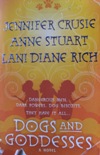
I picked up a passel of books at the VPL’s Spring Book Sale. Check it out. This was Thursday’s stack:

VPL Spring Book Sale

And this was Saturday’s stack:

VPL Spring Book Sale

Yes, I went twice! Why not? Novels were 55 cents! 55 cents, people! At that price, you can’t lose. Or can you…?

(insert ominous movie music here)

My first read was Dogs and Goddesses, a mass market pb that I picked up because Lani was one of the authors. Back in the day, Lani was also a member at the writing site where the original TCers met. Her first novel originated as a NaNo. I want to like her books!

But I’m not going to lie. This book was bad. I never thought I’d say this, but I paid too much for this book. I want my 55 cents back! j/k 😉

Lest you think that I just didn’t like it because this genre of book is just not my thing, do check out the Amazon One Star reviews. They’re like the nicest One Star reviews ever. Unlike the usual vitriol-filled one-star reviews, it’s pretty clear that these reviewers are fans of at least one of the three authors and the one star was given reluctantly.

Most of the reviewers seem to be more familiar with the other two authors (Jennifer Crusie & Anne Stuart). I haven’t read either of them. I have read Lani’s first book (the one that began as a NaNo): Time Off For Good Behavior. I didn’t really like it, but I attributed it to “not my thing.”

Dogs and Goddesses, otoh? Ahhhhh! I only finished it because I think it’s good to read something bad occasionally.You know, as a refresher course on what not to do. Bullet points of commentary:

  • Too many characters. Way, way too many characters! Names would pop up and I’d have no idea who they were. There were three protagonists (each one written by one of the 3 authors; reviewers who were more familiar with the authors said they could tell who wrote what, but the styles seemed indistinguishable to me), plus three love interests, plus the antagonist, plus the antagonist’s minion, plus three other secondary characters, plus several named tertiary characters, plus approximately 10 talking dogs.
  • Why is everyone yelling? I felt like the opening of the book was written in ALL-CAPS. It wasn’t. It just felt that way.
  • Similarly, what’s with the excessively irritable responses to fairly innocuous situations? I think it was supposed to be ramping up the tension. It didn’t work. (Damn it!)
  • Absolutely no getting to know the characters before they are tossed into the plot. I have no idea why I should care about these people. And I don’t.
  • I can’t tell the protagonists apart. I can’t tell the love interests apart. I can’t tell the secondary characters apart. These characters aren’t cardboard; they’re paper. Paper dolls with interchangeable outfits.
  • One character is named “Bun.” There’s no shortage of smart remarks in this book, but no one comments on this. Bun. Seriously.
  • I think this book is supposed to be funny. It’s not. The most amusing thing is the talking dogs.
  • We’re supposed to believe that these three sets of characters are in love. We know this because they keep saying “I love you/him/her!”
  • Their love is instigated by eating magic cookies. They eat so many cookies in this book that I start to feel like I’ve eaten an entire batch by myself: over-full and about to crash down from a sugar high. Blech.
  • There’s a scene where one of the characters paints a wall with a paintbrush (nooooo!). Also she dips the same brush into two different colors without rinsing in between (nooooo!). That is just so, so wrong.
  • WTF was up with those sex scenes? You’ve this silly, silly plot where people are running around scarfing cookies and listening to talking dogs and then all of a sudden we’re being told who’s sticking what body part where. Total discord.
  • What genre is this book supposed to be anyway? Is it Chick Lit (funny)? Romance (sexy)? Paranormal (scary)? I can’t figure it out.
Searing, disquieting honesty

Given how sympathetic [Jean] Thompson’s characters are, and how tenderly she cares for them, I found it puzzling that after a while, I was anticipating the epiphanic, redemptive plot turns with something closer to apprehension than to the relief and satisfaction I assumed I was meant to feel. … I kept putting down the book to ponder how the greatest writers, the Chekhovs and the Alice Munros, can make the quotidian seem transcendent, while others (not that Thompson is necessarily among these) merely remind us of the claustrophobia-inducing banality of the everyday.

Part of the trouble with “Do Not Deny Me” may be that the structure of these stories can seem more formulaic than organic. … Too often, she seems more interested in finding something with which the reader can safely identify … than in risking the searing, disquieting honesty that makes us (as we do, reading Munro) see and admit something secret and previously hidden about ourselves, our behavior and the world in which we live. It’s the reader, not the character, whose epiphany can make a story memorable.

Francine Prose

Toxic to Fiction

[Writer Cate Kennedy] considers the internet’s constant flow of unprocessed information and chatter ”toxic to fiction”, which requires quiet, slow reflection by writers and readers. ”We’re decontextualising, pasting bits of other people’s work on our blogs and creating unoriginal mash-ups,” she said.

Kennedy limits herself to checking emails twice a day and saves up her internet research as if for an occasional library excursion.

Susan Wyndham

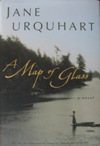
2: A Map of Glass

A Map of Glass by Jane Urquhart

I finished this a few days ago on March 26 and I’ve been trying to figure out what I want to say about it [nb: it was “a few days ago” when I started the post!]. I feel like my remarks are likely to make it sound like I feel more negatively about this book than I actually do. In a nutshell: A Map of Glass was a pleasant (perhaps I should say pleasurable), but unsatisfying, read. It was pleasant/pleasurable while I was reading because Jane Urquhart is a lovely writer at the sentence level. The story just sort of washes over you. It’s cozy and delicious. Like curling up with a blanket and hot tea—and a book, of course—on the sofa.

It’s so pleasant that the fact it’s also unsatisfying doesn’t really hit you until you’re done. Or it could be that you were just waiting till the end, expecting the story to pay off eventually, and then it didn’t happen. Instead, you had the only firm ground in the story pulled away at the last minute, leaving you wondering if the entire thing was an illusion, a fabrication, and if so, what was the point?

Before we continue, you need to know this: A Map of Glass is structured in three parts. The first and third parts are set in the present. The second part is set in the past (and is supposed to be the reading of a set of journals):

“Eventually [Sylvia] gives Jerome Andrew’s journals, which contain a fictionalised account of his family, going back four generations to the genesis of his great-great-grandfather’s timber empire.” –The Guardian

The main characters are Andrew, who dies in the opening scene and is the alleged author of the journals read in part two; Sylvia, Andrew’s alleged lover, wife of Malcolm (a doctor with a messiah complex), and sufferer of unnamed “condition” (seems like autism/Asperger’s but treated as if it’s more Mysterious than that); and Jerome, the artist who (I think I can leave out the allegedly here…) found Andrew’s body.

There are also a bunch of characters in part 2, the section read from the journals, but that’s not the part that concerns me. That part (the filling in the sandwich, if you will) seems to be a fairly straightforward story about Andrew’s ancestors, which a lot of reviewers/readers seem to have enjoyed as a “novella” in the middle of the novel:

“In fact, a problem with Glass is that the present feels less urgent than the past.” –Powell’s

But I’m more interested in what’s wrapped around it…

Part of the problem is this:

“A year later, the dead man’s lover arrives on the artist’s doorstep, aiming not to find out how he died but to explain who he was, how he had lived, how they had loved. … When we first meet Andrew, he has Alzheimer’s and his failure to remember who or what he loved, while pathetic (in the kinder sense of the word), makes it hard to warm to him. Sylvia talks about him, but he fails to come to life, remaining unknown, distant. He’s more of an idea.” –The Telegraph

I think I was waiting the whole book for Andrew to turn into a person, but he never does. He’s just a name. Which is frustrating, because he’s the core of the book: he is what brings Sylvia & Jerome together; it is his journals we are supposedly reading. Oddly, it is the opening scene where his mind is absent that he is most present. We never do find out what he saw in Sylvia or she in him. In the present day sections, this could, I suppose, be chalked up to Sylvia’s “condition,” but in the journals we also never do get the part of the Woodman family story that links Andrew to his father and the rest of the clan, or Andrew to Sylvia for that matter.

So this is where the story feels rather hollow to me. Still, up till the end, I was taking the core elements of the story as they were presented, i.e.: Sylvia did have an affair with Andrew, and Andrew did write the journals. And that this relationship and Andrew’s death, has pushed Sylvia out of her comfort zone—as posited in this review:

“Sylvia and Andrew’s hidden love, which prompts her to redefine her relationship with the world, suggests that her grief is the wellspring for a more deeply examined life.” –The Independent

And then… near the very end of the book, Malcolm says that Sylvia imagined the affair. Screech. Rewind. If true, what does this mean? Jerome found Andrew’s body. Sylvia read about it in the newspaper. Sylvia not only imagined an affair with Andrew, but wrote an entire family history for him. Is this plausible? An imagined affair would perhaps explain the sketchiness of the details regarding their relationship, but what about the family history? Is that something Sylvia would do? It’s hard to imagine her thinking so much about Andrew’s ancestors when she has such a tenuous relationship with people (and even herself). But then you remember she’s not only steeped in her own family history, but also she volunteers at the local museum and that was where she learned about the hotel buried in sand. Hrm. Then again, Malcolm is not exactly a reliable source. Dude clearly has an agenda (though it’s unclear what that is—having Sylvia’s condition named after him, perhaps).

Ultimately, I decided that I have to believe in Sylvia’s version of the events, if only because not to would negate what I think is the best line of the entire book, and that is when Sylvia explains to Jerome her realization that after calling off their relationship years prior, Andrew re-instigated it not for any romantic reason, because he had forgotten that it ever stopped.

In the end, though, it does not matter, just as it does not matter that although I believed that he had returned  because—miraculously—he wanted to begin again, he had really returned because he had forgotten that we had ever stopped.

O.M.G.

In retrospect, I think the parts dealing with Andrew losing his memory are the strength of A Map of Glass—and by extension, the linking of this personal/total loss of memory to the loss of knowledge/memories of one’s history/past—but I wonder about the choice of Sylvia as a filter, as well as the choice to call into question her reliability as a narrator.

More:

[ETA: I forgot to say where I got this book! I actually was at a loss at first; I couldn’t remember where I picked it up. But then I flipped back to the first page and saw the price marked in pencil. So, as it turns out, it was another used find from The Bookshop.]

Writers and Authors

[originally posted at Toasted Cheese]

I just saw that Stephenie Meyer has a new book coming out. It turns out to be a Twilight-tie-in book. And that’s when this occurred to me…

No doubt you’ve heard writers say something like “I write because I have to” or “even if I never get published (again), I wouldn’t stop writing.” IOW, writing, being a writer, is part of who they are, it’s something they have always done, and will always continue to do because they enjoy (or get something from) the process of writing as much as the finished product (and its associated rewards).

OTOH, you have people like Meyer, who had not written anything prior to the Twilight series. I’m highly doubtful that she’ll produce anything of note that’s not Twilight-related (although she may try). Part of this is being typecast, of course; nothing she does (JK Rowling has the same problem) is going to be able to match that first hit.

Of course, both Meyer and Rowling have enough money that they never have to write another word again, if they don’t want to. But if they’re writers at their core, we would have no doubt that they would continue writing regardless of the fact they’re now filthy rich or that readers aren’t interested in anything that isn’t Twilight/Harry Potter.

I guess what I’m trying to say is that maybe this good/bad writing argument we’ve been having is not really about good or bad writing. Maybe it’s about writers vs. authors. Everyone expects a stack of JD Salinger manuscripts to show up sooner or later because everyone thinks of Salinger as a writer. He could stop publishing, but no one believes that he could stop writing. OTOH, if you read Dan Brown’s Wikipedia entry, it’s pretty clear that while he’s an author, he’s not a writer per se. He just kept trying different things until one of them worked out for him—and it happened to be writing novels. It could just as easily have been music or acting or something else.

Is this making sense to anyone besides me?

A Framing Device

Memory is a dream machine. Nonfiction isn’t “true.” It’s a framing device to foreground contemplation, or at least it is in the nonfiction I love the most — nonfiction at the highest reaches of literary art. I want to redefine nonfiction upward — taking nonfiction’s limits and reframing them so that nonfiction can be a serious investigation of what’s “true,” what’s knowledge, what’s “fact,” what’s memory, what’s self, what’s other. I don’t want a nonfiction full of “lies.” I want a nonfiction that explores our shifting, unstable, multiform, evanescent experience in and of the world.

David Shields

The fact-fiction divide

[Philip] Roth … said he would discuss only his writing and would answer no questions about his personal life. Fine. Yet in Roth’s case, this created a major hurdle, because … he is an exceptionally brazen alchemist of the personal into the fictional. For that matter, so is his chief fictional alter ego, the Roth-like novelist Nathan Zuckerman — though both writers are prone to arguing the point.

I was supposed to be talking with Roth about the recently-issued third volume of his collected works. That volume included his 1974 novel My Life as a Man, an act of imagination in which a writer named Peter Tarnopol — whose spectacularly failed first marriage looks a great deal like Roth’s own — struggles to exorcise it. In the process, Tarnopol creates a character named Nathan Zuckerman, who writes his own variations on the marital train wreck. How, exactly, were we supposed to discuss this without getting personal?

I tried. It mostly didn’t work. Asked why he had used Tarnopol and Zuckerman to play with the fact-fiction divide, Roth objected to the question. “I’m not playing with it. I don’t care to play,” he said. “This man is trying to transform his experience into fiction. He imagines it once, he imagines it twice and says: ‘The hell with it, here’s the straight story.’ As simple as that.”

Not to me, unfortunately.

Bob Thompson

Extratextual Knowledge

That naming of a real intersection is a daring act and one that is controversial in Canadian publishing. Here is the issue: When situating fiction in your hometown, you risk relying on street names as a kind of shorthand, a code for those in the know who will immediately situate the characters and action in terms of social class and ambience. But that relies on what’s called extratextual knowledge on the part of the reader. I know Queen and Broadview as rather seedy, for example. I have done this rather lazily in my own fiction: I have mentioned Yorkville, a shopping district in Toronto, as shorthand for rich, which is a message lost to anyone who doesn’t know Toronto. I have had editors suggest I take out street names to make the city a less specific one: If you replace College Street with “a street of cafés near the large university” you sum up the atmosphere of the place in a way that’s accessible for a foreigner.

But then you also lose a certain amount of pride. Let’s be honest: We all know the primary reason for such erasures. It’s to make the book more saleable to Americans. We all want our books and films and TV shows to be published in the United States, and we know a large proportion of their entertainment-consuming population is not interested in looking beyond their borders.

Russell Smith

Ok, here’s the thing, Russell. “Queen and Broadview,” “Yorkville,” and “College Street” don’t mean anything to me, either. So, you know, when you do that sort of thing, you’re not just alienating Americans who are “not interested in looking beyond their borders,” you’re alienating everyone who lives outside the COTU*, including about 85% of Canadians. It’s pretty obnoxious to be aware that it’s a  “message lost to anyone who doesn’t know Toronto” but to then to label all people-who-don’t-know-Toronto as foreigners (and subsequently all foreigners as Americans).

Unless you’re writing for a TO-centric publication, don’t do this. Especially don’t do this in fiction. Go ahead, name the street. But don’t rely on the name. Give it context.

(This is a good illustration of why BC and Ontario often feel like two different countries!)

*Center of the Universe

Drunk, mad, sex-obsessed geniuses

“Why does the writing make us chase the writer? Why can’t we leave well enough alone? Why aren’t the books enough?” Julian Barnes poses these questions in Flaubert’s Parrot, his fictional biography of Gustave Flaubert. Perhaps, as readers, we enjoy the amateur detective work that literary biographies offer. We like to excavate the lives of famous authors and uncover the experiences that might have shaped their stories.

The problem is, writers’ lives don’t always make for great cinema. If writers are any good, it’s usually because they spend weeks alone, in a room, with a computer (or paper if they’re old-school).

Literary biopics usually cater to the fantasy that writers are drunk, mad, sex-obsessed geniuses inspired by the holy spirit (50% proof).

Evan Maloney