Tag Archives: Fiction

19: Skinny Dip

Skinny DipSkinny Dip by Carl Hiaasen

My rating: 3 of 5 stars

This one was a bday gift.

Read in August 2013.

View all my reviews

When the subject of ‘beach reads’ comes up (every summer; it’s a staple), inevitably there’s a disagreement about what sort of book a ‘beach read’ is. Although I’ve been known to read such light fare (haha) as Anna Karenina at the beach, Skinny Dip is the type of book I’d actually classify as a good beach read. It’s a light, entertaining story. Breezy, even.

The story begins with Chaz Perrone (Chaz! you just know you’re in for lols with that name) pushing his wife Joey off a cruise boat in the Florida Keys. Chaz is a biologist (bonus points!) who doesn’t like biology, but who does like being called doctor—“that’s Dr. Perrone.” Mmm, double bonus points for that. Who’s ever heard of a biologist who doesn’t like biology? It’s not something people typically just stumble into like, say, law 😉

Anyway, Joey survives her unplanned dive into the ocean and clings to a rogue bale of marijuana (more lols) until she is rescued by Mick, a former police officer who’s the caretaker of a private island in the Keys. And… I want that job. Owners of private islands: contact me. (I am serious.)

Together, Joey and Mick hatch a plan to get revenge on Chaz and figure out his motive. Joey, of course, is rich via inheritance (x2). First, her parents drove a plane into the ground by putting a bear (yes, a bear. grrr!) in the cockpit. Second, her first husband (Chaz is her second) was squashed by a falling skydiver. Cue more lols. But, according to Joey’s will, Chaz inherits nothing. It all goes to the World Wildlife Mission. (awww) So the question is, what is Chaz’s motive?

What follows is lots of Joey + Mick sneaking about messing with Chaz’s head. The plot isn’t difficult to figure out and it’s all explained anyhow—it’s not really a mystery so much as a comedy—but it’s funny and it sneaks some biology in, which I liked. As part of his job, Chaz collects water samples from the Everglades for testing, so you get to enjoy Chaz-the-biologist-who-hates-biology slogging through the swamp being grossed out. Biology is not for the squeamish! I also appreciated that the secondary characters played against stereotype.
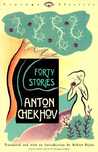
16: Forty Stories

Forty StoriesForty Stories by Anton Chekhov

My rating: 5 of 5 stars

Bought new (at Chapters).

Read in June 2013.

View all my reviews

I’ve read Chekhov stories before, but never a whole book of them. I picked this up a while ago; I don’t remember the exact impetus, but I’m going to guess that it was probably something I read whilst blog/twitter-grazing.

So it was sitting on my to-read shelf. Meanwhile, I read that Frank O’Connor book, with its offensive chapter on Katherine Mansfield, and The Sky is Falling, in which the narrator was obsessed with Chekhov. That was it. The time was right to read this. I’ve long wanted/planned to read more Chekhov because he’s always described as being a big influence on Katherine Mansfield, whose work I love.

Trivia: both Chekhov and Mansfield died young of tuberculosis. A cause of death I realize wasn’t unusual back in the day, but hey! thank science that same fate won’t befall you, present-day-writers!

The stories are arranged in chronological order, starting in 1880, when Chekhov was 20 years old—nice from a writer-reader standpoint because you can see how his writing progressed. A lot of the early stories are very short, flash fiction length. The later stories are longer, more developed. His early work tended toward punchlines (I’m not usually a fan of this style of short story, but some of these were ok. I liked “The Threat” :)), but got more subtle as he grew as a writer.

It includes the well-known stories, of course: “Death of a Government Clerk,” “The Huntsman,” “The Lady with the Pet Dog.”

Some of the other titles I made note of:

  • “Joy,” in which a young man gets mentioned in the newspaper for drunkenly falling under a horse. He’s thrilled because he thinks he’s famous. (This one just seems so… prescient, ya know?)
  • “Who is to blame?” in which a tormented kitchen kitten grows up to be a sleek outdoor cat… who’s afraid of mice.
  • “Sleepyhead,” in which a young nursemaid’s sleep-deprivation leads to tragedy.

I noticed he seemed to have a fondness for the name Pelageya. I looked it up and it means “open sea.” (doh! pelagic!) Cool name. I think I’ll steal it. Now I just need a character to give it to…

15: The Sky is Falling

The Sky Is FallingThe Sky Is Falling by Caroline Adderson

My rating: 4 of 5 stars

From the Fall 2012 VPL book sale.

Read in May/June 2013.

View all my reviews

This story takes place in two time periods: 1983-84 and 2004.

In 1983: Jane Z. is a second-year UBC student originally from Edmonton. She spent her first year living at her aunt’s in Burnaby, but now she wants to live closer to campus. She ends up moving into a communal house in Kitsilano. Her new housemates are Sonia, Pete, and Dieter. They are into peace and anarchy and protesting. They, esp. Sonia, think there is going to be a nuclear war and everyone is going to die.

I have to interject here and say this story totally reminded me why/how I spent my high school years thinking nuclear war was an inevitability. To the point I didn’t worry much about long-term consequences not because I thought I was invincible, but because I thought we were all going to be vaporized sooner or later. It’s weird, how this doesn’t get mentioned much, if at all, anymore. So when I started reading this book and realized that’s what it was about (in part), I was hooked. Well, that and the fact it’s set in Vancouver 😉

Jane is taking Russian and reading Chekhov*, so her housemates assume that she’s Russian (they’re in love with this idea, of course), but she’s actually not. She just had a professor in first year who encouraged her to continue on in his department, and in classic “I can’t decide what to major in” fashion, she floated into Slavic Studies.

In 2004: Jane is now 39. She’s married to Joe, who’s a doctor, and has a 15yo son, Joe Jr. She works as a freelance copy-editor.

One morning there is a story in the newspaper about Sonia being released from prison after serving a 20-year sentence for her part in an attempted bombing in 1984. This gets Jane thinking about the events of twenty years ago, although it turns out that she never really stopped thinking about them. Her whole life has basically been haunted and shaped by how she remembers what happened in the spring of 1984.

I don’t want to say any more about the plot, but I was impressed by how the ending of this one worked out. It felt like all the pieces fell into place but at the same time Adderson resisted tying up all the loose ends.

VPL Fall Book Sale

*Because of all the Chekhov discussion, I decided that would be my next read.

14: Room

RoomRoom by Emma Donoghue

My rating: 4 of 5 stars

From the fall 2012 VPL book sale.

Read in May 2013.

View all my reviews

Here’s one I probably don’t need to say much about. You’ve either read it or you’ve read about it. My question going in was “will it live up to the hype?” The answer: yes.

Jack, the narrator, is five years old. His mother, who he calls Ma, is 26. They live in a 12×12 room, which turns out to be a garden shed (spoiler? I think that horse has left the barn). Jack thinks Room is the whole world and everything else is “TV” (imaginary). Jack calls everything by proper nouns: Bed, Wardrobe, Door. This is partly because there is only one of each of these things in his world. But also, I wondered if it didn’t partly come from the children’s shows he likes to watch. For example, he’s a big fan of Dora, and Dora’s backpack is called Backpack.

Ma has managed to shelter Jack from the reality of their situation, but now that he’s five, he’s starting to ask questions. She decides to tell him the truth. Events start snowballing from there.

What I thought was particularly impressive about Room was the pacing. It starts off at an almost oppressive pace, detailing the minutia of a day in the room. But then just when you start to think “I’m not sure how much more this I can take” Donoghue shifts gears, and the story speeds up to an almost frenetic pace. Finally, she slows it down again, letting readers catch their breaths.

I know some readers didn’t like the story being told in Jack’s voice—they find kid-voices annoying or question the authenticity of his thoughts—but I think to tell this particular story, it had to be from his pov. If it were told from Ma’s pov, it would be a story we’ve heard before. We also have no trouble imagining how we’d feel if we were kidnapped/falsely imprisoned. So telling the story from Ma’s pov sets up a very different narrator/reader dynamic. Jack’s situation is outside the realm of our experience . Readers have to work harder to understand his perspective, not because he’s a child, but because we (with few exceptions) didn’t start off life like Jack did.

tl;dr: It is easy for us to empathize with Ma; we have to work to empathize with Jack.

And that’s why I think the last part, when Jack is suffering from sensory overload, when he wants to go back, is so important. This story is not about freedom, as it would be if it was told from Ma’s pov, but about adjustment. Jack has to adjust the entire framework of his life experience.

VPL Fall Book Sale

13: The Flying Troutmans

The Flying TroutmansThe Flying Troutmans by Miriam Toews

My rating: 4 of 5 stars

From the Spring 2011 VPL book sale.

Read in April 2013.

View all my reviews

Hattie Troutman was living in Paris with her boyfriend, but returns home to take care of her sister Min’s kids when Min has a psychotic break and is hospitalized. Hattie is 28; her nephew Logan is 15 and niece Thebes (short for Theodora) is 11.

Hattie is unsure about taking on this responsibility and decides to take the kids and go look for their father, Cherkis, who left years before. Which means… road trip! Yes, this is a road trip book. Love. Most of the story takes place on the road. Naturally, they have a crumbling van and stay at cheap motels in dusty towns populated by quirky characters.

They start in South Dakota, where Hattie knows Cherkis used to live. There, they get a lead that he moved to California, so they head off cross-country. On the way, they have adventures (of course).

I’m not sure when this is supposed to be set, but they drive across the border without showing ID and Hattie keeps making calls to the hospital to check on Min’s condition from pay phones, so I’ll assume back at least a decade (it was published in 2008).

I think I’ll stop here lest I say anything spoilery. I loved this book.

VPL Spring Book Sale

10: Cockroach

CockroachCockroach by Rawi Hage

My rating: 4 of 5 stars

From the fall 2012 VPL book sale.

Read in March 2013.

View all my reviews

The protagonist is an immigrant living in Quebec. He had a job at a restaurant as a dishwasher, then was promoted to busboy, but he quit when the maitre’d told him he was “too brown” to be a waiter. He’s now on welfare.

He tried to commit suicide by hanging himself from a tree, but the branch broke. He’s currently in court-ordered therapy with a psychiatrist, Genevieve. In his sessions with Genevieve, he talks about his past and his regrets, and these scenes foreshadow the book’s climax.

All of his friends/acquaintances are also immigrants, but they don’t share his background. Most of them, like his frenemy Reza and Shohreh, who he sort of has a relationship with, are Persian/Iranian, but he isn’t. His name and home country are never revealed. (‘Lira’ is mentioned, but this is a generic term, like ‘dollar.’) However, it’s possible he’s Lebanese, since Hage immigrated to Canada from Lebanon.

He imagines himself as a cockroach. This is partly a metaphor for how he sees himself (a low-life, a pest, but resilient), but also being a cockroach allows him to explore places he couldn’t as a human. One question for the reader to decide is how much of what he does as a cockroach is real and how much is imaginary.

He’s kind of an anti-hero. He’s not a ‘good’ person (yes, the dreaded unlikable character!), but I still empathized with him.

Cockroach is funny, in a dark humor / black comedy kind of way. In what comes as no surprise (at least to me!), there are drug-induced hallucinations. Note to self: if you have the urge to write an “I’m on drugs!” scene, just say no.

Also, it’s quite scatological. You’ve been warned!

VPL Fall Book Sale

8: Heave

HeaveHeave by Christy Ann Conlin

My rating: 3 of 5 stars

From the Fall 2012 VPL book sale.

Read in February/March 2013.

View all my reviews

Heave opens with Seraphina “Serrie” Sullivan running away from her wedding. This scene frames the story; the rest is told in flashback, starting from Serrie’s childhood.

I found the voice kind of hard to get into at the beginning. More drug-addled musings. Yep, it’s a theme.

At age 20, Serrie is in 3rd year university. She’s homesick (even though she’s only in Halifax, a short distance from home). Her bffs are Dearie and Elizabeth. Serrie is an alcoholic, like her dad, and has been since she was 14. She has a professor who’s kind to her, who notices she’s missing class, and tells her she should be thinking about grad school. Her brother Percy is doing an MA in Toronto (i.e. he’s perfect).

Serrie overdoses and ends up in the psychiatric hospital. She isn’t depressed; she’s young for her age. She doesn’t want to be an adult because it seems life gets worse the older you get.

Martha, Serrie’s mom, is depressed. She’s lamenting giving up her dreams and makes Serrie feel bad for being young / still having dreams. Cyril, Serrie’s dad, is oblivious. He’s too busy collecting outhouses. Yes, you read that right.

Anyway, when she gets out of the psych hospital, she gets a job in a pie factory (really!), where she meets Hans, this rich German dude.

You know how terrible things are always befalling certain people? And at first you’re like, “omg! that’s so awful!” but after the eleventy-billionth dramatic thing in a week/month/year, you’re like, “wtf dude, what’s with the constant drama? I haven’t had this much drama in my entire life!” Except you don’t actually say that because everyone would give you the side-eye and call you out for being mean and ostracize you even though they’re thinking the exact same thing. Well, that’s kind of what this book felt like. There was some good stuff here, but omg. Drama overload.

Well into the book there’s a big reveal, but it’s foreshadowed throughout. Watch for it!

I will say, with the framing device, most of the book in flashback, girl going crazy because she doesn’t want to grow up, this reminded me of The Language of the Goldfish. The difference being TLotG is a skinny novella, and Heave is a 300+ page epic.

VPL Fall Book Sale

6: Mean Boy

Mean BoyMean Boy by Lynn Coady

My rating: 4 of 5 stars

From the fall 2010 VPL book sale.

Read in January/February 2013.

View all my reviews

The protagonist of Mean Boy is Lawrence (formerly Larry) Campbell, age 19. He’s from Prince Edward Island and is attending Westcock University in New Brunswick. It’s 1975.

The title is ironic. On page 35, he says, “I am trying to be meaner these days…” The highlight of Lawrence’s university experience is the poetry class he’s taking with his hero, poet Jim Arsenault.

Lawrence uptalks, which distresses him. Jim calls him “Larry” which annoys him.

Jim has been denied tenure, much to Lawrence’s consternation (he would have gone to the University of Toronto if Jim hadn’t been at Westcock). He and some of the other students (Todd and Sherrie) in the poetry class decide to write a letter to the admin and get all the students to sign it. The petition feels like a transgressive act to Lawrence and Sherrie.

Meanwhile, there are student/prof drinking-parties at Jim’s house and a poetry reading by Dermot Schofield, Jim’s frenemy + fellow poet, which turns into a comedy of errors. Oh, an awesome subplot featuring Lawrence’s cousin Janet that turns out to be not what you think. Instead, Lawrence learns a lesson about distancing yourself from your family in order to be able to write about them.

In the end, everyone’s flaws are revealed.

I guessed that “Westcock” was actually Mount Allison and a quick search confirmed that supposition to be correct. And it turns out that the character of Jim Arsenault is based on real-life poet/Mount Allison prof John Thompson, which apparently cheesed off some people who knew him. Interesting.

I’ve read all of Lynn Coady’s books prior to this one (Strange Heaven, Play the Monster Blind, Saints of Big Harbour; her latest, The Antagonist, is on my shelf). I read Strange Heaven because it was lauded at the time, and while I thought it was good, I didn’t really get the upop. I had the same feeling with PtMB and SoBH. Good, but missing… something. imo. Obviously others thought they were perfect. But Mean Boy, Mean Boy I loved. The ending gets a little crazy (I can’t seem to escape drug-induced hazes in fiction of late) but I will forgive this because endings are hard.

More 55-cent Books

unwilling to write a mediocre page

I think George Saunders hasn’t written a novel because he’s too much of a prose perfectionist. Because he’s unwilling to write a mediocre page. Because he likes the control the short-story form gives him.

“A novel is a work of a certain length that is somehow flawed,” a wise critic once said — and as I was told during the first few weeks of my MFA program.

To write a novel, and see to it through from the first word to the 150,000th, you have to be willing to embrace the idea that every once in a while your prose is going to be, for lack of a better word, more prosaic than it would be otherwise. Why? Because to get a reader to make it through 150,000 words (the length of my last, and about the length of your average robust novel), you need this clunky, unattractive but very utilitarian thing called a plot.

Hector Tobar

2: The Rules of Gentility & 3: Jane Austen: Blood Persuasion

Janet Mullany was one of our original forum hosts at Toasted Cheese.

Janet’s writing at TC:

In the decade since she left TC, Janet has published more than a dozen books. Amazing right? I figured it was about time we at TC checked out her work, so I headed down to the library and picked up a couple books.

The Rules of GentilityThe Rules of Gentility by Janet Mullany

My rating: 3 of 5 stars

The first book I read was The Rules of Gentility, which was what I’d call a gentle parody of Regency (Jane Austen era) romances. She pokes fun at the conventions of the genre, but in a way that shows her genuine fondness for it. A Bridget Jones influence was apparent here as well, especially in protagonist Philomena’s penchant for making lists of potential husbands, making this a kind of a regency/chick-lit mash-up. Janet’s writing always showed her sense of humor and that was readily apparent here. The story, with its increasingly improbable situations, was at times hilarious. Recommended if you don’t take these things too seriously.

View all my reviews

Blood Persuasion (Immortal Jane Austen, #2)Blood Persuasion by Janet Mullany

My rating: 2 of 5 stars

This, as you may have guessed, was a Jane Austen/vampires mash-up (and a sequel to Jane and the Damned). The protagonist here is Jane Austen herself (age 35, an aged spinster), who harbors a secret: she’s not-quite-human. She used to be one of the Damned (see JatD), but she took ‘the Cure’ and now she’s caught midway between human and vampire. She’s busy being a respectable spinster when her vampire buddies reappear as the new tenants in her brother Edward’s mansion. Their presence pulls Jane back to the dark side, which she resists less because she’s worried about her soul and more because she’s worried about not being able to write (a problem when she was previously Damned). I didn’t like this as much as TRoG, but that’s definitely a matter of personal taste; vampires (werewolves, zombies, ghosts, etc.) are really not my thing. Recommended for fans of the romantic vampire genre.

View all my reviews