Tag Archives: Fiction

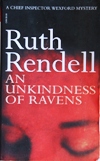
15: An Unkindness of Ravens

An Unkindness of Ravens by Ruth Rendell

Picked this up at the library book sale earlier this year.

This was my first Ruth Rendell writing as Ruth Rendell book, but I’ve previously read several of her Barbara Vine books: Grasshopper, The Chimney Sweeper’s Boy, Asta’s Book, and No Night is Too Long.

The Unkindness of Ravens was a standard police procedural, featuring a bunch of characters who are apparently regulars, including the main detective, Chief Inspector Wexford.  The Barbara Vine books are more dark, psychological thrillers. I think I prefer those, but this was an entertaining mystery nonetheless. I do love police procedurals.

Anyhow, the plot involves a husband who’s vanished (things aren’t what they seem… naturally!) and a group of militant feminists (really!). It was written in 1985, and a typewritten note / typewriter is one of the clues, so there was a somewhat amusing discussion of the idiosyncrasies of typewriters.

A bit of an aside, but that ties into something I was thinking about recently. You know how people always say technology immediately makes a book/movie feel “dated”? You know, in a pejorative way. I don’t think that’s always the case. I think 20-year-old books/movies that were set in present-day and used present-day technology (at the time) don’t feel “dated.” It’s more like… they feel like period pieces. The technology is right for the time period, so it doesn’t stand out particularly. Or, you notice it but in huh, I’d forgotten/didn’t know that kind of way. That’s how this book felt.

Where technology does end up feeling really dated is in books/movies that are supposed to be set in the future. Yeah, 20 years later, that’s almost always hysterical.

14: Peril Over the Airport

Peril Over the Airport by Helen Wells

Peril Over the Airport is part of the Vicki Barr, Flight Stewardess series. I saw it at the library book sale (not a library book) and picked it because I read a lot of these juvenile series as a kid, but I don’t think I ever read any Vicki Barrs. I did like Cherry Ames, though, which was a very similar series (same authors) except Cherry was a nurse.

So, anyway, when you think about it, these books are a little odd, because they’re obviously aimed at a pretty young audience but the main characters are in their 20s (at least) and they have jobs. I mean, can you imagine trying to pitch something like that today? “I have this story about a 23-year-old Starbucks barista. The target audience is 7-9 year-olds.” Somehow, I don’t think that would fly.

Anyhow, in POtA, the setup is that Vicki wants to learn to fly. A pilot she works with recommends she learn to fly from this nice WWII vet who has just happened to set up a small airport in her hometown. So she cuts back on her work schedule and goes home for the summer to take flying lessons. She does work some during the story, but those bits are skipped over, except for one incident where she runs into a character pertinent to the plot. I assume there’s more coverage of her stewardessing in other books in the series.

POtA was published in 1953, and at first I just assumed that was when it was set. Although, it was a little odd that everyone kept referring to Bill Avery as a “boy,” when he had to be closer to 30 than 20 (if it was 1953, and he was a veteran, the youngest he could be was 26, and given his war backstory, probably older). But, his sister appears later in the story, as a war widow with a 5-year-old son, so I think it was actually supposed to be set earlier (I do not think they were implying that she got pregnant after becoming a widow). It was kind of weird, because Wells makes obvious references to WWII, yet when it comes to dates, she very deliberately leaves them out. I mean, that’s typical for this sort of book, but it seems a little silly when you have a major historical event playing a large role in the story.

Wells frequently refers to planes as “ships.” I guess this is an abbreviation of “airship”? Either that, or it was considered cool to call planes ships at the time; maybe military slang?

Given the intended audience, the plot and the mystery to be solved are very basic. Vicki takes most of the book to solve a “code note” the solution of which is obvious on first glance. And the resolution  of the mystery is exactly what you’d expect. But in addition to the ostensible plot and mystery, there is lots of information on flying, both as a hobby (here’s how it works! you can do it too!) and as a career for women (no, women can’t be commercial airline pilots—yet! and yes, it does indeed say that—but they can do almost any other kind of flying! and you can too!). Despite the overtly feminist message, or rather, probably because of it, Vicki is otherwise depicted as being a very traditional female, e.g. she wants to wear high heels even when they are impractical, she’s obsessed with tidying up disorganized Bill’s office, she’s squicked out by dirt.

She’s also described as being tiny, and although it could be though of as just another way of feminizing the character, I liked it here because Wells got it right. Vicki complains of not being taken seriously, of people assuming she’s younger than she is, of the practical difficulties of being little—like not being able to able to reach the pedals, having to sit on a cushion, stuff like that. That was perfect. As a kid who was always stymied by height requirements, I would’ve loved to read about a short adult female who was doing cool stuff like flying in spite of being little.

13: Cinnamon Kiss

Cinnamon Kiss by Walter Mosley

Previously on The Remainder Table: I Heart You, Walter Mosley.

And… that is why you blog, folks. Well, at least one of the reasons.

So anyway, since then I’ve wanting/meaning to read some Walter Mosley. Hoping his writing of fiction would live up to his writing about the writing of fiction. Because, as you know, sometimes it doesn’t. But this time… it did.

Cinnamon Kiss is the 10th Easy Rawlins mystery, so I jumped into the series in medias res. It was ok, though. Even though the book did not have a huge “as you know, Bob” info-dump on the first few pages (thank you), enough info was sprinkled throughout to sort out the supporting characters and pick up the gist of the existing relationships. I do imagine knowing the full background of the characters would add further dimensions to the story, however.

So anyway, I really enjoyed Cinnamon Kiss. Sometimes I almost forget how much I like mystery fic (so much mediocrity out there…). And then something like this reminds me. Oh, yeah… But the best part about it may be that fans of the series think CK isn’t Mosley’s best work. So yay! If the rest of the series is even better, awesome. I have something (or 10 more somethings) to look forward to.

In CK, Easy’s daughter is sick and he needs to raise some money quick to pay for her treatment. He’s so desperate he considers pulling off a heist with his friend Mouse, but reconsiders when he gets a call from another friend, Saul, about a job for a mysterious detective in San Francisco.

The mystery was solid, although the final resolution was a little less than satisfying. And oh, sure, Easy’s a little too popular with the ladies. But it’s detective fic, so it’s already a bit o’ a fantasy to begin with, so I think that’s ok. The story’s setting and atmosphere were vivid and the characters intriguing, but I think Mosley’s real strength is dialogue. The dialect switches (depending on whom a character was speaking to) seemed absolutely effortless. I wonder if he teaches. He could totally give a lesson on dialogue how-to.

Also I do love that Easy is short for Ezekiel. Of course I do.

Some Reviews:

What adults read now

I think there’s a worry that if [literary fiction is] funny then perhaps there’s something slight about it. That it’s not as important as a deeply researched, earnest, historical novel, or a kind of humorless tale of contemporary life. I think there possibly was a moment in the ‘60s and ‘70s when the serious books tended to be pretty funny. I don’t know if that’s as true these days. … I think it’s being done, but it’s not as front and center, not as widely read as it used to be, fiction that does that sort of thing. Maybe it’s also linked to readerships, how they’ve changed over the years. Or maybe it all got eaten up by Harry Potter and Twilight. I think, more and more, that’s what adults read now. All the people we’ve talked about are people who write hilarious, heartwrenching, and often horrific fiction, and they wrote for grown-ups. Maybe there aren’t enough grownups who want to read that sort of thing anymore.

Sam Lipsyte

Everything into Products

I am not saying that it is a bad or dishonest thing to try to sell your work. It is not. What I am saying is that I am tired of the rush to commodify everything, to turn everything into products, including people. I don’t want a brand, because a brand limits me. A brand says I will churn out the same thing over and over. Which I won’t, because I am weird.

Maureen Johnson

Tune Her Out

[E]very time I spoke to my grandmother, she’d issue the same decree. Her voice now represented all of the voices questioning my right to depict China at all, preempting my every sentence, shrouding me in so much self-doubt that, many days, I censored myself. I couldn’t write a word.

In order to write, I needed to tune her out. I needed to remind myself that it’s the duty of novelists to write past polemics, to show complexity and humanity everywhere we look. That the crucial voices were those of my characters[.]

Deanna Fei

Characters aren’t your friends

I really irks me when people critique a book or a movie on the basis of “unlikeable characters” or characters who take morally questionable or reprehensible actions, which is like saying you didn’t like The Poseidon Adventure because the ship wasn’t seaworthy. When you read a book you’re not supposed to evaluate the characters as people, like you’re deciding whether or not to hire them or be friends with them. Characters aren’t your friends and they don’t have to be role models.

Elisa Gabbert