
[S]ome of my favourite bloggers are mothers and write about their mothering experiences, among other things … And what unites the blogger/mothers that I do read and enjoy is, for the most part, how they engage with motherhood and with the wider world at the same time.
This is what I’m looking for in books about motherhood as well … How motherhood can be addressed in literature so as not to alienate anyone who isn’t a mom. And to understand why mothers are so reviled, in real life, on the internet, in general. Because they are a bit, and that’s a funny thing.
Tag Archives: Literature
Private Stuff
Early in the novel “When You Reach Me,” which last week won the John Newbery Medal for the most outstanding contribution to children’s literature, the narrator, Miranda, falls into an uncomfortable conversation with a schoolmate about her favorite book, “A Wrinkle in Time” by Madeleine L’Engle.
Miranda, who is 11, doesn’t want to have the discussion. “The truth is that I hate to think about other people reading my book,” she thinks. “It’s like watching someone go through the box of private stuff that I keep under my bed.”
Dandelion Child
A Swedish idiomatic expression, maskrosbarn (dandelion child), refers to the capacity of some children, not unlike those with low reactive phenotypes, to survive and even thrive in whatever circumstances they encounter, in much the same way that dandelions seem to prosper irrespective of soil, sun, drought, or rain. Observations of such children have generated, for example, an extensive developmental literature on the phenomenon of resilience, the capacity for positive adaptation despite experiences of significant adversity. A contrasting Swedish neologism, orkidebarn (orchid child), might better describe the context-sensitive individual, whose survival and flourishing is intimately tied, like that of the orchid, to the nurturant or neglectful character of the ambient environment. In conditions of neglect, the orchid promptly declines, while in conditions of support and nurture, it is a flower of unusual delicacy and beauty.
—W. Thomas Boyce & Bruce J. Ellis
via “The Science of Success“
8 & 9: Jack & Reading In
Jack: A Life with Writers by James King

Jack is a biography of Jack McClelland, who ran McClelland & Stewart (Canadian publisher that his father founded) for many years (1950s – 80s). McClelland championed Canadian literature and started the New Canadian Library series. As biographies go, this is a pretty entertaining one. You learn (if you didn’t already know!) how close to bankruptcy publishing firms have always operated as well as all sorts of gossip about famous Canadian writers. Be prepared for the usual sexism of the era.
Reading In: Alice Munro’s Archives by JoAnn McCaig
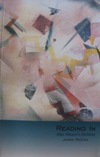
Reading In is an exploration of Alice Munro’s archives, that is, the papers (primarily business letters) she has donated to the University of Calgary. It’s based on McCaig’s PhD dissertation. Here’s the fascinating part: Prior to publishing the book, McCaig published an article based on her research. Munro (& others) gave their permission for letters to be quoted in the article, however Munro was displeased with the article and subsequently denied McCaig permission to further quote or paraphrase her letters. This means that the book is a truncated version of what McCaig originally intended it to be.
Bizarre, right? Why would a university pay an author for her papers but not make her sign a standard agreement giving researchers permission to quote from the materials as necessary? Don’t universities do this? If they don’t, what’s the purpose of buying this stuff then? In any case, copyright issues with quoting aside, I really don’t see how legally Munro could deny McCaig permission to paraphrase the letters she donated to a university library. It’s like how there is no expectation of privacy with respect to stuff you put in the garbage. She can’t have an expectation of privacy with respect to stuff the public can access.
Reading In had an interesting premise, but I had difficulty with some of the conclusions that McCaig came to. As noted above, Munro only donated her business correspondence. Because the collection is an incomplete record, I think it’s difficult to draw any overarching conclusions about a correspondence or the relationship it documents. Munro obviously kept her personal correspondence (which may include some letters from people she also exchanged business letters with) and there’s also evidence that she likely retained letters that contained editorial suggestions. And of course there’s no record of conversations that took place on the phone or in person (which would seem pertinent when you’re talking about the nature of a relationship). So, ultimately, I’m thinking that perhaps the more valuable discoveries to be made in such an archive will be smaller—more contained—findings that rely less on assumptions.
Writing for Nonreaders in the Postprint Era
Maybe this is what I should take this summer…
Course Description
As print takes its place alongside smoke signals, cuneiform, and hollering, there has emerged a new literary age, one in which writers no longer need to feel encumbered by the paper cuts, reading, and excessive use of words traditionally associated with the writing trade. Writing for Nonreaders in the Postprint Era focuses on the creation of short-form prose that is not intended to be reproduced on pulp fibers.
Hmm, let’s see… Do I have the prereqs?
Prerequisites
Students must have completed at least two of the following.
ENG: 232WR—Advanced Tweeting: The Elements of Droll
LIT: 223—Early-21st-Century Literature: 140 Characters or Less
ENG: 102—Staring Blankly at Handheld Devices While Others Are Talking
ENG: 301—Advanced Blog and Book Skimming
ENG: 231WR—Facebook Wall Alliteration and Assonance
LIT: 202—The Literary Merits of Lolcats
LIT: 209—Internet-Age Surrealistic Narcissism and Self-Absorption
Ooh! Looks like I just squeak in there on the merits of Lit223 and Eng301! (Too bad I failed Eng231WR for not showing up to class. ;-))
2: The Mysteries of Pittsburgh
The Mysteries of Pittsburgh by Michael Chabon

Ok, so I really like the movie Wonder Boys. Wonder Boys the movie is based on a book written by Michael Chabon.
At the time I first saw the movie, that name meant nothing to me, but a few years back, I stumbled across a short-lived blog written by Ayelet Waldman (Bad Mother). I’d never heard of her before that, either, but the blog was funny. Anyhow… somewhere in there I learned that she was married to Michael Chabon, who was supposedly a Great Writer. O rly? So I guess I Wikipediaed him or something and made the Wonder Boys connection.
Fast-forward to one of our annual pilgrimages to The Book Shop in Penticton, and I spot The Mysteries of Pittsburgh by Michael Chabon. It’s not Wonder Boys, but I decide to give it a shot. Especially since one of the cover blurbs compares it to The Catcher in the Rye. O rly? How come I’ve never heard of it then? And why is everything compared to TCitR?
Aside: Honestly, sometimes I feel like I’m living on another planet literature-wise. I’ve read a lot of books, a great many of which would be classified as literature, and yet… too frequently the litblogosphere will be fussing all over someone and I’ll be all “who?” (David Foster Wallace) or “obviously I know who he is, but I’ve never read him—am I the only one?” (John Updike). I’m starting to think maybe I have a (perhaps deliberate) blind spot for white male American literary authors with a certain pedigree: the kind of dudes who used to have BAs from Ivy League schools, professorships in English departments, wear tweed jackets with suede elbow patches and smoke pipes and now have MFAs from Ivy League schools, professorships in creative writing departments, wear black T-shirts and well-worn jeans and smoke well, you know.
So anyway… Michael Chabon. The Mysteries of Pittsburgh. Well, first of all, apparently he wrote this when he was 24, so props to him. When I was 24… well, actually 24 was a pretty good year for me. But I didn’t write a novel.
I actually found TMoP pretty entertaining, but not realistic. at. all. It’s about this dude (Art) who’s on the verge of graduating from university and works at a bookstore having a bit o’ an existential crisis. His friends/romantic interests are all quirky oddballs (of course). So far pretty standard early-twenties stuff. Except then it goes all Sopranos. Yes, his dad is a noted mobster. And one of his friends is a low-level enforcer. It displeases dear ol’ dad that he’s associating with such a lowlife. Etcetera. So it ends up kind of surreal. Which may or may not float your boat, but there it is.
As for the comparisons to CitR… I didn’t really find this to be a coming-of-age story so much as an “ordinary person in improbable situation” story. Like Nancy Botwin in Weeds. Except not as deep and with less-interesting characters (esp. the female ones).
In conclusion, I’m not buying the Literary God rhetoric, but I still want to read Wonder Boys.
22: Man Walks into a Room
Man Walks into a Room by Nicole Krauss

Sneaking in one last book for 2007. Appropriately, it is actually a remainder table find 🙂
Man Walks into a Room is Nicole Krauss’s first (or debut, as the literati like to say) novel. Krauss is married Jonathan Safran Foer. Foer is, aykb, a literary darling. I haven’t read any of his work (though I might have to now) because having read MWiaR, I have to wonder why he gets all the attention.
Loved this book.
One of the dust jacket blurbs says, “Man Walks into a Room is that rare thing: an evocative, finely written first novel that is a true work of fiction.” —A.M. Homes. (In that respect, it reminded me of Eden and her first novel, which she really needs to find a publisher for!)
Samson Greene is a 36-year-old literature professor with a wife and a life in New York city until the removal of a benign brain tumor causes him to lose the last 24 years of his memory. MWiaR is about his reaction to that loss, but it is also an exploration of mind and memory, loneliness and intimacy:
…then and there it occurred to him that maybe the emptiness he’d been living with all this time hadn’t really been emptiness at all, but loneliness gone unrecognized. How can a mind know how alone it is until brushes up against some other mind? A single mark had been made, another person’s memory imposed onto his mind, and now the magnitude of his own loss was impossible for Samson to ignore. (pp. 192-193)
Near the end of the book, there was a riff on WASPy nicknames like Pip and Chip and Kick. Would’ve been a throwaway bit, except one of the names was Apple. Had to check the dates to see if she was poking fun at Gwyneth Paltrow, but no, Gwyneth’s daughter wasn’t born until 2004. I guess she was just prescient 😉
Some links:
- Excerpt from prologue and chapter 1.
- Review at the Village Voice (from May 2002).
- Review at the San Francisco Chronicle (from June 2002).
- “The Last Words on Earth” (short story), the New Yorker, February 2004
- Interview at Small Spiral Notebook. (November 2007)
11: The Moon is Always Female
The Moon is Always Female by Marge Piercy
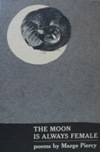
Ack. I actually finished reading this ages ago. It’s been sitting on my desk looking at me for most of the summer, as a reminder to write a post about it. Meanwhile, I’ve been otherwise occupied reading books for my directed reading course (and by extension, my thesis). But that project is nearing completion, and it’s time for some just-for-fun reading to finish off the summer. Before starting something new, here are my two cents on The Moon is Always Female.
Marge Piercy is one of the poets I first came into contact with when reading The Norton Introduction to Literature when undoubtedly I should have been doing something else. Like reading that Poli Sci textbook I never realized I owned until an hour before the final exam. (The fact that I read the TNITL for fun should in itself have been a strong indication that I should have majored in English, but I was too busy cutting off my nose to spite my face at the time to realize this.) The poem was “To have without holding.” The first stanza (p. 40):
Learning to love differently is hard,
love with the hands wide open, love
with the doors banging on their hinges,
the cupboard unlocked, the wind
roaring and whimpering in the rooms
rustling the sheets and snapping the blinds
that thwack like rubber bands
in an open palm.
Heh. I just noticed the first comment under “Most Helpful Customer Reviews” at Amazon is from my close personal friend Eden. How apropos, since I picked this up when I saw it at my favorite used bookstore last summer because of the many times she’s mentioned it. Let’s see what she had to say:
Piercy’s poems in this collection touch my every emotion. They make me laugh, cry, consider, ache, scream and everything in the spaces between. I “had” to read this for a contemporary lit course in college over ten years ago. Problem was, I couldn’t stop reading it. It was the first book I couldn’t bring myself to sell back. It’s exceptional, from the words on the pages to the typeface itself. Favorite include: “For the young who want to” “For strong women” “Poetry festival lover” and of course “The moon is always female.” After reading it, you will feel like you know Piercy. And you will also better know yourself.
Hmm, thanks for doing my work for me, E! I’d also add that it’s the kind of collection that it’s nice to leave out where you can pick it up and randomly re-read a poem or two when the mood strikes you. “For the young who want to” is one of my favorite poems (by any poet) and I never tire of re-reading it. The last stanza (p. 85):
The real writer is one
who really writes. Talent
is an invention like phlogiston
after the fact of fire.
Work is its own cure. You have to
like it better than being loved.
In which I find out that I'm not a real person
It makes my head hurt, both that there are people who write who don’t know what literary fiction (otherwise known as plain old literature) is and also that literary fiction is continually disparaged as being something that “real” people don’t read.
*sigh*
Which literature classic are you?
So I’ve actually read this! It’s even on my bookshelf. Which I suppose means the result is somewhat accurate…
Virginia Woolf: Orlando. You are a challenge, for
outer events, the outside world, the time
etc. play no importance to you. Your focus is
in writing, in gender issues, and inside your
own head. Self-analysis and exploration of
yourself as well as the outer world hold
great importance to you.Which literature classic are you?
brought to you by Quizilla

 The Remainder Table