
[C]reative nonfiction writers do not make things up; they make ideas and information that already exist more interesting and, often, more accessible.
…
In creative nonfiction, writers can be poetic and journalistic simultaneously. Creative nonfiction writers are encouraged to utilize literary and even cinematic techniques, from scene to dialogue to description to point of view, to write about themselves and others, capturing real people and real life in ways that can and have changed the world. What is most important and enjoyable about creative nonfiction is that it not only allows but also encourages the writer to become a part of the story or essay being written. The personal involvement creates a special magic that alleviates the suffering and anxiety of the writing experience; it provides many outlets for satisfaction and self-discovery, flexibility and freedom.
Tag Archives: Poetry
The Effect of Form
There is only one rule in writing a memoir, but it’s an important one: You can’t intentionally lie. This one rule has the effect of form on poetry, setting up a challenge that often forces creativity and makes the work more powerful than free verse.
The thought of himself in a hat
[I]f you ask a 21-year-old poet whose poetry he likes, he might say, unblushing, ”Nobody’s.” He has not yet understood that poets like poetry, and novelists like novels; he himself likes only the role, the thought of himself in a hat.
All facade, no scaffold.
Why don’t poems have more ideas? So many poems I read are essentially just descriptions. So you went outside. It was beautiful. Or not. I don’t care how creatively you describe it, if it didn’t trigger any thoughts beyond “Hells yeah I am going to describe this,” it’s not a poem. … Lots of poems I read in the slush, if you took out the description, there’d be nothing left. All facade, no scaffold.
Poetic Drunkenness
The writer who cares more about words than about story (characters, action, setting, atmosphere) is unlikely to create a vivid and continuous dream; he gets in his own way too much; in his poetic drunkenness, he can’t tell the cart—and its cargo—from the horse.
—John Gardner, On Becoming a Novelist, p. 6
5: Legends of Vancouver
Legends of Vancouver by E. Pauline Johnson (Tekahionwake)
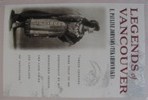
Pauline Johnson was from Six Nations in Ontario (her father was a Mohawk chief). After a career performing her poetry on stage, she ended up in Vancouver. The legends (with one exception) are Squamish and were told to Johnson by Chief Joe Capilano (also with a few exceptions). Most of the stories consist of a present-day (her time, of course; about 100 years ago now) framework where Johnson sets herself up as a listener, followed by the legend. At the end of legend, she brings the reader back to the present with a closing thought.
Johnson was clearly a gifted storyteller, and I think a good part of the reason people continue to find the stories so compelling is the way she tells them. However, I think the way the stories came about and are credited brings up some interesting questions/issues with respect to written vs. oral storytelling, as well as the weight we place on the importance of the book. None of the oral storytellers are given co-author credit, and while Joe Capilano is at least mentioned by name, some of the stories are told to Johnson by a woman (or women? it’s unclear whether it’s the same woman or different ones) who isn’t identified. Of note:
- The legends included in the book are actually just a few of the ones Johnson wrote up; many more were published in newspapers/magazines. One early version of the book includes three additional legends.
- In some cases, the person who Johnson attributes the story to changes from the original periodical version to the one published in the book.
- The book was compiled by a group of Vancouverites in order to raise money to provide for Johnson when she was dying. It’s unclear who chose the stories or what order they would appear in.
Johnson is always respectful of the oral storytellers, and, of course, legends are meant to be shaped and adapted with each re-telling, but it does make you think about what responsibilities a person has when they put someone else’s story into print. Print solidifies things, especially when it’s in book form. We like books in part because they’re finite and it’s possible to get a grasp on the whole thing. Thus, book versions end up being thought of as definitive, which may or may not be true, and may or may not be a good thing.
(I think this can be related to the blog to book trend. It’s hard/impossible to to feel like you’ve finished reading a blog in its entirety; even if you’re an avid long-term reader, it’s unlikely you read every comment or follow every link. Hence, the book. The book cuts out all the tangents and turns the blog into a comfortable narrative that allows the reader the satisfaction of reaching the last page and closing the book.)
Links:
- Pauline Johnson ebooks @ Project Gutenberg.
- Miss604 on Pauline
- Johnson’s Wikipedia entry
- Pauline Johnson Archive @ McMaster University
4: Roughing It in the Bush
Roughing It in the Bush by Susanna Moodie

Roughing It in the Bush is often cited as an early Canadian classic. At the same time, its Canadian-ness has also been questioned. For one thing, Moodie started writing about Upper Canada (now Ontario) in the 1830s, thirty-plus years before confederation (so maybe it’s not an early Canadian book, but a late British North American colonial book). As well, Susanna Moodie was an immigrant who wrote about her experiences from that perspective (so maybe she should be thought of as an English ex-pat writer, not a Canadian writer). Of course, “what does it mean to be Canadian?” is the quintessential Canadian-dilemma, so I think she qualifies on that count 😉 Really, I think she can be thought of as either—or both. Just depends on what you’re looking for.
Roughing It is an account of the middle-class Moodies’ first years in North America. Susanna and her husband John were woefully unprepared for life in the “bush,” which made for lots of good material for Susanna to write about. Although it’s supposed to be non-fiction, it seems pretty clear that the character “Susanna Moodie” is a lot ditzier than the writer Susanna Moodie was, i.e. that the stories were embellished to make them more funny and entertaining. While the writer Susanna Moodie was writing by candlelight and sending her stories and poems to magazines and newspapers (when she could afford stamps), the character “Susanna Moodie” was busy acting clueless and getting into scrapes to provide fresh material.
Which… you know… sounds a lot like a present-day memoir! Actually, my immediate reaction after I finished reading the book was that if Moodie were around today she’d be a blogger. Think about it: the book is a collection of anecdotes and poems and other ephemera, with the occasional chapter contributed by her husband or brother (guest posts!). Throw in a fish-out-of-water scenario, add a dash of hyperbole and a pinch of drama, and voila! Recipe for a successful personal blog. And of course, she was a mother, so you might even call her the first Canadian mommyblogger 😉
Links:
- Susanna Moodie ebooks @ Project Gutenberg
- Susanna Moodie’s Wikipedia entry
- Susanna Moodie archive @ Trent University
3: Swann
Swann by Carol Shields

A few years back I read Shields’s short story compilation Dressing Up for the Carnival (I guess before I started these book posts). It was definitely a remainder table book; I remember picking it up because I kept hearing about Shields, but had never read anything of hers. Maybe I wasn’t sure if I’d like her writing or not?
Here’s the title story in Dressing Up for the Carnival and some reviews (January Magazine and The New York Times).
Anyhow, it turned out I liked Dressing Up for the Carnival more than I expected, so I picked up The Stone Diaries, her Governor General’s Award and Pulitzer Prize-winning novel, on a used-bookstore excursion. It’s still on my to-be-read shelf, but…
I took an English course this summer and the first thing we read was Swann (sometimes titled Swann: A Mystery). Swann is about farmwife Mary Swann and how she is “discovered” and turned into a minor poet worthy of academic analysis. Despite the sometimes-subtitle, Swann is more wry and cutting than mysterious. (There is a mystery, but it’s a rather transparent one.) Although it’s a novel, it’s really a critique of the literary and academic publishing worlds. The book is also kind of experimental—each section is told in a different way. The first section is most novelistic; the final section is written like it’s a screenplay. I think the execution may turn people off (as in this reader review), but I think the choices Shields made were very deliberate and it’s interesting to consider why she made them. Anyhow, I thought Swann was funny (and true), but I’m not sure I would have appreciated it as much if I wasn’t an insider, so to speak. Here’s an excerpt.
More links:
- Shields’s Wikipedia entry.
- Shields’s obituary.
AB Article
I have another new Absolute Blank article at TC: Poetry 202: Sight and Sound. It’s a follow-up to Poetry 101: Getting Started.
Didn’t plan to do another so soon, but we had an opening that needed to be filled… and now back to our regularly scheduled programming (a.k.a. thesis-writing).
17: Skin Divers
Skin Divers by Anne Michaels
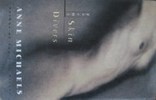
Anne Michaels’s The Weight of Oranges / Miner’s Pond is probably my favorite poetry collection (really two collections in one volume) of all time. Maybe because so many of the poems are about rain.
From “Rain Makes Its Own Night” (The Weight of Oranges):
Rain makes its own night, long mornings with the lamps left on.
Lean beach grass sticks to the floor near your shoes,
last summer’s pollen rises from damp metal screens.This is order, this clutter that fills clearings between us,
clothes clinging to chairs, your shoes in a muddy grip.
Mmm. Anyhow, Skin Divers is her third volume of poetry. This was another used bookstore find. A few weeks ago, feeling the need for a poetry fix, I plucked it off the To Read shelf and read it all in one sitting. It’s a slim volume, as they say—only 68 pages including the acknowledgments—so this was not a great feat. But… I always feel a little guilty reading a book so fast when I know how long it probably took to write it. (And that feeling is not helped by the quote on the back cover of the dust jacket which closes: “This is a book to be grateful for, to read, and be read by, slowly.”) !!! Way to pour on the guilt, Don McKay 😉 I’ll try to make up for speed with re-readings.
When I’m evaluating poetry, the most important thing for me is that it sound right. It should have rhythm. It should flow. If it sounds right, it doesn’t have to be logical. It’s poetry. So much of the “poetry” we receive at TC is clunky and prosaic. Inserting random line breaks does not turn prose into poetry. (This is what happens when people write poetry, but don’t read it, methinks. But that’s a rant for another day.)
Michaels’s poetry sounds right. It’s… deceptively simple. Some lines you might think: I (or anyone) could have written that. And then you read it again and think: wow, that’s amazing.
From “Skin Divers”:
Like the moon, I want to touch places
just by looking. To tell
new things at three in the morning, when we’re
awake with rain or any sadness, or slendering through
reeds of sleep, surfacing to skin. In this room
where so much has happened, where love
is the clink of buttons as your shirt slides
to the floor, the rolling sound of loose change;
a book half open, clothes
half open. Again we feel
how transparent the envelope
of the body, pushed through the door
of the world.
Oh, hey. Rain again 🙂
 The Remainder Table