Tag Archives: Poetry

11: The Moon is Always Female

The Moon is Always Female by Marge Piercy
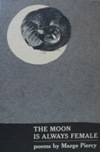
The Moon is Always Female

Ack. I actually finished reading this ages ago. It’s been sitting on my desk looking at me for most of the summer, as a reminder to write a post about it. Meanwhile, I’ve been otherwise occupied reading books for my directed reading course (and by extension, my thesis). But that project is nearing completion, and it’s time for some just-for-fun reading to finish off the summer. Before starting something new, here are my two cents on The Moon is Always Female.

Marge Piercy is one of the poets I first came into contact with when reading The Norton Introduction to Literature when undoubtedly I should have been doing something else. Like reading that Poli Sci textbook I never realized I owned until an hour before the final exam. (The fact that I read the TNITL for fun should in itself have been a strong indication that I should have majored in English, but I was too busy cutting off my nose to spite my face at the time to realize this.) The poem was “To have without holding.” The first stanza (p. 40):

Learning to love differently is hard,
love with the hands wide open, love
with the doors banging on their hinges,
the cupboard unlocked, the wind
roaring and whimpering in the rooms
rustling the sheets and snapping the blinds
that thwack like rubber bands
in an open palm.

Heh. I just noticed the first comment under “Most Helpful Customer Reviews” at Amazon is from my close personal friend Eden. How apropos, since I picked this up when I saw it at my favorite used bookstore last summer because of the many times she’s mentioned it. Let’s see what she had to say:

Piercy’s poems in this collection touch my every emotion. They make me laugh, cry, consider, ache, scream and everything in the spaces between. I “had” to read this for a contemporary lit course in college over ten years ago. Problem was, I couldn’t stop reading it. It was the first book I couldn’t bring myself to sell back. It’s exceptional, from the words on the pages to the typeface itself. Favorite include: “For the young who want to” “For strong women” “Poetry festival lover” and of course “The moon is always female.” After reading it, you will feel like you know Piercy. And you will also better know yourself.

Hmm, thanks for doing my work for me, E! I’d also add that it’s the kind of collection that it’s nice to leave out where you can pick it up and randomly re-read a poem or two when the mood strikes you. “For the young who want to” is one of my favorite poems (by any poet) and I never tire of re-reading it. The last stanza (p. 85):

The real writer is one
who really writes. Talent
is an invention like phlogiston
after the fact of fire.
Work is its own cure. You have to
like it better than being loved.

9: Contemporary Verse 2 (Winter 2005)

Contemporary Verse 2: The Canadian Journal of Poetry and Critical Writing, 27.3 (Winter 2005) “The Poetics of Space: Where Poetry Lives”*

CV 2 (Winter 2005)

*I realize an issue of CV2 is not actually a book.

This is another thing I picked up at the VPL book sale last fall. CV2 is exclusively a poetry journal. The first part of the issue is interviews with several poets. Each interview is followed by poems by that author. The remainder of the issue is miscellaneous poems.

The interview format is interesting and I think gives the journal a more general appeal, i.e. anyone interested in the writing process might enjoy the interviews. It’s like a poetry lesson in a way since the interview is followed by a selection of the poems that have been discussed.

My favorite of the interviewees’ poems were Fiona Tinwei Lam’s. Her selections were from Intimate Distances. (Love that title.)

From “beach” (p. 59):

I try to tempt you there with castles carefully
tipped out of plastic buckets,
festoon the grainy cakes with twigs and pebbles—
but you topple them all
then trudge away.

I also liked Julia McCarthy’s prose poem, “Out of the Ordinary,” which starts:

Everyday I pray for boredom, for nothing to happen. I want a dull life as though underwater, but even there things are sharper and the greenery, sublime. (p. 70)

This was one of the journals that really impressed me back in the day. Reading this issue now, it made me happy to realize that the poetry we publish in TC is just as good as much of the work here.

Random fact: Dorothy Livesay, the founder of CV2, lived at the long-term care facility where I worked for a time. I was enough of a creative writing nerd to be thrilled by being in her presence. Every time I saw her I was like, “Squee! Dorothy Livesay!” I don’t know if anyone else knew who she was.

5: Reasons for Moving

Reasons for Moving (manuscript) by Stephanie Eden Lenz

Reasons forย Moving

This is the second novel my close personal friend* and co-editor Eden has completed.

She finished her first novel, Whited Sepulchers, in July 2000 (that date makes me =-O). She started RFM shortly thereafter and she was also shopping WS around for a while, but then she had two kids and the books went on the backburner.

Lately she’s been re-editing WS in preparation for sending it out again. In January, she picked up RFM and finished the first draft in 16 days. 60+k in just over two weeks. Bravo! It’s so good to see her writing fiction again. She’s going to write an editorial about the experience for the March issue of TC.

I need to re-read WS (it’s on my List), but from what I recall, RFM is very different in content and style.

RFM is set in the early ’90s in a college town in Pennsylvania. The narrator, Seth, who is 20 at the time of the story, was an abused child who left home after a traumatic event some three years earlier. Since then, he’s been hitchhiking around the country and doing what he has to to get by. He winds up on this college campus and, finding he blends in with the students, starts following them to classes. It’s winter and basically he’s looking for a warm place to hang out. He ends up following a girl to a small poetry writing seminar where the instructor spots him before he can escape. Soon he’s writing poetry, rooming with the classmate he followed that first day, and perhaps most surprisingly, setting down some roots. Through both the poetry and the personal connections he makes, he finally starts to work through his traumatic past, stop the destructive cycle he’s been on since he left home, and begins to look toward the future for the first time in his life.

*Is that phrase trademarked yet? ๐Ÿ˜‰

Another Silly Quiz

Ottava rima? Hrm, can’t say I’m familiar. But I guess any result that includes the phrase “gleeful spite” is all right by me ๐Ÿ˜‰

Ottava rima? Me? That can’t be right!
Too frivolous? But tut, there’s no such thing!
Let others ponder thoughts of wrong and right,
Or sit and think how much they love the spring;
I’d rather spend my time in gleeful spite,
Or maybe laugh, or maybe sit and sing.
Besides, it might be fun to be inspiring –
But surely it would get so very tiring.

What Poetry Form Are You?

Apparently, if I wasn’t an ottava rima, I’d be a sonnet:

I am the sonnet, never quickly thrilled;
Not prone to overstated gushing praise
Nor yet to seething rants and anger, filled
With overstretched opinions to rephrase;
But on the other hand, not fond of fools,
And thus, not fond of people, on the whole;
And holding to the sound and useful rules,
Not those that seek unjustified control.
I’m balanced, measured, sensible (at least,
I think I am, and usually I’m right);
And when more ostentatious types have ceased,
I’m still around, and doing, still, all right.
In short, I’m calm and rational and stable –
Or, well, I am, as much as I am able.

What Poetry Form Are You?

Seen at: scribblingwoman.

TC’s Pushcart Nominations

One of the cool things about being an editor is that you get to nominate writers for prizes! Toasted Cheese’s nominations for the Pushcart Prize are:

If you read this blog but don’t read Toasted Cheese, consider this your invitation to check TC out ๐Ÿ™‚ We are tasty, especially when served with dill pickles.

Which literature classic are you?

So I’ve actually read this! It’s even on my bookshelf. Which I suppose means the result is somewhat accurate…

orlando
Virginia Woolf: Orlando. You are a challenge, for
outer events, the outside world, the time
etc. play no importance to you. Your focus is
in writing, in gender issues, and inside your
own head. Self-analysis and exploration of
yourself as well as the outer world hold
great importance to you.

Which literature classic are you?
brought to you by Quizilla

Reading Submissions

So I’m reading subs for TC’s March issue. I’m at the point where I’m just wrestling with the borderline decisions. While it always seems like a daunting amount of reading, in reality, when you get down to it, most of the decisions are quite easy. If we get 100 subs, say, 60 of those will be culled during the short-listing process. Those don’t require much thought; they’re either not good enough or not appropriate for TC (or both).

Of the remaining 40, I can easily cut half of those on my first thorough read. We’re pretty generous on the first-round cuts; if we waffle at all on a piece, it stays in for reading by the full editorial board. But a lot of times those are things I know from the beginning that I’m not going to say yes to (although other editors might). So those go. And then there are always pieces that show potential, but when I actually sit down and give them my full attention, they don’t work.

So that leaves about 20. A few of those (generally less than 5 and usually closer to 1) I’ll have given definite yesses. Some things you read once and you just know. The rest will be split between maybes-leaning-to-yesses and maybes-leaning-to-nos. With the number of subs we get now, I aim for 8-10 yesses. When we combine votes that usually works out to ~10 regular acceptances, plus a few editor’s picks, depending on how divided we are.

On second read, I send a few more to the no pile and a few more to the yes pile. This is usually where any fluctuations due to the order of reading are smoothed out. For example, if the first 10 stories I read are nos, and the 11th is okay, I’ll probably give it a maybe for the time being, knowing in the back of my mind that it’ll probably end up a no. Similarly, I often give maybes to pieces I read early on, but on second read, I’ll give them firm yesses. Partly that’s a matter of comparisonโ€”waiting to see how a piece measures up to the other subsโ€”but also, it’s a matter of confirming that it holds up to further scrutiny; as any reader knows, you pick up stuff on subsequent readings that you don’t on first read.

But inevitably, I’m left with 3-5 pieces that I consider borderline. Usually they’re stories (we get more fiction subs than anything elseโ€”usually the number of regular fiction subs is equivalent to the poetry, flash, and cnf subs combined). Generally I’m torn because the writing is strong, but the story leaves me flat. Often they’re things that I start out really enjoying, thinking “nice writing,” wondering where the writer is taking me, and thenโ€ฆ

โ€ฆthe story just stops. As if the writer got tired of writing.
โ€ฆthe story doesn’t go anywhere. Good writing, no point. Note that this is different than having no plot. I’m fine with plotless stories, but there has to be a point.
โ€ฆthe story goes off the rails. Starts out well, but suddenly veers in a direction that doesn’t make sense.
โ€ฆthe story has a final paragraph/sentence that is so horrendous that it makes me question the rest of the story.

I read them again (am I missing anything? generally: no). If a story grows on me the more times I read it, it gets pushed into the yes pile. If it remains as murky as ever, it ends up in my no pile. I try to avoid leaving anything as a maybe. Maybes work given our format, but I guess it seems like a bit of a cop-outโ€”it’s a better exercise for me as an editor and a writer to make a firm decision. Ultimately, I end up spending more time on these than any of the other subs, but writing-wise I probably learn the most from them.

In Flanders Fields

In Flanders fields the poppies blow
Between the crosses, row on row,
That mark our place; and in the sky
The larks, still bravely singing, fly,
Scarce heard amid the guns below.

We are the Dead. Short days ago
We lived, felt dawn, saw sunset glow,
Loved, and were loved, and now we lie,
In Flanders fields.

Take up our quarrel with the foe:
To you from failing hands we throw
The torch; be yours to hold it high.
If ye break faith with us who die
We shall not sleep, though poppies grow
In Flanders fields.

John McCrae

Funny

Saw this post at MediaBistro this morning.

*insert laughter here*

I recognized it immediately. We (Toasted Cheese) received this “query” about two months ago. I snarked at the sender’s extreme cluelessness, considered ignoring the e-mail, but in the end, whipped off a quick “our submission guidelines are here” response. We haven’t heard anything further from the guy.

Anyhow, Claire at MB covers all the salient points. Honestly, I don’t think there’s any hope for people who are as out of it as that letter-writer but her advice may help others.

Mine would be:

1. Learn how to write a query letter. There’s plenty of information available online. Google is your friend.

2. Professional correspondence–even in e-mail form–should always have a greeting “Dear Ms. Editor” and a closing “Sincerely, Jane Writer.”

3. Don’t: tell the editor your life story, list every story you’ve ever written, lead with a negative (“I’ve never been published”).

4. Do: show the editor that you’ve done your homework (why is your work right for the editor’s publication?), list a few relevant writing credits if you have them &/or your credentials (e.g. a degree in writing), follow the publication’s submission guidelines.

5. It’s your job to find your target publication’s submission guidelines, READ THEM, and follow them. This takes time, but it is not rocket science.

6. Only submit work that is appropriate for the publication. If the publication says it accepts fiction and poetry, don’t send a book review! If it’s a romantic-themed journal, don’t send a horror story. If it says “stories under 1,000 words only” don’t send one that’s 2,000-words.

Every submission period, we toss ~20% of the subs we receive because they haven’t followed our fairly basic submission guidelines. Submissions are most often disqualified for the following reasons:

*wrong e-mail address / incorrect subject line

*too many pieces submitted at once / two or more genres submitted at once / more than one submission during a submission period

*exceeds 5,000 words (our maximum)

Proust Questionnaire

Can you answer the Proust Questionnaire with all one-word answers?

Your most marked characteristic? flexibility
The quality you most like in a man? intelligence
The quality you most like in a woman? snarkiness
What do you most value in your friends? understanding
What is your principle defect? capriciousness
What is your favorite occupation? writing
What is your dream of happiness? simplicity
What to your mind would be the greatest of misfortunes? senility
What would you like to be? fast
In what country would you like to live? all
What is your favorite color? periwinkle
What is your favorite flower? calla
What is your favorite bird? bufflehead
Who are your favorite prose writers? contemporaries
Who are your favorite poets? Canadians
Who is your favorite hero of fiction? Prior
Who are your favorite heroines of fiction? teenagers
Who are your favorite composers? singer-songwriters
Who are your favorite painters? expressionists
Who are your heroes in real life? journalists
Who are your favorite heroines of history? feminists
What are your favorite names? Celtic
What is it you most dislike? ignorance
What historical figures do you most despise? exterminators
What event in military history do you most admire? armistice
What reform do you most admire? suffrage
What natural gift would you most like to possess? voice
How would you like to die? unregretful
What is your present state of mind? content
To what faults do you feel most indulgent? pride
What is your motto? next!