Monthly Archives: September 2006

Blogging: Motivations & Responsibilities

In class on Tuesday, at one point the discussion turned to blogs and why people blog, the consequences of blogging (is it okay to mention other people in your stories?), and what a blog is (does it have to be personal to be a blog?).

As a writer, I find it hard to separate “why blog?” from “why write?” Telling one’s own stories and writing about issues from one’s personal viewpoint are nothing new to writers. The same material you find in personal blogs is also found in memoirs, autobiographies, columns, editorials, personal essays, etc.

What’s different about personal blogging is not the content, but the fact that anyone can do it, that bloggers don’t generally have editors, and the accessibility of it (anyone can read it).

So I suppose in any discussion of personal blogging, you have to start from the premise that there are two kinds of bloggers: writers and non-writers. For the writers, writing is the essence of blogging—it’s another format to try, a way to hone their craft, etc. They blog because blogging is writing. They wrote before blogs existed and if blogs vanished tomorrow, they’d still write.

But for non-writers blogging (writing) is a means to an end. It might, for example, be a way to keep in touch with family or meet friends or promote a product/service. For non-writers, blogging is just a vehicle that might get them to whatever their goal is. Their motivations are entirely different from those of writers.

A couple other things: I found the comment about thinking a blog had to be personal interesting because it’s such a reversal of traditional thinking (if anything to do with blogs can be “traditional” haha). My research into blogs indicates that a lot of early bloggers think that personal blogs (online diaries) aren’t really blogs at all; to their minds, blogs are only blogs if they have traditional “links plus commentary” posts. Also, most mainstream media attention has focused on issues-oriented, alternative media-type blogs written by male bloggers, not personal blogs (even though the majority of bloggers are teenage girls keeping online diaries).

Of course, even if you’re just posting links, you’re personalizing. The links you choose and what you say about them say something about you, even if you never say anything about your personal life per se. On a related note, sometimes bloggers will make explicit what they will/won’t write about on their blogs. One common off-limits subject is politics. I always thought this was strange because everything is political. (You know: “The personal is political.”) You don’t have to explicitly state who you vote for to involve politics. I don’t know how you’d write about anything substantive without involving what you agree with/believe in—and that’s politics.

One more thing: in The Subject of Semiotics, Kaja Silverman discusses Laura Mulvey’s “Visual Pleasure and Narrative Cinema” and she says this:

Laura Mulvey argues that the classic film text distinguishes sharply between the male and the female subjects, and that it does so on the basis of vision. The former of these is defined in terms of his capacity to look (i.e. as a voyeur) and the latter in terms of her capacity to attract the male gaze (i.e. as an exhibitionist). This opposition is entirely in keeping with the dominant cultural roles assigned to men and women, since voyeurism is the active or “masculine” form of the scopophilic drive, while exhibitionism is the passive or “feminine” form of the same drive. (222-223)

Okay, so why is this interesting. Well, first, one of the comments made in class with respect to motivations for blogging was that if a blogger wouldn’t write if s/he wasn’t blogging, then s/he was motivated by exhibitionism. Second: this is entirely circumstantial, but it does seem to me that women are far more likely to blog about highly personal subjects than men are. So you could go the direct route and say women are acting in keeping with their culturally-defined role and acting as exhibitionists in keeping personal blogs. But, I think that would be missing an important point. It’s not men who are reading these uber-personal blogs; it’s other women. And the uber-personal information shared is not designed to attract the male gaze; rather, much of the content would probably have the opposite effect. So… it’s more like using the voyeur/exhibitionist dichotomy as a means of resistance against the cultural norm.

*

Some posts I had clipped on the motivations and responsibilities of writers/bloggers (emphasis added):

Writers write for their ideal reader, for their loved ones, for themselves or for no one. All this is true. But it is also true that today’s literary writers also write for those who read them.

It is because all writers have a deep desire to be authentic that even after all these years I still love to be asked for whom I write. But while a writer’s authenticity does depend on his ability to open his heart to the world in which he lives, it depends just as much on his ability to understand his own changing position in that world.

There is no such thing as an ideal reader, free of narrow-mindedness and unencumbered by social prohibitions or national myths, just as there is no such thing as an ideal novelist. But a novelist’s search for the ideal reader – be he national or international – begins with the novelist’s imagining him into being, and then by writing books with him in mind. —Orhan Pamuk via MoorishGirl

*

I find that I don’t care as much about story or plot or action as I do about getting inside someone’s head. Usually the author’s head. In this case, inside the subject’s head. But that’s what’s interesting to me. The chance to get a glimpse of an inner monologue, to see how someone else’s wheels turn.

In effect, this is what blogs let you do, or at least I’d like to think so. I started blogging almost exactly 4 years ago, right before I started law school. I just wanted a place to store thoughts, and a way to force myself to write every day. But I found that once I started, it’s hard to stop. I got addicted to the instant connection with people out there in the world, the immediate feedback, the feeling like someone out there cares about what you’re thinking. And as I started reading other people’s blogs, I found that sometimes, even if you can’t articulate why you’re reading, you start to get hooked. A blog — a good blog — lets you inside someone’s head, and if you like being there, it can become awfully compelling. —Jeremy Blachman

*

I think it’s the first book that uses a blog as a narrative vehicle, and in doing so Jeremy explores a question I find pretty compelling — how do we know who to trust? What makes someone authentic, believeable, truthful? … In the book, there’s an active tension between the blog persona and the “real” persona (as evidenced by emails).


Blogs are private, and public. As a vehicle for an unreliable narrator the blog is very interesting, and I am not sure the cultural conversation about blogs has really started to embrace the complexity of the way people are exploring, sharing, and creating their identities online. I think the book begins that conversation in an interesting way. —Sherry Fowler

*

I am interested in the question of what the implied promises are between blogger and blog reader. … I agree that there is a pact of sorts, in almost any writing, between writer and reader. I aspire to be a good blogger, and I have some ideas about what that means. I’ve never put them down explicitly, though. Let’s see if I can unpack them.

The Blog Author promises to:

* write truthfully
* write as un-self-consciously as possible — avoid contrivances
* write about subjects that move her
* write about things about which she has personal knowledge, direct experience, some investment
* tell her own story, not other people’s stories
* avoid complaining
* not use the blog as a prop or a crutch or a shield
* not use the blog to avoid having direct conversations with specific people
* post thoughts, and leave them up. Disclose edits, and if I change my mind, annotate and link rather than delete or modify the original posts. —Sherry Fowler

*

Does it really matter whether or not this video was truly created by a teenager or not? And if it does matter, what does it say about our own obligations to remain honest on our personal sites? …

Personally, I’m of the belief that the theory of caveat emptor applies to anything available on the internet — let the reader beware, everything may not be as it seems. That said, I do see an argument which says that for those of us who have loyal readers who visit our sites daily, common decency mandates that we not betray their trust by being dishonest about who we are. But does that mean I have to be forthcoming about everything?

What say you — do we, as authors/artists/citizen journalists/whatever, have an obligation to (a) reveal all and/or (b) reveal honestly? —Karen Walrond

Clearing Out My Bloglines Clippings

I’m not sure it’s possible to get more meta than this series of posts I had clipped at Bloglines from Bloglines News about blog publishing/feeds.

Funny, I was just having a conversation last night in which I mentioned that I didn’t think my thesis topic was very “commercial.” But… obviously Bloglines feels that the number of not-private-but-not-public-either bloggers warrants some consideration. So. Interesting.

Of course, by claiming your blog(s), you link your Bloglines account to it/them. I’m not sure that that’s a serious concern, though, since they may already be connected, e.g. if you have a Bloglines-generated blogroll.

I claimed my blog & TC’s so I can play around with this stuff and see how effective it is.

Have no fear, Publisher Tools are here!

We launched a new set of tools for publishers which allow you to claim your feeds and manage them within Bloglines. We’re offering several nifty tools but we’re especially excited about offering you a way to mark an old feed as a duplicate of a new feed. When we set a feed as a duplicate, all of the subscribers are brought over to the new feed so there’s no need to ask your Bloglines readers to re-subscribe.

Feed Access Control Standard for RSS and ATOM

[W]e are proposing (and have implemented) an RSS and ATOM extension that allows publishers to indicate the distribution restrictions of a feed. Setting the access restriction to ‘deny’ will indicate the feed should not be re-distributed. In Bloglines, we’ll use this to prevent the display of the feed information or posts in search results or any other public venue. If other readers and aggregators use the information in the same way, and publishers of feeds, including services that let users create feeds, implement this standard, we could make significant progress toward making feeds truly safe for non-public information. We think that’s a pretty cool idea.

Bloglines Proposed Feed Access Standard – Part II

Pew’s recent report on bloggers found that “52% of bloggers say they blog mostly for themselves, not for an audience” and that “despite the public nature of creating a blog, most bloggers view it as a personal pursuit.” Maybe their content isn’t completely private, but some may not intend it for the masses. The standard we propose endeavors to enable bloggers and publishers to distinguish between making their content available for limited public consumption by friends, families, colleages or communities versus wanting it to be easily found by the public at large.

Three Cheers and a Tiger!

Three Cheers and a Tiger is a 48-hour short story contest. The fall contest is for science fiction and fantasy stories. All entries must be composed within the contest time frame.

This fall Three Cheers opens Friday, September 22 at 5 pm ET and closes Sunday, September 24 at 5 pm ET.

The topic and word count will be announced Friday at 5 pm ET at Just the Place for a Snark.

Full Contest Rules

Welcome Mat

So I moved to WordPress. I was wooed by the categories and won over by the ease of merging the two old blogs. I didn’t really need two blogs; I needed categories. Now I’m all organized and I think it looks great 🙂

I was going to change the title (fresh start and all that) but… it’s really hard to come up with a unique title. Strangely, however, The Remainder Table seems to be! So I’m sticking with it. I’m going to start writing about my research and TRT kind of suits it anyway.

2006 Books Read – #14

Claire’s Head by Catherine Bush

Claire's Head

I bought this because I really enjoyed Rules of Engagement.

Like RoE, Claire’s Head deals (in part) with the dynamic between sisters. I don’t have a sister, so reading about sister relationships is kind of like exploring a foreign country for me. Which is to say, strange, but at the same time, interesting.

The story is primarily an exploration of pain and how we live with it. Claire and her oldest sister Rachel suffer from migraines. Middle sister Allison does not. (Is it a cliche that the middle kid is the prosaic one? Is it meant to be?) The sisters lost their parents in a freak accident some years earlier, so there is also an element of grief involved.

Essentially the plot is as follows: Rachel disappears. Claire travels the world looking for her. Allison does not join her. Claire’s personal and work relationships suffer the more time she spends away. She also suffers from increasingly devastating migraines.

The descriptions of Claire’s pain can be hard to read and I was relieved to get through the book without triggering any psychosomatic headaches.

I didn’t find CH quite as compelling a story as RoE. The mystery is pretty straightforward. But of course, a twisty plot is not the point here, and as an exploration of what it’s like living with chronic pain, particularly pain in one’s head—which is different from other pain, because you can’t distance yourself from it—it’s superb.

2006 Books Read – #13

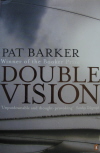
Double Vision by Pat Barker

Double Vision

The trouble was, Kate thought, Alec had always thought of himself as a good man. That made him sound smug and horrible, which he wasn’t, but he did tend to assume that in the war of good and evil he’d always be on the right side, whereas Kate couldn’t help thinking real adult life starts when you admit the other possibility. ‘We’re all a bit like that, aren’t we?’

Ah, that’s why I love Pat Barker. Even if this book had nothing else to recommend it, it would be worth reading just for that bit.

Barker’s writing is eloquent and unfussy. She’s really readable. Lovely writing, no distractions.

There are two main characters in this book: a burned-out war journalist who is grappling with the death of his photographer friend, and the photographer’s wife, a sculptor, who is not only dealing with the death of her husband, but also recovering from a bad car accident. Their lives intersect when the journalist returns home to work on a book about his experiences. A romantic relationship does develop, but not between these two characters.

It’s an absorbing story on the surface level. But it also—as is typical for a Barker novel—explores complex questions about war and violence.

This isn’t my favorite Barker book, but it’s the best book I’ve read this year.

Vacation Part 2

Tourist in Our Own “Hometown”

Hiked the Grouse Grind. Time: 1:32. This is the view from the top:

Vancouver

The big white blob in the top center is BC Place.

If you go: bring a fleece (it’s cold at the top) and money for the gondola down ($5) and the coffee bar. The latte and brownie (mmm) at the top were definitely a highlight of this adventure.

*

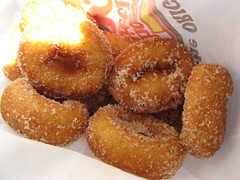
When we were in elementary school, all BC schoolkids got PNE tickets in their end-of-year report cards. Despite this, neither of us had ever been to the PNE until last year (!). This year, we were veterans. We toured the prize home, checked out the farm animals, and watched the SuperDogs show. And, of course, we ate donuts (1 bag plain, 1 bag cinnamon sugar):

Those Little Donuts

and rode the wooden coaster:

Wooden Coaster

This coaster is literally throws you out of your seat. It’s wicked!

*

Walked to the end of the Iona Jetty (4K each way):

Iona Jetty

Iona is close to the airport (YVR) so you can watch planes taking off and landing, as well as marine traffic, birds, etc. There were some crazy fish jumping out of the water while we were there.

*

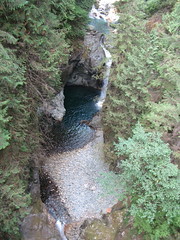
“Braved” the Lynn Canyon Suspension Bridge:

Lynn Canyon

Just before I took this photo, a guy slid down the waterfall. Ouch.

Unlike the Capilano Suspension Bridge, this one is free! Parking is also free! As you might suspect, free means it’s uber-popular, so you might not want to go on a long weekend like we did 😉 Would be a good place to take out-of-town visitors.

2006 Books Read – #12

House of Smoke by JF Freedman

House of Smoke

When we were visiting the parental units earlier this summer, they had a box of books by the door ready to go out. Mom asked if I was interested in anything. I poked through the box and grabbed a Paul Theroux novel. She encouraged me to take this one as well.

This is a okay detective story, but nothing special. I kept getting ahead of the plot, which… I’m not sure why that is. I never used to be much of a plot-guesser. Maybe I’ve just read too many detective novels and I know all the elements.

The lead is a female ex-cop turned PI with Issues (her ex beat her, she’s lost custody of her kids). My main quibble is that it was obvious to me that this was a male writer writing a female character. He kept having her do either a) things guys think all women do (like wear sexy pink panties under her police uniform. WTF?) or b) things guys want women to do (like the requisite f/f “but I’m not a lesbian!” “me neither!” sex scene). Also, she inevitably had to be rescued by a dude. Arggh.

So yeah. Somewhat exasperating, but an acceptable beach read. Totally the kind of thing you’d pick up in the little new/used bookstore just off Main Street in the resort town you’re spending your vacation in to read at the beach. You know what I’m talking about. Which, come to think of it, is probably exactly where it originated 😉

What I Did On My Summer Vacation

We went to Seattle!

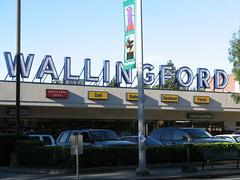
First stop: Wallingford (tee hee).

Wallingford

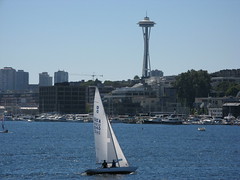
At Gas Works Park, we watched people sailing on Lake Union:

Space Needle

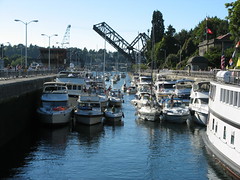
Discovered the Ballard Locks (Hiram M. Chittenden Locks) are an endless source of entertainment on a sunny Sunday afternoon:

Ballard Locks

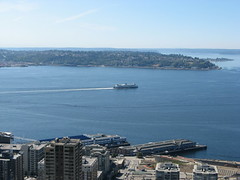
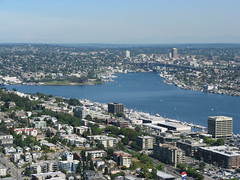
The Space Needle may be a cliche destination, but you can’t argue with the views:

West Seattle

Downtown

Gas Works Park, Lake Union

Pike Place Market: like Granville Island, but bigger and less yuppified. The fish-tossing is a bit silly, but the Market Spice tea is yum!

Pike Place Market

2006 Books Read – #11

Girlbomb: A Halfway Homeless Memoir by Janice Erlbaum

Girlbomb

This came to me as a “just because” gift from Eden. Isn’t she sweet? 😉 Okay, thoughtful. That’s better. Wouldn’t want to ruin her rep!

No expectations this time around; I knew nothing about the book except for what was on the book jacket.

Like Running With Scissors, Girlbomb is a memoir of the author’s teen years. Like Augusten Burroughs, Erlbaum ends up almost-but-not-quite homeless as a result of poor parenting. In her case, she leaves home (and ends up in a shelter) when her mother gets back together with an abusive husband.

Erlbaum, like Burroughs, has a good sense of humor about her experience. Unlike Burroughs, who quit attending school somewhere around the 6th grade, no matter how chaotic her “home” life got, Erlbaum kept going to school and ultimately graduated. I suppose some people will find this incredible, but it made sense to me. I think it goes to what I was saying in my RWS review: of course, high school is inane, but it does provide order / structure, which would be comforting if the rest of your life is in chaos.

Ultimately, I found Girlbomb a more relatable memoir than RWS. Although the events portrayed were more extreme than than anything I personally experienced, they also had the ring of familiarity. I sympathized with the author’s actions and motivations, rather than being frustrated by them. And the people, while not always likable, at least had some redeeming qualities—more “normal” human fallibility, less outright crazy.