
- Anonymous, “Race, Gender and Academic Jobs” (Inside Higher Ed)
- Ta-Nehisi Coates, “The Case for Reparations” (The Atlantic)
- Jessa Crispin, “To Be a Ghost” (The Smart Set)
- Susan B. Glasser, “Editing While Female” (Politico Magazine)
- Rose Lichter-Marck, “Vivian Maier and the Problem of Difficult Women” (The New Yorker)
- Kevin Nance, “These Beautiful Contradictions” (profile of Roxane Gay in Poets & Writers)
- Janet Potter, “If No One Sees It, Is it Still Art? On Finding Vivian Maier” (The Millions)
- Deidre L. Redmond, “A Black Female Professor Struggles With ‘Going Mean’” (The Chronicle of Higher Education)
- Rebecca Solnit, “Pandora’s Box and the Volunteer Police Force” (Guernica)
Monthly Archives: May 2014
7: An Untamed State
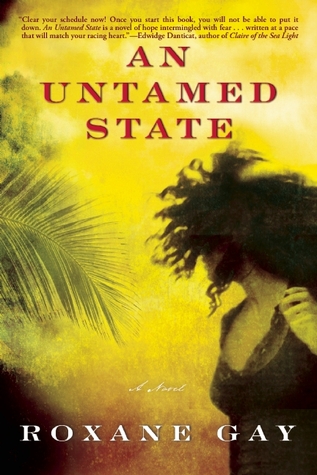 An Untamed State by Roxane Gay
My rating: 5 of 5 stars
Purchased at Chapters on Robson.
Read in May 2014.
Disclaimer: I am such a Roxane-with-one-N fangirl. I read everything she writes. I’m not objective at all when it comes to her writing.
Back in 2012, I read Ayiti, her story collection. An Untamed State grew from the standout of that collection, “Things I Know About Fairy Tales.” When I was looking for that post, I came across this Roxane quote from 4 years ago:
My parents will not consider me a real writer in a way they can truly understand until they can go to Barnes & Noble and find something I’ve written, not in an anthology, but with my name alone on the spine. My writing career is the least relevant thing about me when it comes to my family and friends. It’s not that they don’t care but honestly, they do not care.
Welp. 😉
The opening of An Untamed State is intense. The story goes right into the action, without any build-up. (Aside: take note everyone who likes to begin stories with their MC sitting around thinking to themselves.) Mireille is kidnapped in front of her parents’ house in Haiti. Her husband Michael and son Christophe are in the car with her, but they are not taken. She’s held for ransom because her father is wealthy, but he refuses to pay. Her captors begin raping her repeatedly.
In between these very intense scenes, the backstory is filled in via Mireille’s memories. I liked how this was structured because a) it was realistic (what else would she do alone in a room with nothing to do but escape into her head) and b) it pulled back from the tension a bit so it wasn’t relentless. Although, in its own way the backstory was intense, especially Mireille and Michael’s “fairy tale” romance.
The novel starts where “happily ever after” leaves off, playing off both the sunny Disney versions of fairy tales we’re all familiar with and the dark, twisted original stories that didn’t hesitate to make readers uncomfortable.
There is empathy for all the characters, which I loved, because people are gray and it annoys me when protagonists are portrayed as angelic and antagonists as evil. It’s too simplistic. So characters like Mireille’s father and the various captors are given the opportunity to show their humanity, and Miri is allowed to be flawed. She’s been criticized for being an “unlikable” character but real people are flawed, unlikable, prickly and you still empathize with them. At least, I hope you do? Because you don’t have to be perfect to deserve to be treated decently and not have terrible things happen to you. Honestly, when I think about the fictional characters I like the most, it’s always the ones I empathize with because of (not in spite of) their flaws. I like “unlikable” characters.
The overarching milieu of the story is rich country vs. poor country, rich vs. poor within a country, etc. and the tension between meritocracy, diying yourself to success vs. how much you should help others who can’t/won’t do what you did. But there are so many layers…
The story is in two parts, and in the second part, the After, Miri deals with how she can’t go back to how it was before. Reading this right after Speak was unintentional, but an interesting juxtaposition. Both have main characters who don’t deal with trauma the way society wants them to.
One aspect of the After is karma, or just kindness circling back. Miri was kind to her mother-in-law, Lorraine, when she was sick, even though Lorraine didn’t want her there, and now Lorraine is there for Miri when she needs help, even though Miri doesn’t want the help either. It addresses how sometimes the people who are supposed to be the closest to you (in Miri’s case, Michael) can’t give you what you need. Sometimes it’s someone a step away who is better able to care for you. Maybe it’s more objectivity? That they can see the forest and not be blinded by the trees, everything fraught from the past.
Vacation

Writers on Vacation by Debbie Ridpath Ohi
I don’t think you can expect to keep up your writing routine, whatever that is, when you’re on vacation with other people who are not writers. If you’re on vacation with family or friends, you’re probably crammed into a car or a room with them much of the time, and the times when you’re not they’re going to want you to “do something” with them not “sit and stare at your laptop.” Writing! It’s totally the same as putzing about the interwebs!
When I was a kid, I always used to take my binder of writing projects (mentioned here; all fortunately long-ago destroyed) with me on family vacations—and bring it back untouched. When did I think I was going to write? In the backseat of the car, with my brother poking me? In a motel room with my parents and brother and the TV competing for my attention? In line at an amusement park? It was wildly unrealistic.
You’d think I’d have learned from my youthful experiences, but no. In subsequent years, I kept doing the same thing in whatever its current incarnation was, printing out my current project “to work on” in desktop days, hauling along my laptop in more recent years. Actual writing done on communal vacations: not much.
Back in the day I had the aforementioned binder containing works-in-progress, a journal (my secret book), and my commonplace book. What I didn’t have was what I really needed for those trips: a writer’s notebook.
For a long time, I carried notebooks around with me, but they weren’t writer’s notebooks, they were journals. Journals can be wonderful, but inherent in the format are certain expectations, chiefly, that you will update them on a somewhat regular basis with semi-coherent, narrative entries. Such expectations (even if self-imposed) meant that writing in my journal often felt like a chore at the end of a long day, rather than a respite from excesses of sun and socializing.
I wish it hadn’t taken me so long to discover the beauty of a writer’s notebook. A writer’s notebook contains no expectations, implicit or explicit. You write in it when you want. You write in it what you want. It’s not your work-in-progress, your journal, or your commonplace book—but it might be a bit of all of these, plus your reading log, your to-do list, your address book, and anything else you want to throw in there. It’s a mutt, a messy hybrid. The perfect thing to take on vacation when you know you’re not going to have a lot of time to yourself.
With my writer’s notebook, I never feel stressed about not writing enough on vacation—whatever I end up writing, even if it’s just one word, is just the right amount. After all, you never know where that one word might lead…
Of course, there’s another kind of vacation. The kind you go on alone (or maybe with other writers). It might be a formal writing retreat, or perhaps a solo adventure of another kind, but either way, you get to set the schedule. Which means you can write as much as you want without ever getting the “you’re still on that computer?!” look from anyone.
When I finally finish the dissertation I’m taking a real vacation. Alone. Perhaps I will bring along a story or essay to work on—then again, maybe not. But I will definitely scribble in my writer’s notebook.
Vacation
All I ever wanted
Vacation
Had to get away
Vacation
Meant to be spent alone
(I love how this—the official video—sounds exactly like a crappy old cassette. I mean, how else would you expect it to sound?! 😉 )
making memories matter in the present
Stuart [Dybek] surprised me when he told us on the first day of class that writing was about memory—making memories matter in the present. Writing, description in particular, was a matter of translating personal obsessions into words. When you write you explore your own mind, a process that is largely intuitive and unconscious.
the disappointment of losing
Graduating … means you have experienced success already. And some of you – and now I’m talking to anyone who has been dumped – have not gotten the job you really wanted or have received those horrible rejection letters from grad school. You know the disappointment of losing or not getting something you badly want. When that happens, show what you are made of.
Secret Book
The first book that comes to mind in answer to the question “what children’s book changed your life?” is not one of the famous ones. It’s the lost-in-the-shadows-of-A-Wrinkle-in-Time Madeleine L’Engle book, Meet the Austins.
However. There is another book, even more obscure. So obscure that I couldn’t remember the title or author or the main character’s name. This is what I did remember: secret book, Christmas tree farm, root cellar. It turns out that was enough (thanks to Loganberry Books and their Stump the Bookseller archives):
Lyn Cook, Samantha’s Secret Room, 1963. Scholastic Canada. Samantha (Sam) lives on a rural property in Canada and gains a penfriend by tying a letter to a christmas tree. The caravan belongs to a cousin who comes to visit for a family reunion. The secret room is in a root cellar.
The weird thing is the phrase “secret book” is actually in the solution for the book above this one and so far I haven’t found it mentioned anywhere else. So, hmm. This is definitely the book I was thinking of, though, so if it’s not the one with the secret book, I would be perplexed.
Anyway. IIRC, the “secret book” was a journal kept in the secret room, and it’s where I got the idea to start keeping a journal in an ordinary notebook (vs. a diary in one of those dated books with a lock that I always failed at). I even wrote “secret book” on the front of my first notebook. Haha. All it was missing was a “keep out. this means you.” I did not have a secret room. (Sadness. I really, really, really wanted a secret room.) I did not even have a secret drawer in my desk. (Moar sadness. Also really, really, really wanted a rolltop desk with secret compartments.) So yeah. My secret book was kept in my desk shoved underneath whatever else was in there. Not too secret.
But it’s that not-so-secret secret book was the notebook in which I first wrote that I wanted to be a writer when I grew up (which I wrote about here). And I kept writing in that book until I filled it up and started a new book and so on and so on. So that’s why Samantha’s Secret Room is the children’s book that changed my life.
This is everything I could find about Samantha’s Secret Room and the author Lyn Cook:
- A review of Samantha’s Secret Room from 1992 (it was re-issued in 1991) in CM: A Reviewing Journal of Canadian Materials for Young People. This review mentions Sam’s journal, but not the secret book:
The story’s events, which are occasionally related via Sam’s journal entries, occur against a backdrop of the daily and seasonal responsibilities of farm life.
The thread tying the book together is Sam’s continuing search for a secret room that belonged to her early nineteenth-century namesake. Sam, whose own secret place to be alone is the root cellar, believes the other hidden space to be located somewhere in their old twenty-room house.
(And now, I’m beginning to think that the secret book is a giant spoiler, i.e. it wasn’t Sam’s book, but the one she finds in secret room #2, and that’s why no one’s mentioning it. I will refrain from mentioning where SR #2 is located, which is something I do remember.)
- It has a Goodreads page. (Just added it. Now I won’t lose it again.) There’s not very much information on it, and only a few reviews, all from people who remember reading it as kids. Lots of 5-star ratings, though.
- erm, apparently there are people who track “the oldest living writers.” ok. Lyn Cook is on this list, dated January 2014. She was born in 1918.
- She’s also on this list of Famous Canadian Women. “May 4, 1918 – Born Lyn Cook (1918 – ) 1st author to have books for youth published after WW ll.”
- She’s listed at A Celebration of Women Writers. “Waddell, Evelyn Cook [aka Lyn Cook; Margaret Culverhouse] (1918 – )” That one had links which led me to…
- A review of a different book by Lyn Cook, The Bells on Finland Street. The intro blurb says:
“Lyn Cook” is the short name for Evelyn Margaret Cook Waddell, who was a presenter for CBC Radio in the 1940s and 1950s. Her weekly half-hour radio programme, “A Doorway to Fairyland,” had child actors voicing the parts of characters in the books she presented. The Bells on Finland Street is her first novel, and was followed by a number of novels for young readers. Because her written work includes publications before 1950, she is on the list of authors to be included in the Canada’s Early Women Writers (CEWW) database, part of the Canadian Writing Research Collaboratory (CWRC), being established at the University of Alberta.
- …and this post from 2012 about a poem Lyn Cook published in the 1940s (using her grandmother’s name, Margaret Culverhouse):
Only two of the authors our project deals with are actually still alive. … children’s author Lyn Cook, otherwise Evelyn Cook Waddell. I telephoned Mrs. Waddell a week or so ago, as I was flying out to Ontario, where she lives. I was unable to meet with her, as she lives farther than I thought from my destination, but we spoke for quite a while about her years as a CBC children’s radio show host, and her life as a mother and children’s author in the 1950s and 60s.
I thought “A Doorway to Fairyland” might be in the CBC’s digital archives (there is lots of cool old stuff there), but nope. I did run across this, though:
Thursday, April 26, 2012: Singer-songwriter Bonnie Ste-Croix traveled the whole country recording her latest album, Canadian Girl, but she always finds her way home to Gaspé. Bonnie shares a book that was a childhood favourite, Samantha’s Secret Room, by Lyn Cook.
An audio clip seemed like an appropriate way to wrap up this post, but it’s not working for me. Well, maybe that’s even more appropriate for an out-of-print almost-but-not-quite-forgotten book.
writing has a pattern
The whole point is that writing has a pattern and life hasn’t. Life is so untidy. Art is so short and life so long. It is not possible to have perfection in life but it is possible to have perfection in a novel.
I subscribe to The New Yorker fiction podcast and one of the recent ones was “Paul Theroux reads Elizabeth Taylor.” Elizabeth Taylor? hmm, weird. Sure enough, there’s another Elizabeth Taylor, an English novelist. This quote is on her Wikipedia page (and elsewhere), but no one seems to cite the original source.
radical revision
For the same reason that most businesses fail slowly (by focusing on small details instead of big-picture stuff), most writers can’t get their work better than a certain level of passable mediocrity because they’re “optimizing” the small stuff before they hit on a project that’s worth optimizing. They approach revision by thinking about word choice and commas and cuts and line breaks, but those things can only make a poem or a novel or whatever 1-5% better. A radical revision that completely rethinks the scope or the flow or what have you could make it twice as good.
6: Speak
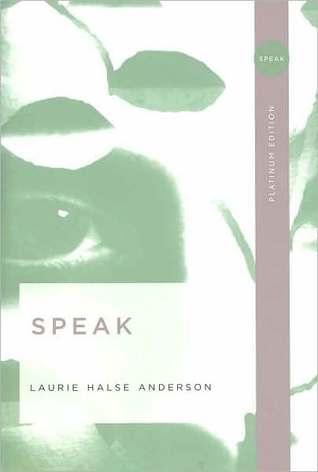 Speak by Laurie Halse Anderson
My rating: 3 of 5 stars
From the Fall 2013 VPL book sale.
Read in April/May 2014.
I picked this up because it was one of those books I’d heard mentioned a lot, but I’d never read it. I wasn’t really sure what it was about—mostly what I’d heard was a lot of compliments without any specifics. So I wasn’t spoiled going in, but I quickly realized there was a Thing and what that Thing was. (I think it was supposed to be a dramatic reveal, but it seemed obvious to me. Perhaps because I am an Old.)
Melinda has just started ninth grade and she doesn’t speak. Well, she does, but as little as possible. No one speaks to her, except the new kid who doesn’t know any better. Melinda is Outcast.
I liked the opening and I have to admit being a bit disappointed when I realized Melinda was being shunned because of this thing she did and not just because. To be clear, the school isn’t shunning her because of the Thing (which no one knows about) but because of something she did in response to the Thing.
There were lots of things I liked about Speak. I liked the narrative voice, and the way the book was structured. The story is quite funny despite the dark subject matter. I totally bought Melinda’s closing down and not telling anyone what happened. Classic introvert response to trauma.
I also thought the characterization of the teachers was really good. Somehow it managed to capture both the kid’s-eye view of them (Melinda’s) and what they were really like at the same time. It made me think about how when you’re a kid you never really think of teachers as real people, having lives and problems of their own. (Teachers: magical robots who are switched on at 9 and shut down at 3. haha.)
 I’m surprised a bigger deal wasn’t made of what is apparently an abrupt and radical shift in Melinda’s personality. I guess it’s supposed to be somewhat lost/covered for by starting high school, her parents’ workaholism and marital issues, the incident that led to everyone hating her, etc. But still. You’d think at least one person would have questioned it (beyond “oh, she’s just being a teenager”).
My main criticism: I had a hard time buying that none of the other students knew what happened, that there were no rumors making the rounds. It did make for a more dramatic catharsis, but… this is high school. There is nothing, nothing that a high schooler loves more than drama. Even if no one witnessed what happened (questionable), I find it hard to believe IT wouldn’t have told a friend or two who told a friend or two and so on and so on. Because he’s THAT GUY. Or if not that, just that people didn’t notice the weirdness between them (he goes out of his way to provoke her) and start speculating why. Especially given his existing reputation that comes into play later in the book. Given that, how did no one put 2+2 together?
 The Remainder Table