Author Archives: Theryn

1: House of Sand and Fog

House of Sand and Fog by Andre Dubus III

House of Sand and Fog

My mom passed this one along to me. Of course, I heard about it when it was an Oprah pick back in the day, but I’d never read it. I’ve also seen the trailers for the movie based on the book, but I’ve never actually seen the movie.

So anyway, based on what I knew about it, I expected House of Sand and Fog to have two main characters: the woman who loses her house (Kathy) and the man who buys it (Colonel Behrani). And indeed, they were there, but there was also a third character (whose name is, perhaps not coincidentally, only two degrees of separation from “Loser”) whom I hadn’t anticipated.

This was a quick read, and I give kudos to ADIII (aside: I wonder if he signs his letters like that—Cheers! ADIII or perhaps all best, adiii—ok, I’ll stop) for writing a story in which all three main characters are rather unlikable (each in his/her own way), but you still want to keep reading to find out what happens anyhow. The two key characters do generate some sympathy, but that’s tempered by how they handle the situation (hint: badly). The third character, though, he’s just plain unsympathetic.

The story plays out as a tragedy. Unfairness kicks off the sequence of events, but ultimately, everyone is done in by their own failings.

Message? Perhaps:

  1. Do not ignore bills even if they are sent to you in error (righteous indignation won’t keep a roof over your head).
  2. Do the compassionate thing, even if it derails your plans to regain former social status.
  3. Do not hook up with meddling, loose cannon law enforcement agents who have a misplaced sense of entitlement.

Hmm! Maybe it’s supposed to be seven deadly sins thing:

  • Kathy: sloth, gluttony, wrath
  • The Colonel: pride, greed, wrath
  • L-s-er: lust, envy, wrath

Ah yes, good ol’ wrath. A pinch of rage mixed with a dash of spite. But have we learned nothing? Beware the spite, people, it will get you nowhere:

Jerry: “Excuse me. I’d like to return this jacket.”
Clerk: “Certainly. May I ask why?”
Jerry: “For spite.”
Clerk: “Spite?”
Jerry: “That’s right. I don’t care for the salesman that sold it to me.”
Clerk: “I don’t think you can return an item for spite.”
Jerry: “What do you mean?”
Clerk: “Well, if there was some problem with the garment. If it were unsatisfactory in some way, then we could do it for you, but I’m afraid spite doesn’t fit into any of our conditions for a refund.”
Jerry: “That’s ridiculous, I want to return it. What’s the difference what the reason is?”
Clerk: “Let me speak with the manager… excuse me… Bob!”
(walks over to the manager and whispers)
Clerk: “…spite…”
(Manager walks over)
Bob: “What seems to be the problem?”
Jerry: “Well I want to return this jacket and she asked me why and I said for spite and now she won’t take it back.”
Bob: “That’s true. You can’t return an item based purely on spite.”
Jerry: “Well, so fine then… then I don’t want it and then that’s why I’m returning it”
Bob:
“Well, you already said spite so…”
Jerry: “But I changed my mind.”
Bob: “No… you said spite… too late.”

Seinfeld, “The Wig Master

(See? Everything comes back to Seinfeld. 😉 )
4: Halfway House

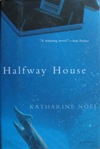
Halfway House by Katharine Noel

Halfway House

I actually finished reading this in late October—you know, back when I was still looking forward to spending November focusing on NaNo. AYKB, between TC stuff and offline chaos, that did not happen, and this post kept getting shuffled to the bottom of my to-do list. And now it’s the end of the year, and it’s still there, the last thing needing to be scratched off before 2008 ends.

So… here we go. I guess it’s somehow fitting that it’s taken me so long to get around to writing this review, given how long it took me to read the book. Looking back, I see I knocked a couple books off quite quickly right after I turned in the final draft of my thesis, but this one took me weeks to get through. I’m not really sure why; it wasn’t that the book was a slog or difficult or anything like that. For whatever reason, I just seemed content to read a single chapter at a time. That kind of a reading approach doesn’t always work out, of course; with a lot of books you’d end up having to flip back to refresh your memory each time because you couldn’t remember what happened up to your bookmark. But Halfway House had the stickiness necessary to be a satisfying slow read; whenever I picked it up, I didn’t have any problem continuing on as if I had just put it down.

Halfway House is Katharine Noel’s debut novel. Essentially it is the story of what happens to an “ordinary” family (mother/father/daughter/son) after the daughter develops a mental illness (bipolar disorder). I say “ordinary,” because I didn’t find them that ordinary to begin with: Pieter, the father/husband, is a professional musician and Jordana, the mother/wife, is the daughter of his friend/mentor. They first meet when she is a child and he is dating someone else; she crushes on him and they end up together, so she’s like 15 years younger than him. The kids (Angie & Luke) are exceptional athletes (swimmers), especially Angie, and she is also a brilliant student. There’s an expectation that she, at least, will attend an Ivy League school. (And… if you think $35k for a year‘s tuition is reasonable, you’re not ordinary. That is all.)

So, it’s very much about how easily a seemingly perfect family unit can fall apart when one thing (albeit a big thing) changes. At first, they try to go along as before, but it eventually becomes clear that—even if the right combination of meds is found—Angie is not going to simply recover and resume her before-life where she left off. Pieter and Jordana’s marriage falters and they separate. Luke ends up going to school in the Midwest, where he meets an actual ordinary girl ;-). In reality, of course, the cracks were already there; Angie’s break just widened them.

There was a lot packed into this book; maybe not all of it needed to be there, but I didn’t mind it. The writing is great; the descriptions are vivid and the characters do seem authentic. It felt like a world that had been percolating in someone’s mind for a long time. (My first thought was “MFA thesis” and after doing my usual post-read investigation, I think that might be right.) Still… I think one of the reasons I didn’t feel an urge to read this book faster is that I never really found myself attaching to any of the characters. Everything seemed to be taking place at arm’s length; there was a distance between reader and characters, rather than the immediacy one tends to expect with fiction. It felt like we (author and readers) were analyzing the characters rather than engaging with them. But maybe this is just a reflection of New Englander reticence?

Blog On

Since my thesis was on blogging, it seems apropos to announce on my (oft-neglected) blog that I successfully defended it yesterday. w00t! Finally.

Final title: Works-in-Progress: An Analysis of Canadian Mommyblogs. It ended up being less about the medium (my original plan) and more about the content, partly because the content was interesting in itself, and partly because gah! blogs are hard to write about! I probably should have written it in WordPress, rather than Word. Of course, then the challenge would have been getting anyone to read it. Oooh! I could have forced everyone to subscribe to it in Bloglines! Hahaha. So now I’m coming up with the brilliant ideas. Hmm, I wonder if anyone has done that. Now, that would be creative…

Anyhow, a few more details to wrap up, and then I’m taking the rest of the fall off. I’ll be starting my PhD in January (last degree, I promise), but in the meantime, I plan to read novels! write something fun! (NaNo?) and go outside! (But of course I jest! I’ve been outside recently! Wait… what’s this wet discharge dripping from the sky called again?)

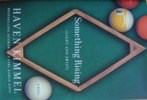
3: Something Rising (Light and Swift)

Something Rising (Light and Swift) by Haven Kimmel


I feel the same way about Something Rising as I did about A Girl Named Zippy, which I read back in 2005 (unfortunately, back then I was keeping track of books read, but hadn’t yet started to write reviews): it teeters on the brink of being brilliant, but never quite makes it there. The writing is great (I suspect if I read an excerpt, I’d give it a higher rating than I would the whole book), so much so that I find myself wanting to like the story more than I do. But if I’m honest with myself, this ends up in the “liked but did not love” pile.

Which is weird, because Cassie Claiborne is a character I should love. She’s a pool-playing tomboy with an innate understanding of geometry. She drives a beater Mazda. And Cassie is short for Cassiopeia.

It’s not so much that nothing happens. Stuff does happen (all the realm of regular-stuff-that-happens-to-regular-people, but that’s fine). It’s that Cassie (and all the other characters) seem to be sleepwalking through life. Cassie’s mother (Laura) and her boo-hoo, I should’ve married the dude I was engaged to when I ran off with your no-good dad. Gahhh! Get over it, already. Oh, well, maybe she might have if she had ever (in 30 years!) bothered to look him up and find out he’s a bigger loser than her deadbeat ex. Argh. Cassie’s sister (Belle) and her (undiagnosed!) hypochondria/phobias/whatever she has. She won’t leave the house—except she managed to go to university for 4 years, so she can conveniently have a work-from-home editing job.

But the biggest problem is that even though Cassie is the MC, I have no idea what she wants. (I mean in a concrete way—obviously she has some abstract desires.) She plays pool and does day labor and has never filed a tax return. Ok. But what does she want?! In the end there’s a deus ex machina, which combined with a foreshadowed (called it!) development, gets Cassie out of her rut… the end.

Essentially, everyone is passive and only ever does anything in reaction to events that happen to them. Passivity is fine to a certain extent (it was ok early on in the story, when Cassie was a child/teen), but if that’s all there ever is (by the end of the book, she’s well into adulthood), it’s frustrating. You want to shake all the characters and slap some life into them. And it’s not an era thing; according to the timeline, Cassie’s supposed to have grown up around the same time I did. I think this adds to my impatience.

The other thing is… the prologue starts off by foregrounding Cassie’s math skills (this is after she starts playing pool). In fact, it ends:

In this, the spring of her tenth-grade year, she had done poorly in everything but math. Her teacher, astonished, had sent a letter to Laura that said one thing: She’s a natural.

Since the prologue ended like this, my expectation was that Cassie’s pool-playing abilities were going to lead to something else (what else I don’t know, but something). Instead, they just led to more pool. (Which mostly happens off-screen, btw. I mean, if pool is to be the focus, more pool, please!) Even at the end, when she finally makes a move, the intimation is that she’s just going to continue playing pool. Which, ok, that’s fine. In real life. But it’s not very interesting in a novel. She was playing pool in the beginning and she’s still playing pool at the end… And? And? That unfulfilled expectation was the biggest let-down, I think.

When I finished A Girl Named Zippy, I didn’t love it enough to actively seek out another Kimmel book. However, I knew that if I should ever run across one on the remainder table, I would probably pick it up. Kimmel’s writing was just too promising to not give her another chance. And so when I saw Something Rising on the remainder table at Chapters, I bought it. Now I’ve read it and I feel the same way. So will I give Kimmel a third chance? Probably. 😉

2: Luna

Luna by Julie Anne Peters

Hmm, it’s been a while. Time to get back to reading for pleasure. My first pick: Luna, a young adult novel I picked up off the remainder tables at Chapters. Not only that, but it was a “buy 3, get 1 free” sale (which, yes! even applied to the remaindered books) so I think I got 4 new hardcovers for $20. Quel deal!

Onto the book. It had an interesting premise and it had that award sticker, so I figured at the very least it would be interesting from a writing perspective. So, in a nutshell, the book’s protagonist is Regan, age 16. The dilemma is that Regan’s older brother Liam is transgendered and is transitioning to become a girl (Luna). Regan is the only one who knows (or at least she thinks she is) and keeping the secret is taking a toll on her.

From a writing standpoint, it helped me sort out something I’ve been thinking about: why you would have the MC be an essentially passive character (I was thinking about one of my characters and trying to articulate to myself why she is the MC when she mainly reacts to others’ actions). In this case, it would seem logical to write the story from Liam/Luna’s pov, or perhaps one/both of the parents. At least, that would be the case if this were a regular novel (not YA). From a YA perspective, though, writing from Regan’s pov does make sense. After all, that’s a key characteristic of being a kid/teen–not having control of what happens to you. And an essential component of coming-of-age is taking control (acting instead of reacting). Ok, so now it seems obvious.

Anyhow, I read Luna in about 3 hours and I did like it, although I felt it had some problems. Characterization was a strong point. Regan was a relatable character, and in general, the characters seemed realistic. I did feel that it skimmed the issues a bit. The focus on Luna’s interest in makeup, dresses, shopping, etc. makes it seem like being female is tied to stereotypically girly things, which… sigh. While it’s true that Regan was the MC, so from her pov, why Luna knew she was female wasn’t really the key issue, as a YA issue book 😉 it seems like why Liam knows he is a girl could be articulated better—that is, something beyond the fact that he doesn’t want to do stereotypically male things (play sports) but does want to do stereotypically female things.

Quibbles… Regan’s series of clumsy mishaps, while amusing the first and possibly second time, went on way too long. And I didn’t really understand why, especially since Liam was apparently so well-known at school, no one would know who Regan was. That seemed contrived. People know who siblings are (especially when they’re only a year or two apart). I also thought it was rather convenient that Liam/Luna was a computer genius who was thus essentially independently wealthy. Most 17/18-year-olds are not going to be so fortunate—and so it left me wondering what the take-away would be for someone reading this who was in Luna’s position.