
- Christie Aschwanden, “Why Blog?” (The Last Word on Nothing)
- Kerry Clare, “Solid” (Pickle Me This)
- Ta-Nehisi Coates, “The Champion Barack Obama” (The Atlantic)
- Jill Kronstadt, “You’ve Come a Long Way, Lady James” (Bloom / The Millions)
- Steven Kurutz, “Lee and Morty Kaufman: Cleaning Up in Their 90s” (The New York Times)
- Edan Lepucki, “Style Sheet: A Conversation with My Copyeditor” (The Millions)
- Megan McArdle, “Why Writers Are the Worst Procrastinators” (The Atlantic)
- Seth Mnookin, “Why Philip Seymour Hoffman’s Death Is So Scary” (Slate)
- Maureen Orth, “Mia’s Story” (Vanity Fair, from 1992)
- Jennifer Pastiloff, “Survival of the Fittest: On Losing My Hearing” (The Nervous Breakdown)
- Janet Potter, “28 Books You Should Read If You Want To” (The Millions)
- Arianne Wack, “Is She Writing About Me?: A Profile of Lorrie Moore” (The Millions)
Ira Glass on Storytelling
I ran across this earlier this week and it reminded me of of the “why are you telling me this?” quote I posted a while back.
The I-don’t-have-5-minutes-to watch version:
- A story has two key building blocks 1) an anecdote and 2) a moment of reflection.
- An anecdote is a sequence of actions.
- Start with the action! Raise a question from the beginning. Keep raising questions. If you raise a question, it implies you’re going to answer it at some point. This is what keeps people watching/listening/reading.*
- The moment of reflection is the point of the story. It’s the “why are you telling me this?” part.
- You need both!
- In a good story, you flip back and forth between the two.
*I agree this is what gives a story momentum, but at the same time I don’t think all questions need to be explicitly answered in stories. In fact, I prefer if they aren’t. You’ve got to leave something for your audience to figure out on their own / argue about for decades 😉
The Wisdom of George
Last night I happened to stumble across the first episode of Seinfeld. You know, the one where Jerry wears red sweatpants and there’s no Elaine. Anyway. Jerry and George are nattering away, as they do, and what do I hear George say?
JERRY: Yeah, OK. Oh, wait a second. Oh, I, I forgot to clean the bathroom.
GEORGE: So what? That’s good.
JERRY: Now, how could that be good?
GEORGE: Because filth is good… Whatta you think: rock stars have sponges and ammonia lyin’ around the bathroom? They, they have a woman comin’ over: “I’ve gotta tidy up?” Yeah right, in these matters you never do what your instincts tell you. Always, ALWAYS do the opposite.
JERRY: This is how you operate?
GEORGE: Yeah, I wish.
The Opposite! In the very first episode. It’s a sign, right? 😉
this vocation is not a sprint
Postal submissions taught writers that this vocation is not a sprint. Writing is a series of marathons separated by long respites, where we regain breath and build strength. It is time for writers to slow down again, so that our performance in the next race can be better, more meaningful, and if we are lucky, closer to the eternal, mysterious rewards of art.
the furious finish is part of the process
I used to think that I needed wide open days and uncluttered hours to get important creative work done. Sometimes that’s true. But I’ve also learned that perhaps more important than what happens when I’m staring at the page is what happens when I’m not. How I chew on the idea in my downtime. My subconscious must know about the deadline—needs it, even—and works feverishly to pull it all together. Perhaps it’s even a pipe dream to imagine having something done early enough to bask in its finished glory with a glass of wine. And maybe that’s not even the point—writing is work and the furious finish is part of the process.
Some things I read this month
- Christie Aschwanden, “How an internet quiz put me in my place” (The Last Word on Nothing)
- Anna Fitzpatrick, “Young Adult, Not So Virginal” (Hazlitt)
- Rebecca Mead, “Written Off” (The New Yorker)
- Michelle Nijhuis, “My Dirty Stream” (The Last Word on Nothing)
- Drew Philp, “Why I Bought a House in Detroit for $500” (Buzzfeed)
- Emily Rapp, “Proof of Loss” (The Rumpus)
- Scott Saalman, “Do Not Endure Verbal, Emotional, or Physical Abuse” (The Morning News)
2: The Sketchnote Handbook
 The Sketchnote Handbook:
the illustrated guide to visual note taking
by Mike Rohde
My rating: 4 of 5 stars
Bought at Chapters on Robson.
Read in January 2014.
I can’t remember where I saw this mentioned (maybe The Art of Nonconformity?), but it was one of those moments when you instantly identify with the book’s subject. Not an “aha!” moment exactly. More of a “yeah!” moment. So sketchnoting is a thing and someone wrote a book about it.
Doodles always filled the margins of my notes, circled the edges, squeezed the written notes into the center of the page. What I didn’t really do: integrate my doodling with my notes. I didn’t doodle with intention so much as I doodled to stay awake. (The minute I sat down in a classroom and a lecture started, I’d start nodding off. I blame Social Studies 11, which I slept through from start to finish. After that, just sitting in a desk was enough to make me sleepy. Pavlov’s response ftw 😛 )
What this is: a book about visual notetaking (handwriting + drawing). The entire book is handwritten / hand-drawn (no type). It’s filled with tips for taking visual notes—sketchnotes—along with example pages from the notebooks of many different people who take notes this way (showing different styles).
Messages: sketchnotes are fun, easy, personal. Rohde emphasizes that anyone can do this; you don’t have to be an artist. Sketchnotes are about “ideas not art.” He breaks down the various elements of a sketchnote (layout, typography, diagrams, etc.) and encourages you to build a visual library (items you can quickly sketch). There’s a practice section in the last chapter.
My main takeaways from this book: set your doodles free from the margins and incorporate them into your notes. Don’t try to write everything the speaker says down; focus on capturing big ideas. Make your notes pretty in real-time, not after-the-fact. Not only is it more efficient, but if you’re having fun, you won’t fall asleep 😉
Recommended for doodlers and visual-kinesthetic learners.
Some links:
- The Sketchnote Flickr group
- Download a sample chapter from the author’s website.
MooCards
As a step toward one of my 2014 goals, I ordered some business cards from Moo. They arrived yesterday, two weeks exactly after I ordered them. Much faster than the estimated arrival date of January 28 (bet they do that so you’re all impressed when they arrive “early” 😉 ).
As I was figuring out what to put on them, I realized that I have approximately a zillion food photos and almost none of writerly things like notebooks and pens and laptops. So there’s a goal for 2014: take more photos of writerly things. In the end, after much futzing, I went with one simple design that incorporates a version of my cover image on the front and the Hunting of the Snark beaver on the back (what else?!).

1: The Hitchhiker’s Guide to the Galaxy
 The Hitchhiker’s Guide to the Galaxy
by Douglas Adams
My rating: zzzzz
From the Spring 2011 VPL book sale.
Read in January 2014.
 I probably never would have read this except I ran across a copy at one of the library book sales and I decided I couldn’t pass it up because it’s everyone’s favorite. And then it sat and sat on my shelf because I was scared to read it because it’s everyone’s favorite. Until last week, that is, when I decided I would attack my to-read shelf one letter at a time. (We’ll see how long that lasts 😉 ) The first author in the As? Douglas Adams. Well, ok, then.
And… I didn’t enjoy it at all; I just wanted it to be over. Reading it was like bzzz bzzz bzzz line that’s supposed to be funny bzzz bzzz bzzz bizarro scifi name bzzz bzzz bzzz now-ubiquitous pop-cultural reference (yes, I knew the answer to Life, the Universe + Everything! before reading the book) bzzz bzzz bzzz bzzzzz zzzzz. Most memorable takeaway: babelfish, the fish that burrows into Arthur’s ear and translates for him.
I’m wimping out on rating this one. This is one of those things that falls under “not for me.”
ETA: So I added this to my young adult shelf at Goodreads and afterward I noticed this:
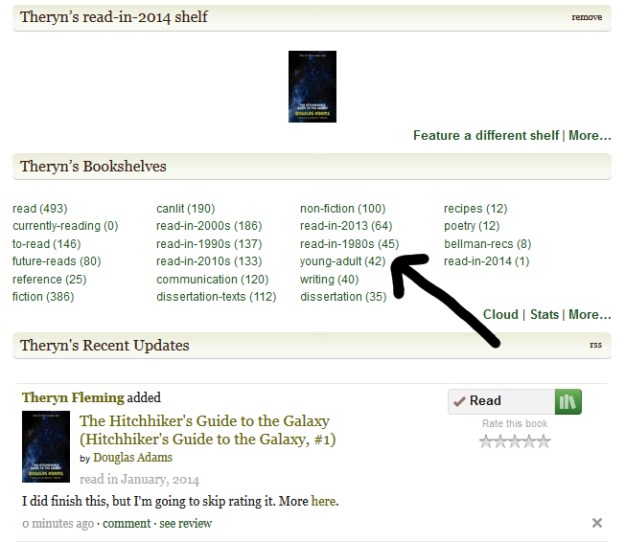
Now that’s actually funny.
Reframe
Back in December, I was catching up on my alumni magazines and saw this article. Not too long ago, but prior to reading said article, I wrote a comment on one of Sparky’s posts that basically said exactly what the professor in the article advocates. So, a) validation! and b) I really need to work on marketing my ideas. 😛
Anyway, the short version of the article is that there are three ways to view work: as a job, a career, or a calling. Job people are the TGIF, watch the clock, counting the days to retirement crowd.
So I read this and I think: ah yes! the “3 categories” game. I have a few versions of this myself. Interestingly, they all fit into the job/career/calling scenario.
- There are 3 types of law students: the ones who want the money / prestige (= law as career), the ones who want to save the world (= law as calling), and the ones who really want to write (= law as job).
- There are 3 types of undergrads: the ones who want a degree because “a BA is the new high school diploma” (job people); the ones who need a specific degree to reach a predetermined professional goal (career people); and the ones who are studying what they’re passionate about and for whom a degree is icing on the cake of learning (calling people).
Which is not to say that just because you’re in one category now, you’re stuck there forever. You can, of course, move from one category to another. To that end, in the article there’s some discussion of how you can find work that you find more fulfilling. And then it goes on to say:
If we aren’t willing to switch to another kind of work, then he advises us to reframe the work we do.
AHEM. Reframe. My comment:
You’re not going to quit your job, so I think you need to reframe your feelings toward it. There are obviously things you value about it (the money it provides you, the fact you can retire early, etc.) and those outweigh the negatives for you.
Look, I even used the same word. Moral of this post: listen to me. I am wise like Yoda 😉
 The Remainder Table