Loved this piece. Sometimes I think about what might have been if I’d had a writing teacher who believed in me, who pushed me to continue past my comfort zone.
“Energy is everything,” he said. He meant the ability to work—to sit at the desk, day in and day out, and to get the words down, despite the disappointment and in spite of the success. Pushing on and pushing through, building sentence after sentence, page after page. Not turning away from the blank page, but always trying to build something from nothing.
I only just now figured out what it is about collections of short stories that turn me off. … I don’t like beginnings and endings in fiction. This is true for novels as well. It generally takes 3 to 4 times as long as it should to get through the first 8 to 10 pages of a novel, given my usual middle-of-the-book reading speed; it’s like there’s this big activation energy I have to overcome, all these additional resources I have to put into figuring out the characters, setting, tone, what’s going on, what’s the style, how do I read this, etc. Then you ease into it and it’s smooth sailing for at least 150 pages. Unfortunately, I tend to get antsy toward the ends of things. I think it’s because I like finishing books; it gives me a sense of accomplishment and means I can start something new. So I rush a little toward the end and miss things; too, I overanalyze them, because writers fret over endings and I’m more likely to question the decisions there and feel like something falls flat or feels false. So there’s a certain amount of dread as I approach the last 10-15 pages of the book.
This is a long quote, because yes! All of this. Although, I don’t know that I’d say I don’t like beginnings per se, but I do find them more difficult to get into / slower reading than middles. Partly I think it’s that when I start a new book I still have one foot in the-book-I-was-previously-reading’s ending. So there’s a transitional phase there.
Endings… well. It’s true I often find endings disappointing. They’re so rarely as good as the rest of the story. Endings are hard. Or maybe I am just super nitpicky.
I have come to the conclusion that the way to read short stories is one at a time, which may seem obvious, but when you’re mainly a novel-reader who’s used to getting in that middle-of-the-book zone where you just buzz from one chapter the next devouring the book, stopping and setting the book aside for a while after you finish each story is kind of an “ohhh” moment. So what with all the beginnings and endings and pausings, it makes sense that story collections are much slower reads for me than novels.
Now that I’ve let go of the expectation of being able to read a story collection like a novel, I’m less reluctant to pick one up. There’s still some hesitation, though, because of all those beginnings and endings. (But then you read a gem of a story and it makes it all worth it.)
Why do I always forget how much simple, repetitive kitchen tasks can calm and sooth, how surrendering to a singular goal is not madness but a source of pleasure? Narrowing my focus to just one thing is not a scary and impossible fairytale but a relief and pleasure and really the only solution most of the time.
People are always twisting themselves up in knots about feminism. I’ve lost track of how many times I’ve heard a celebrity say, “I’m not a feminist, I just want to…”
Just want to what?
Go to school?
Study whatever subject you like?
Attend the school of your choice?
Have a job/career?
In the field you studied for?
Keep your name after you marry?
Keep your job after you marry?
After you have children?
Own a business?
Own property of any kind?
Vote?
Drive a car?
Travel alone?
Go outside without being harassed?
Have autonomy over your own body?
etc. etc. etc.
All the people who claim to not be feminists want some, if not all, of these things. So what I have to say to them is: you are wrong when you say you’re not a feminist. You are a feminist, because that’s what feminism is.
On December 6, 1989, a man killed fourteen women at Ecole Polytechnique in Montreal. He killed them because they were women studying engineering.
On December 6, 1989, I was an undergrad, a biology major. I wasn’t an engineer, but I was studying sciences. The fourteen who were killed were my age or just a little older. They were, essentially, my peers. This could have happened in one of my classrooms.
People who know me know I’m wary of co-opting other people’s tragedies. Obviously, people who were there that day, people who knew the fourteen women, have been far more deeply affected by this event than I can even imagine. But it did have one profound, lasting impact on me.
I have never wavered on the subject of feminism.
I am a feminist because I believe women and men should have equal rights and opportunities.
While it’s true that most women won’t be murdered for choosing to study engineering or computer science or math or chemistry, most will be ridiculed or harassed (even jailed in some jurisdictions) at some point in their lives for making a choice that would be mundane if a man had made it. The sentiment underpinning the Montreal massacre—the belief that women should not have the same rights and opportunities as men—is still prevalent.
Why is it that people are embarrassed to say they’re feminists when really they should be embarrassed to say they’re not? Because they’ve bought into the rhetoric (“feminists are man-haters”) of those who would like women to return to the place they were a century ago. When you say “I am not a feminist” even though you believe that a woman should have the same rights and opportunities as a man, you are, in effect, supporting a position you don’t actually believe in and, if you are a woman, you’re sabotaging yourself. So stop saying it. You owe it to yourself, you owe it to those who fought for the rights you currently have, you owe it to those for whom you are a role model, and you owe to those who no longer have a voice.
How it works: the first round you read a little bit of each book (I’m thinking 5 pages because of the adage that you should be able to hook a reader within the first five pages). The next round you read a bit more of each of the survivors (say the first chapter of each). The next round a bit more, and so on. The winner gets read to the end.
As we were talking about it, I remembered this list of “best novels” from 1898 that I’d seen a few weeks ago, how I’d been curious about some of the titles I’d never heard of and thought: if only I had more time to read… Or! If only I were more ruthless!
Bring on the Tournament of Old Books!
I headed to Project Gutenberg to see what I could find and drafted up my list. (I skipped titles I’ve previously read, with a few exceptions. For example, I’m sure I read Robinson Crusoe and Gulliver’s Travels when I was a kid, but they were adapted/abridged-for-kids editions, which don’t count. Also watching movies and/or musicals ≠ reading 😉 )
I’m not sure when I’m actually going to have time to do this (probably not this month), but here are my brackets (click to embiggen):
I can’t remember where I saw this mentioned, but I’m on the lookout for interesting books about running (which seem to be few and far between as discussed in my post about What I Talk About When I Talk About Running). The problem is most runners aren’t writers so most writing-about-running is a snore. If you’ve ever perused a running forum or blog, most posts about running are race reports that go something like this: “I got up at 3am, put on my clothes that I laid out the night before (detailed list of chosen clothing), ate (something icky), used the bathroom (tmi), left the hotel at 5am, blah blah blah transport to the start, congregated in a sea of humanity, last-minute portapotty break (tmi), mile by mile or km by km reports of condition of feet/legs/stomach, what types of fake food were ingested at what times, how many pitstops were made (tmi) and on and on and on. Finally (you’re asleep, aren’t you?) concluding with time splits for each mile or km, depending on preference, and chip time (woo if PB, sadface if not). The End.”
zzzzz.
So yeah. That’s not what I’m looking for. But this book sounded like it might be, so I decided to check it out.
I didn’t know anything about the author, but the cover identifies him as a Tibetan lama. So, when I started reading, I was thrown by the author’s voice. At first I wondered if it was ghostwritten because the voice is so generic North American. My curiosity eventually got the better of me and I hit up Wikipedia (where else?) for a bio. Turns out he lived in the US for the majority of his childhood/young adulthood. Ah. On his YouTube channel, I found a video about the topic of this book:
I thought it was going to be more about running as a form of meditation, but he dispels that idea almost immediately:
People sometimes say, ‘Running is my meditation.’ Even though I know what they mean, in reality, running is running and meditation is meditation. (19)
Basically, his take is that running is for the body; meditation is for the mind. The premise of this book is that running complements meditation (or vice versa), that running is not incompatible with meditation (which I guess some people think). The book is organized in four phases or stages of running proficiency represented by the tiger, lion, garuda, and dragon.
In the Shambala tradition of warriorship, these creatures are called the “four dignities.” They represent the inner development of a courageous individual. The idea is to develop balance and integrity. The result is strong windhorse, lungta—the ability to bring about long life, good health, success, and happiness. (57)
Each phase has a different focus of contemplation:
tiger = motivation;
lion = good fortune;
garuda = love and kindness;
dragon = compassion and selflessness;
windhorse = basic goodness.
The writing is serviceable, if a bit choppy. The chapters are blog-post short and there’s quite a bit of repetition. All of this made me wonder if it was a blog-to-book. It reads like that, anyway. While each chapter was fine on its own, as a book, it never really feels like it gets into a flow.
He always refers to people by their full names (and often job description) no matter how many times he’s mentioned them previously. Writing Tip: this is very annoying for readers. As a writer, you must make your characters (even if your characters are real people) memorable enough that you don’t have to re-introduce them every time they reappear.
One of his refrains is friendliness/gentleness, as in being kind to yourself / not beating yourself up for not running or not meditating, but at the same time not letting yourself slack off completely either. As a moderator, I appreciated this:
The wise are balanced, and the foolish are extreme. (82)
Yeah! Have to remember that one the next time someone goes on a “I quit TV/the internet/social media/blogging/vice-du-jour” jag. Foolishness! 😉
On gentleness vs. aggression:
Aggression is a short-term solution for a long-term problem. Gentleness is persistent. Gentleness is therefore a sign of strength, while aggression is often a sign of weakness. Aggression is often a last resort. Where do you go from there? If you become more aggressive, you seem insane, whereas if you have gentleness, you are like a great ocean holding a lot of power. (85)
He touches briefly (very briefly) on walking and yoga. “We should all enjoy a good walk, incorporating the qualities of mindfulness and gentleness.” (90) I love walking (may have mentioned that once or twice), so yes to this. And he says “practicing yoga has provided an excellent balance to running.” (91) Which of course I already know. Running + yoga = the best. But there’s not much more to this chapter than that, unfortunately.
On pain:
One could say that life is at least 50 percent pain. If we do not relate to pain, we are not relating to half our life. Everything is fine when we are happy, but when we are in pain, we become petrified. The inability to relate to pain narrows our playing field. When we are able to work with pain and understand it, life becomes twice as interesting. Relating to pain makes us more fearless and happy. (113)
So what makes this interesting is that while I was reading the book, I ran across this quote about creativity and pain:
Studies on the nature of creativity have shown that people who consistently come up with more inventive and creative ideas are not necessarily innately gifted, nor are they necessarily more intelligent than other people. They are however capable of tolerating a certain level of mental discomfort.
It works something like this:
When our brains are presented with a problem- any problem- we feel slightly anxious. When we solve a problem, our brains release endorphins that make us feel good. So, we have a problem to solve, we often run with the first answer we come up with because it feels good (literally) to find a solution!
But people who are willing to see that first solution, and then set it aside- delaying that endorphin high- while they continue to search for another answer, and another, and another… until they have compared all possible solutions and then chose the best option- and run with it- consistently come up with much more interesting, creative solutions.
[H]appiness is not a goal, but a by-product of mentally and physically healthy activities. If we engage in these, happiness of mind and body will ensue.
Letting yourself become genuinely connected with happiness allows you to also deal with sadness. If your mind is obsessed with happiness, you might react to sadness by getting depressed and angry. I’ve learned that the best way to be happy is not to have happiness as your objective. If you crave personal happiness, it only becomes more elusive. (123-4)
On boredom (which relates to pain, and reminds me of what I wrote about boredom in my post on Eating Dirt):
In relating to pain, it is not so much the pain that is difficult—it is the inability of the mind to handle the pain. In meditation, people are often unable to handle the pain of the posture, disturbing thoughts, or boredom. It is not the boredom itself that is painful but the mind’s inability to handle it. Often, what exasperates the mind is the mind itself becoming hysterical: we are unable to handle both the pain and a hysterical mind. So when pain arises in either meditation or running, we need to feel the difference between the pain itself and the mind’s inability to handle the pain—or, in the case of a trained mind—our ability to handle it. (141)
This was maybe the most valuable section in the book for me. When I wrote about boredom in my Eating Dirt post, I knew perhaps I sounded like I was being melodramatic. I don’t think I was though. Younger-me was terrified of boredom, and I think my ability to cope with boredom (or, really, to not even go there) is a major difference between grownup-me and younger-me. (It’s all a matter of perspective. For me, everything changed when I declared to myself, “I am a writer.” Not the “I want to be” moment but the “I am” moment, which came later. Because if I am a writer, how can anything be boring? Everything is material.)
Anyway, there are some interesting ideas in this book but they’re not explored in a lot of depth. It might be more revelatory to people who’ve never considered running/meditation together before. Or running or meditation at all? I was a little puzzled as to the intended audience for the book. It was shelved in the sports section of the bookstore so I assumed going in it was aimed at runners with the idea of adding meditation to their running practice. But much of the time it seems like he’s explaining the running as much as or more than the meditation, which wouldn’t be necessary if runners were the intended audience. And he does say his impetus for writing it was that some people thought it was odd that he was a runner. So it’s for non-runners and non-meditators? How likely is it that someone who’s not into either thing picks up this book? Not very. So I’m not sure.
In the end, still on quest for the perfect book about running 🙂
Electric Literature: What did you look for in the winning reviews that you picked?
Emily St. John Mandel: In a word, engagement. Too often I read reviews that are concerned with nothing but the book in question, and there’s a hermetically sealed quality to such reviews, a narrowness of scope. I’ve come to believe that good reviewing requires engaging with the world outside of the individual book. At the very least, the book should be placed in the context of other books, but ideally—and I recognize that this is an entirely subjective opinion—I prefer reviews that go beyond talking about literature, so that the book under review is considered in the context of the surrounding world.
I’ve written before about how I typically prefer to read reviews after I’ve read the book, not before—and I think this is part of the reason why (the other is spoilers, of course). A review that is just about the book requires reading the book first to really engage with it. But occasionally I’ll find myself reading a review all the way through without having read the book. In that case, the review has transcended its genre to become just a good piece of writing. About the book, but also about something more than the book.
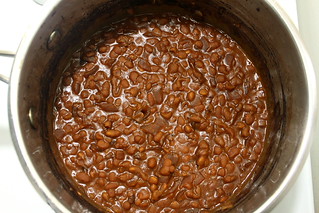
When I was a kid, canned beans were one of three weekend lunch staples (the others being Kraft Dinner and Campbell’s soup, of course). Each can always had a single piece of fat, which I surmise allowed them to labeled ‘pork and beans.’ I don’t think this was as big a selling feature as the makers imagined. We called it the ‘prize’ as in “ew! you got the prize!” No one ever ate it.
Beans were second in the hierarchy after KD (like all Canadian youth, we had an irrational love for macaroni-with-powdered-orange-cheese). We ate them with Worchestershire sauce, a habit we picked up from a babysitter we once had.
As an adult, I somehow got roped into eating tomato sauce beans, which always tasted meh to me. I put it down to not being so keen on canned food anymore. That is, until I discovered there are two kinds of beans: the tomato sauce kind and the molasses kind. Aha! It was the molasses beans I wanted.
(My search-fu tells me the beans I remember were Libby’s, which has since been bought out by Heinz, makers of the bland tomato sauce beans.)
Rather than reverting to food in a can, which would inevitably be a disappointment, I decided to try making them. How hard could it be? Not very, it turns out. I used this recipe from Simply Recipes. I basically followed the recipe as-is, but I’m not going to say “exactly” because it always amuses me when someone comments on a recipe: “This recipe is great! I followed it exactly! Except… [long list of substitutions, additions, deletions].” lol. Anyway, here are my notes:
Step 1. I soaked the beans overnight and drained them.
Step 2. There were only 2 tbsp of Dijon left in the jar, so I used 1 tbsp of yellow mustard to make up the difference.
Step 3. I used 4 pieces of bacon, chopped up into very small pieces. Going for flavor, not unwanted “prizes.” (I think they’d be fine without the bacon, but would need to sub in some oil/salt.)
Step 4. I baked them in the oven in the big pot I make soup in (I don’t have a dutch oven. The pot worked fine. I don’t think the beans care what kind of handle(s) the vessel you use has ;)). They didn’t need any additional water, but I did check on them and stir them a few times. I took them out after 7½ hours, because they were done.
Verdict: delicious! Will definitely make these again. Super easy, just requires a bit of planning ahead.
There are so many stories that I have read through the years that are just like “I got up in the morning. I had a really great lunch, then walked down to the beach and spent the afternoon there. There was an awesome sunset, then I went back and had a really great dinner. “As a reader you think, “Why are you telling me this? What do you want me to take away?”
You should have a very clear sense, as a writer, of what your point is. You should be able to write one pithy sentence where you say, “What I want the reader to take away from my story is ________.” If you can fill that in, you need to do some more work. Keeping that question front of mind gives you a road map, a tool to help ensure that you’re on track as you write.
This—exact same wording and all—is what I’m thinking as I’m going through the slush and reading all the “Character sat thinking to self (miserable and/or feeling sorry for self, natch) and then s/he walked around a bit (while thinking to self) and then s/he sat somewhere else (and thought some more) and so on and so forth” stories.
Why are you telling me this? What do you want me to take away?
Stories need to have a point. No, a story is not “just a story.” If you’re telling someone a story, there has to be a reason. What is it?
(If there really is no point to your story, then your story is the writing version of that boring person who yakked your ear off while saying nothing at the last family gathering or party you attended. You know who I mean. You don’t want your story to be that person.)
The thing is, I think most writers do have something they want readers to take away from their stories (yes, even the ones who claim their story is “just a story”). The problem is that the reason for telling the story is not transferring to the page. It’s stuck in the writer’s brain. It’s Hemingway and his iceberg again. The writer is aware of the whole iceberg. The reader only sees the bit that’s sticking up above the water.
Sometimes writers forget that readers can’t see the part of the iceberg that doesn’t make it onto the page. Readers don’t need to see the whole iceberg, but they do need to see enough of it to understand why you’re telling them this story. But before you can decide how much is enough, first you need to know why you’re telling the story.
Fill in the blank: “What I want the reader to take away from my story is ________.”


 The Remainder Table