Category Archives: Reading

15: An Unkindness of Ravens

An Unkindness of Ravens by Ruth Rendell
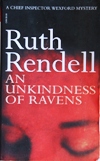
Picked this up at the library book sale earlier this year.

This was my first Ruth Rendell writing as Ruth Rendell book, but I’ve previously read several of her Barbara Vine books: Grasshopper, The Chimney Sweeper’s Boy, Asta’s Book, and No Night is Too Long.

The Unkindness of Ravens was a standard police procedural, featuring a bunch of characters who are apparently regulars, including the main detective, Chief Inspector Wexford.  The Barbara Vine books are more dark, psychological thrillers. I think I prefer those, but this was an entertaining mystery nonetheless. I do love police procedurals.

Anyhow, the plot involves a husband who’s vanished (things aren’t what they seem… naturally!) and a group of militant feminists (really!). It was written in 1985, and a typewritten note / typewriter is one of the clues, so there was a somewhat amusing discussion of the idiosyncrasies of typewriters.

A bit of an aside, but that ties into something I was thinking about recently. You know how people always say technology immediately makes a book/movie feel “dated”? You know, in a pejorative way. I don’t think that’s always the case. I think 20-year-old books/movies that were set in present-day and used present-day technology (at the time) don’t feel “dated.” It’s more like… they feel like period pieces. The technology is right for the time period, so it doesn’t stand out particularly. Or, you notice it but in huh, I’d forgotten/didn’t know that kind of way. That’s how this book felt.

Where technology does end up feeling really dated is in books/movies that are supposed to be set in the future. Yeah, 20 years later, that’s almost always hysterical.

Landscape

Book-lined rooms were part of our shared domestic landscape. To walk into a house with books was an unspoken promise of conversation that would jump beyond the events of the day. Brightly colored book jackets, waving for attention, were also good companions, a linear museum of handsome typography and graphic design through the decades.

William Zinsser

Inherently Solitary

I plan to use [an ereader] to read, alone, in public, and not to attract the kind of weirdo who, upon seeing me with it, thinks it’s okay to come over and ask to touch it, and how much I like it. I would never want that, and in fact, if I thought that was going to happen, I’d stick to print for public reading, even if it does my shoulder in.  If this desire to read alone, to engage in something so inherently solitary in the presence of other humans is objectively uncool, and society is one big high school cafeteria…I guess I’m cool with that.

Rosalynn Tyo

Reading

By making books commodities, the modern market has stripped them of much of their romantic charm. I like the smell of a moldy book as much as the next bibliophile, but not as much as I once did. And while I’ve yet to purchase a Kindle or iPad, which make buying books in a store or online seem like hard work, I keep some titles on my netbook and iPod and can see myself making a fuller transition to e-books. And as I do, I’ll become even less romantic about books—just as I became progressively less romantic about music as my collection has shifted from vinyl to CDs to mp3s. Holding an LP cover or even a CD jacket used to anchor the listener to something corporeal. But not anymore. The same is happening to books. The ancient ceremony of reading by turning its pages being disrupted by the e-book’s clicks and swipes. In the process it distances us from the old magic conjured by books. Books are being replaced by reading.

Jack Shafer

Direct and … pleasant

I’ve noticed two things [are different since publishing my last book]. One is that I’m able to observe via Twitter the global launch of the book. I’m able to simultaneously see for the first time that the English language editions, which have been exported from England into Europe and Australia, are released a week and a half before they’re released to the rest of the world. I kind of vaguely knew before but didn’t think about. The other thing is the number of Twitter users asking me questions that I’m usually woefully unable to answer about formats and editions.

I am [experiencing a greater level of fan engagement]. It’s much more direct and much more pleasant than I would have expected it to be.

William Gibson

The reality of the Web, not the dream

This original conception of hypertext fathered two lines of descent. One adopted hypertext as a practical tool for organizing and cross-associating information; the other embraced it as an experimental art form, which might transform the essentially linear nature of our reading into a branching game, puzzle or poem, in which the reader collaborates with the author. The pragmatists use links to try to enhance comprehension or add context, to say “here’s where I got this” or “here’s where you can learn more”; the hypertext artists deploy them as part of a larger experiment in expanding (or blowing up) the structure of traditional narrative.

These are fundamentally different endeavors. The pragmatic linkers have thrived in the Web era; the literary linkers have so far largely failed to reach anyone outside the academy. The Web has given us a hypertext world in which links providing useful pointers outnumber links with artistic intent a million to one. If we are going to study the impact of hypertext on our brains and our culture, surely we should look at the reality of the Web, not the dream of the hypertext artists and theorists.

Scott Rosenberg

Emotional Attachment

There is much more emotional attachment to the paper book than there is to the CD or the DVD. It is not logical — it’s visceral.

Mike Shatzkin

Actually, it is logical. (It might not matter to you, but the different response is totally logical.) You don’t sit across the room from a book; you interact with it—hold it, look at it, turn the pages, etc. A book is not just visual; it’s also tactile + olfactory (old book smell!) + a little bit aural (think: sound of the pages turning). You don’t interact with music and movie media in the same way. You listen to music. You watch/listen to movies. But you don’t smell or touch the medium while you’re watching or listening. You might not even be in the same room with the device delivering the movie or music. I started a post on this eons ago. I should finish it!

What makes them enjoyable

For me, to deny books their physical structure simply ignores far too much of what makes them enjoyable. The commitment they require, the way they force you into a state of simultaneous calm and focus — these are things I have yet to duplicate by any other means. Not to mention other factors that I’m terrified have been lost in the transition from paperback to screen: the mood it puts you in to carry a particular book in your bag all day, or the giddy/strange feeling of seeing your favorites on someone else’s shelves.

Emma Silvers

To know that secret

He liked to watch me on my laptop, how my face changed depending on what I was doing, how sometimes I laughed like I was reading about the best secret, how he wanted to know that secret. Sometimes, he would take my laptop from me and stand on the coffee table and hold it over his head and I would pretend to be angry and then he would run to another room and hide the laptop and when he came back I would give him my undivided attention. He liked that too.

Roxane Gay

Go, read the whole thing.

Merit Badges

We show off our books on shelves like merit badges, because we’re proud of the ideas we’ve ingested to make us who we are, and we hope to connect with others based on that. I think this is endearing and charming. When I paint someone else’s favorites and they have the same book I have in mine, I feel closer to them, like we must understand each other in some meaningful way.

Jane Mount