Always good to remember…
[T]he internet will be there in the morning, I don’t have to read everything now.

Always good to remember…
[T]he internet will be there in the morning, I don’t have to read everything now.
Just some quotes from posts I had bookmarked, which may or may not be useful.
Shirley Jackson might have been a part-time mommy-blogger, had she lived in the internet age. … Life Among the Savages, a memoir of her life raising three small children in Vermont … is a direct ancestor of the current crop of mothering memoirs — someone should put together a history of the genre — and it shares their frequently jokey “if I didn’t laugh, I’d cry” tone, a tone so different from that used in “The Lottery” that I had to check to make sure this was the same Shirley Jackson. The beginning sucked me in completely[.]
*
The real problem, of course, the real reason why I’m not “squeeing” over BlogHer (ugh, what a word, squee), is that these aren’t really the blogs I read. … BlogHer is a meetup for a particular set of blogging communities, and that’s why people bond and hug and clap and get so emotional. The problem for me is that I read geek blogs and copyright blogs and academic blogs and some politics blogs and some crafts blogs, and those bloggers aren’t at this conference. This conference is for a fairly specific slice of the blogosphere, and I guess it’s not really the slice that I feel at home in.
*
While the first BlogHer conference, in 2005, seemed to be about empowering women bloggers, today, empowerment appears to be about “look how powerful we are, corporations take us seriously and want to give us free swag!” But of course, if blogging becomes mainly about accepting free swag and loving the corporations, well, that’s not empowerment, that’s more like oppression – a slightly more subtle form of oppression, perhaps, maybe willing oppression. It doesn’t bode well for the power of blogging to actually spread the voices of the people, though, if the people are happy to speak for the corporations.
*
Honesty – how truthful do you want to be in your blog? There are plenty of examples of fictional blogs that have presented themselves as real. When readers discovered they were fictional, they felt cheated and became very angry (I’ve blogged about why readers get angry at this. On a smaller scale, most bloggers leave out the ugly bits and maybe play up the good stuff, as in the quote from Lars Tangen in this blog post. I’m not saying you need to be utterly honest (in fact, the more literary blogs get, the less factual truth matters, in my opinion, but you do need to think about this.
*
Dooce.com is now the full time job of both Heather and her husband, Jon. The blog supports an online community and a merchandise store. Heather is the author of a bestselling book, was named by Forbes as one of the 30 most influential women in media in 2009, and just signed an exclusive development deal with HGTV.
…
In a recent post entitled “Check Up for Self Delusion,” Penelope Trunk, another popular female blogger, recently wrote, “Probably the most accurate representation of women is in the blogosphere. There is no filter here, no need to appeal to both Peoria and Pasadena all at once.” She goes on to compare Dooce.com with an even more popular mommy blog, The Pioneer Woman.
*
Probably the most accurate representation of women is in the blogosphere. There is no filter here, no need to appeal to both Peoria and Pasadena all at once. But even the whole of the blogosphere does not represent the female experience particularly accurately.
…
The Pioneer Woman is largely housewife porn. The men are hot and rugged, just like in a romance novel. The author, Ree Drummond, is running an operation similar to Rachel Ray or Martha Stewart, but she markets herself as a stay-at-home mom, and a homeschooler at that. The whole thing strikes me as totally preposterous. … On Dooce, Heather Armstrong blogs about depression, her kids being difficult, and her parents being Mormon. I love Heather Armstrong. But she’s the gold standard for writing a blog about your life and keeping a marriage together, and she is not, actually, writing about the female experience for married women.
Have I missed anything substantive? Let me know.
2. ” Heroes” are just people you haven’t trashed on the internet yet. [ALTERNATIVELY: “HEROES” ARE JUST PEOPLE WHO HAVEN’T TRASHED YOU ON THE INTERNET YET. YOU CAN CHOOSE.]
1. Don’t read the comments.
I am a bad blogger. Or what could be more kindly termed an indifferent blogger. I only turn up when the fancy takes me and if I were being paid by the hour for this, then my family would be living on jam sandwiches.
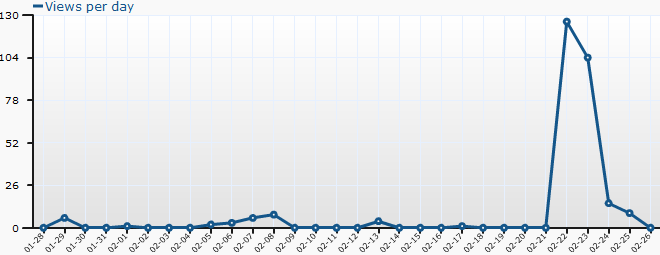
I wanted to post this screenshot of my stats to illustrate a couple things:
Perhaps the strangest and most interesting thing about #creepythesis is the way people talked about it, about me. As if I was never going to see what they said. (More on this later.) As if Twitter were a private chatroom.
Which it most definitely is not.
While you were following #creepythesis on the weekend, an SFU staffer who monitors Twitter was following keywords of interest to him. You know, like SFU.
(You see where this is going, right?)
#creepythesis may have blown up and burned out faster than ’70s child star, but whether anyone actually intended to follow through on the twitterstorm is moot, because said staffer-who-was-monitoring-SFU-tweets emailed the dean about it anyway.
Anyhow. This isn’t about me, per se. It’s more a heads up for the next time someone is wrong on the internet.

This is fair warning that I am totally turning #creepythesis into a paper. I’ll be posting some of my initial thoughts as I have time. I’ll tag everything with #creepythesis, so you can just follow that if you want to keep apprised but don’t want to read my other posts.
I was organizing and ran across the link to the Science Scouts badges that was going around Twitter a while back. While I know a lot of people who would qualify for more awesome badges than I do (gotta love the “I actually grew up AND became a marine biologist” and the “I AM actually a freaking rocket scientist” badges!), they did have the perfect one for me:

Hehehe.
They did not, however, have the “I left creative writing to pursue the study of biology” badge, which I would also qualify for. Get to work on that, will ya? 😉
For all the discussion Facebook has prompted … its most profound impact may be to alter, even obliterate, conventional notions of the past, to change the way young people become adults.
Six of my nieces will head off to college over the next several years. Some have been Facebooking since middle school. Even as they leave home, then, they will hang onto that “home” button. That’s hard for me to imagine. As a survivor of the postage-stamp era, college was my big chance to doff the roles in my family and community that I had outgrown, to reinvent myself, to get busy with the embarrassing, exciting, muddy, wonderful work of creating an adult identity. Can you really do that with your 450 closest friends watching, all tweeting to affirm ad nauseam your present self?
Peggy Orenstein, “Growing Up on Facebook“
Herein lies the reality that makes all of this quite messy to deal with. It wasn’t just anyone who left MySpace to go to Facebook. In fact, if we want to get to the crux of what unfolded, we might as well face an uncomfortable reality… What happened was modern day “white flight.” Whites were more likely to leave or choose Facebook. The educated were more likely to leave or choose Facebook. Those from wealthier backgrounds were more likely to leave or choose Facebook. Those from the suburbs were more likely to leave or choose Facebook. Those who deserted MySpace did so by “choice” but their decision to do so was wrapped up in their connections to others, in their belief that a more peaceful, quiet, less-public space would be more idyllic.
danah boyd, “The Not-So-Hidden Politics of Class Online“
The walls around myspace and facebook freak me out much like walled communities offline do. I like having my blog where anyone can read it without having to log into a different space.
Justine Larbalestier, “MySpace v Facebook“
Maybe this is what I should take this summer…
Course Description
As print takes its place alongside smoke signals, cuneiform, and hollering, there has emerged a new literary age, one in which writers no longer need to feel encumbered by the paper cuts, reading, and excessive use of words traditionally associated with the writing trade. Writing for Nonreaders in the Postprint Era focuses on the creation of short-form prose that is not intended to be reproduced on pulp fibers.
Hmm, let’s see… Do I have the prereqs?
Prerequisites
Students must have completed at least two of the following.
ENG: 232WR—Advanced Tweeting: The Elements of Droll
LIT: 223—Early-21st-Century Literature: 140 Characters or Less
ENG: 102—Staring Blankly at Handheld Devices While Others Are Talking
ENG: 301—Advanced Blog and Book Skimming
ENG: 231WR—Facebook Wall Alliteration and Assonance
LIT: 202—The Literary Merits of Lolcats
LIT: 209—Internet-Age Surrealistic Narcissism and Self-Absorption
Ooh! Looks like I just squeak in there on the merits of Lit223 and Eng301! (Too bad I failed Eng231WR for not showing up to class. ;-))

 The Remainder Table