
So often when you’re thinking of a book, you remember its cover. It’s a way of drawing people through the visual into reading.
Tag Archives: Books
12: What I Talk About When I Talk About Running
What I Talk About When I Talk About Running by Haruki Murakami
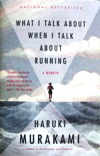
I see that reviewers really didn’t like this book (see, for example, the NY Sun, the Sunday Times, the Telegraph). Keep in mind the sharp edges are tempered due to the author being beloved.
I think this is where I’m supposed to get outraged and start ranting about people reading it wrong, and so on. But honestly? I find it rather amusing, because they’re so clearly wtf? about the whole thing. Like when Murakami writes about what he thinks about while running:
What exactly do I think about when I’m running? I don’t have a clue. … I just run. I run in a void. Or maybe I should put it the other way: I run in order to acquire a void. But as you might expect, an occasional thought will slip into this void. … The thoughts that occur to me while I’m running are like clouds in the sky. Clouds of all different sizes. They come and they go, while the sky remains the same sky always. The clouds are mere guests in the sky that pass away and vanish, leaving behind the sky. (p. 16-17)
They’re all like, “But that’s so dull!” But it’s not dull to me, because that’s exactly how it is. As is this:
I don’t even think there’s that much correlation between my running every day and whether or not I have a strong will. I think I’ve been able to run for more than twenty years for a simple reason: It suits me. … Human beings naturally continue doing things they like, and they don’t continue what they don’t like. (p. 44)
It’s a great illustration of the importance of audience. In the opening paragraph of the NY Times review, Geoff Dyer writes:
I’m guessing that the potential readership for “What I Talk About When I Talk About Running” is 70 percent Murakami nuts, 10 percent running enthusiasts and an overlapping 20 percent who will be on the brink of orgasm before they’ve even sprinted to the cash register. And then there’s me, the zero-percenter: a non-running Murakami virgin. Oh well. The supreme test of nonfiction is that it be interesting irrespective of the reader’s indifference to the subject under discussion, and a great writer’s work is obviously beflecked with greatness whatever the occasion. So the terms of the test are clear.
Well, I’d never heard of Haruki Murakami before I picked up this book. But I do run. And I also write. And, as I noted shortly after I bought the book, I have in fact actually used running as a metaphor for writing! So when I saw WITAWITAR while browsing the memoir/bio section at Chapters (where, fyi, it was displayed face-out rather than spine-out, ahem), I knew I had to read it. In other words, I think I’m an Ideal Reader for this book, one of the (apparently*) teeny number of people who both write and run. It never would’ve occurred to me that this was a rarity, but not only does Murakami comment on it (apparently he’s popular with running mags for this reason), Peter Terzian’s LA Times review makes note of how unusual it is for writers to write about running [emphasis added]:
In a 1999 essay for the New York Times, Joyce Carol Oates drew a parallel between the tireless walker-writers of the 19th century (Coleridge, Dickens, Whitman) and the contemplative present-day jogger. “In running,” she wrote, “the mysterious efflorescence of language seems to pulse in the brain.” An afternoon run allows Oates to untangle the structural problems that bedevil her fiction in the morning.
Oates’ essay aside, the literature of running is as thin as a mesh singlet. Running pops up in fiction and poetry from time to time, from Homer to John Updike, but the sport doesn’t easily lend itself to the dramatic. The vagaries of weather, the joint pains and the repetition of putting one foot in front of the other can’t compete with the traded blows of the boxing ring or a home run.
O rly?
While reading WITAWITAR, I started thinking that perhaps I should be writing about running—not just in one-offs, but in a more sustained way—but the idea that running can’t compete with boxing or baseball?! That’s like an outright challenge!
Oh, it’s on.
But back to the book. If the ideal audience for one’s book is miniscule, does that matter? Should one try for wider appeal? Murakami thinks not. Before he started writing, he ran a bar where he learned this:
If one out of ten was a repeat customer, then the business would survive. To put it the other way, it didn’t really matter if nine out of ten didn’t like my bar. This realization lifted a weight off my shoulders. Still, I had to make sure that the one person who did like the place really liked it. In order to make sure he did, I had to make my philosophy and stance clear-cut, and patiently maintain that stance no matter what. (p. 38)
I love the 1,000 True Fans concept (i.e. in order to make a living doing something creative, you don’t need a kajillion fans; you just need ~1,000 people who really love your work). Over at TC, I’ve been trying to start a discussion about self-/e-publishing and readers. The point I’ve been trying to make is that if the bulk of your readership consists of True Fans, it’s in your best interest to treat them well (i.e. not try to sell them crap just because you can). Murakami’s idea seems along the same lines.
Oddly, right after I bought WITAWITAR, I saw Kevin Hartnett’s essay about it at The Millions. Recommended. It’s a good essay and a much better summary of what the book’s about than my meanderings. Plus, he’s already sought out Murakami’s fiction, so he’s a step ahead of me.
*I don’t really buy that there’s so little crossover. Do you write & run?
Handfeel
[T]he publishing industry is already responding to the digital challenge by making books more “papery”, a turn-on for bibliophiles for whom the tactile pleasures of a book are very much part of the reading experience.
A strong trend among entrants for this year’s Book Design Awards was for jacket and page designs with an artisanal look. In the way that food scientists engineer breakfast cereal and soup for “mouthfeel”, publishers and designers are paying increased attention to texture, weight and “handfeel”.
Bookshop browsers now find themselves tempted by unbleached and hand-cut pages and uncoated jackets. Handwriting or calligraphy feature prominently and images look as if they have been glued in.
This made me laugh. It’s verging on human/book slashfic!
11: T is for Trespass
T is for Trespass by Sue Grafton

Another 55 cent book from the Book Sale. Hardcover, with a jacket, and another that was not a library book.
Previously on The Remainder Table…
[S is for Silence] flips between Kinsey’s 1987 world and flashbacks to 1953 (various characters). Since Kinsey is not a party to the 1953 flashbacks, the reader always knows more than she does. I’m not thrilled with this device. In a detective story, I think it’s best if we stick to the detective’s PoV—this is the only way the reader can play along (and isn’t that what a detective story is about?).
I’d forgotten about this. In T, while most of the story is told from Kinsey’s PoV, some of the chapters are told from the villain’s PoV. As with the flashbacks in S, I wasn’t excited about this device—I don’t think Grafton provided any insights into the character that we couldn’t have gotten another way. And it mitigated the suspense. Sure, there was still the “what is she going to do?” suspense, but there was no “who’s the villain?” More importantly, it put the reader ahead of Kinsey from the very beginning, which made Kinsey look kind of slow when she finally did catch on (which seems kind of unfair to the character).
I’m guessing that Grafton couldn’t think of a way to create doubt as to who the villain was with this particular storyline, so that’s why she went this route. But I think it would have been possible, if some of the minor characters had been played up more.
In T, what would normally be the side plot turns into the main plot. Kinsey’s neighbor, 89-year-old Gus, falls and dislocates his shoulder. He needs help while he recovers, but his only relative is a great-great-niece in NY. Kinsey manages to locate the niece, and she makes a brief visit to Santa Teresa. But because Gus is a Grumpy Old Man, she has trouble finding a home care nurse for him. When she finally finds someone, she only has Kinsey do a cursory background check, because she is eager to get back to her life in NY. Duh-duh-duh!
I enjoyed T more than S. But I know if I think about it too much, the whole thing will fall apart. (So I’m not going to ;-))
Here’s the thing. I know Kinsey Millhone isn’t great literature, but also know if I come across another in the series, I will probably read it. It’s reading junk food! nomnomnom It’s not even so much about the series itself, but about the fact that reading it also reminds me of reading the first books in the series, back when my favorite TV show was Remington Steele and my career aspiration was to be either a police detective, a private investigator, or a cat burglar.
Random tidbit: Grafton’s pet word is “ease”: people are forever easing onto stools, cars easing out of driveways, etc. etc.
Haha. It’s true! She still likes ease, but its noticeability was eclipsed by her new pet word (phrase?): “thumb lock.” I assume she means a deadbolt. I’ve never heard them referred to as thumb locks before.
10: The End of East
The End of East by Jen Sookfong Lee

Another hardcover picked up at the book sale (I’m starting to feel repetitive…). This one was actually a library book—gently-used, as they say. The dust jacket was in good condition.
I was pretty excited to read this book because it’s not only set in Vancouver, it’s set on the east side.
If you’re not familiar, the east side of the City of Vancouver is generally referred to as “East Van.” The west side, otoh, is just referred to as the west side. This is because there’s already West Vancouver—a different city, to the north(west) of Vancouver. There is also the West End, which is the neighborhood near Stanley Park. (If you think that’s confusing, to the east of West Vancouver are not one, but two, North Vancouvers.)
Bonus Fun Fact: most people think of the east and west sides being divided by Main Street. But this is incorrect! The east/west divide is actually Ontario Street. This leaves a two-block strip of east-side addresses for Realtors to tout as “west of Main!” This has cachet because the west is the more affluent side of the city.
And my blathering is less of a digression than you might think when you consider the title…
Anyhow, I could very much visualize the areas she described, but I did start to wonder how much of that was my own pre-existing knowledge. Was there too much of a reliance on street names as a shorthand? I’m not sure. If you’re not from Vancouver and you read it, let me know what you think.
The End of East is Jen Sookfong Lee’s first novel. It’s about three generations of the Chan family, but more broadly about the difficulties Chinese immigrants to Canada faced due to racist immigration laws.
Seid Quan immigrates to Vancouver in the early 1900s, at a time when Chinese immigrants were subject to the head tax. He settles in the Downtown Eastside, in Chinatown, and ends up taking over ownership of a barbershop. His village finances his immigration and his purchase of the shop and he works for many years to repay them. He is only able to return home a few times (for both financial and immigration law reasons). After many years alone in Canada, he is able to bring his son and his wife over. Eventually, his son marries and has five daughters, the first generation to be born in Canada. The story is narrated by the youngest, Samantha (Sammy).
Sammy’s parents and grandparents are nuanced characters, and her telling of their stories is unsentimental yet moving. I really liked the non-linear structure of the story. Instead of moving steadily forward in time we jump forward and back, learning different pieces of the story, until they all fit together in the end like a puzzle. Loved that. (And I think Lee’s ability to do this well in a first novel bodes well for her future books.)
The weak part of the book for me was Sammy. She’s just sort of… there. First you think, well, maybe she’s just there to tell her family’s story, a Scheherazade, if you will. Ok, I could get behind that. Except, not exactly. Because there is this sketchy backstory that doesn’t really go anywhere. And also this weird side-plot that doesn’t really go anywhere. And even these things would have been ok if they had been developed to that level but associated with another character, e.g. one of her sisters. The problem for me was that she’s a first-person narrator.
But this is a quibble. I liked this book very much, and I look forward to reading Lee’s second novel when it comes out.
9: Back Roads
Back Roads by Tawni O’Dell

I got this at the book sale, but it’s not a library book. Must have been a donation. Good condition hardcover, with dust jacket. The front cover is embossed with TLO. Author’s initials?
It’s odd reading this book, finally. Brings back memories of when it was first released and Oprah picked it and everyone and their dog was reading it. Back in the pre-TC days…!
- NY Times review from March 2000.
- Oprah Book Club page from March 2000.
Of course, I didn’t read it then, because I don’t like to jump on bandwagons. So it’s funny that after I finished reading and went poking around for a few links to add here, one of the first that popped up was a recent newspaper article that mentioned it’s being made into a movie. lol! Good thing I read it before all the dust jackets were replaced with movie-tie-in covers 😉
- April 2010 story in Pittsburgh Tribune-Review about Tawni O’Dell & the Back Roads movie.
Back Roads is narrated by 19-year-old Harley, who has been guardian of his three younger sisters since their mother went to prison for killing their father. He’s worried about money, being a virgin, and how to keep his sisters out of trouble. The eldest, Amber, is wild. The middle, Misty, is possibly insane. The youngest, Jody, is traumatized.
At the beginning, Harley is working two jobs and is infatuated with the mother (Callie) of one of Jody’s friends. He hasn’t seen his mother since she went to prison, although he takes his sisters to see her. He has court-mandated appointments with a psychologist. It’s a good set-up.
The flaw to this book, for me, was with the plot, which started out well, but careened out of control from about halfway to the end. I think one Big Secret was plenty. Two Big Secrets? Overkill. The thing is, Secret One, which was plenty huge and could have been developed much further than it was, kind of got swept away by the tsunami of Secret Two.
It was a bit of a let-down to have this big build to the first secret (there had already been a red herring subplot on the way to its reveal), only to have it brushed aside like it didn’t really matter (I think it did). I felt like I was being yanked around as a reader.
I realize the second secret led directly to the climax, but I think we could have got there another way.
But I liked this book. The voice, the characterization—so often when you have a bunch of siblings, they’re indistinguishable from one another aside from their names; here Harley’s three sisters were all distinct individuals—and the setting were all well done.
Not to mention it was refreshing to read a story without a single millionaire in it. Oh, wait. Maybe Callie was a millionaire. She did have all that land… 😉
8: Rise and Shine
Rise and Shine by Anna Quindlen

Also from the book sale. I picked this up because way back in the day I used to like this newspaper column Anna Quindlen wrote.
So it’s a library hardcover. It came with the dust jacket, but I couldn’t get the library stickers off, so it’s jacket-less now. I understand this is sacrilege to some. But it’s a 55c book, with WITHDRAWN FROM COLLECTION stamped inside. I’m ok with my decision. 😉 The book itself is white with gold lettering.
I gather from online reviews that this wasn’t the best Quindlen novel to start with, as it seems to be the least-loved of her books. But it was a good sequel to The Nanny Diaries, as it is also set in New York and features uber-rich people! However, unlike The Nanny Diaries, the main mom in this one, the narrator’s sister, Meghan, is presented as being a good mom despite being a workaholic, who has raised her son right—he may be rich, but he’s humble about his privilege! He even uses honorifics and last names when addressing the help!
Throughout Rise and Shine, the privileged characters were unfailingly polite, helpful, kind, etc. to the underprivileged characters. But the kindnesses all came from a position of superiority. They accepted, they forgave, they patronized, but they didn’t understand. They oozed sympathy, but they lacked empathy.
The book was really telly, not so much in a “I’m going to tell you a story” kind of way, but more of a “Let me explain to you how it is” kind of way. So there were these weird passages of exposition (that went on for pages and were completely extraneous to the plot) about things that anyone who hasn’t been living under a rock would be aware of, like the fact that many New Yorkers make use of a car service (“black cars”), rather than private cars or public transport. Um, yeah. What? Does she think we’ve never seen a movie/TV show set in NY? Or, you know, that car services don’t exist anywhere else? I’m really not sure why that was there. It should have been cut. (I’m looking at you, Anna Quindlen’s editor.)
The backstory is that Meghan and Bridget (the narrator) are orphaned at a young age when their parents die in a car accident. Their early life, which Meghan can remember and Bridget, being younger, can’t, was one of privilege, although it turns out the wealth they thought they had was an illusion. After their parents die, it turns out their father was in debt up to his eyeballs and they were left with nothing! Oh noes! Off to the poorhouse!
Well, not exactly. Meghan and Bridget go to live with their mother’s sister and her husband, and live an ordinary middle-class life (their aunt is a nurse). They have to share a room. (The horror!) When they grow up, Meghan is driven to succeed! I guess to gain back all they (thought they) lost. She winds up the STAR! of a network morning program (Rise and Shine). Meanwhile Bridget drifts through a series of menial and granola jobs, before finally going back to school in her thirties to become a social worker.
Bridget is actually a pretty interesting character and I think if this had been more her story and less “Meghan’s story as told by Bridget” I would have liked it better. For example, I would’ve like to read more about dealing (or not dealing) with the loss of their parents (the part that’s glossed over in the backstory) or more about how Bridget deals with the wild swings between the uber-rich world of her sister and the very poor world that she deals with at her job. It’s kind of like a superhero role: by day, mild-mannered social worker, by night, glittery dinner-party sidekick!
So anyway, the inciting incident is when Meghan calls an interviewee an asshole on air. Or, rather, she thinks they have gone to commercial, but they haven’t and her mic catches her muttering to herself. Also, the guy, as presented, was an asshole. But this causes a big to-do.
Which… that’s all? That’s it? That’s the Big Incident? Yes, I know. Wardrobe Malfunction-gate. I know people get their underpants in a twist over lesser things in real life. (Sigh.) Yet, in fiction, plot twists have to be believable. And the thing is, I don’t believe (even in real life) that people really get upset at hearing other people swear. Even on TV. I think they act like they’re upset because it’s politically advantageous. But I don’t think they’re really upset. (It’s not like the person was calling you an asshole, which would be something entirely different.)
Anyhow. I guess I’m supposed to feel bad for Poor Meghan, but I don’t. I just don’t feel the urgency when someone who has more money than they know what to do with loses their job and then is like “oh noes! I’ll never work in The Biz again! whatever will I do?!” Oh, I don’t know. How about setting up a philanthropic organization a la Bill Gates and giving away some of those millions? Or you know, any one of a googol things that you could do when you have millions of dollars to fund it. Or are you so lacking in imagination that you honestly can’t think of anything to do but lament not being Ms. Popularity anymore?
And then, well into the book, an actual tragic event occurs, the impact of which is lessened because it’s so clearly a device to kick Meghan out of her funk and straight back into everyone’s good graces, and before you know it, ta-da!
Happy Ending!
The book I had imagined reading
An unread book is all possible stories. It contains all possible characters, styles, genres, turns of phrase, metaphors, speech patterns, and profound life-changing revelations. An unread book exists only in the primordial soup of your imagination, and there it can evolve into any story you like. An unread book – any unread book – could change your life. … I often find that the book I have read is somehow not as exciting as the book I had imagined reading. No book is ever quite as good as it potentially could have been.
7: The Nanny Diaries
The Nanny Diaries by Emma McLaughlin & Nicola Kraus

After finishing Dogs and Goddesses (shudder), I wanted to read something in a similar genre, rather than immediately fleeing to something I knew I’d like. The Nanny Diaries, also picked up at the VPL book sale, seemed to fit the bill: it’s not just chick lit; it’s also co-authored!
[Aside: I had this moment of cognitive dissonance when I first saw the authors’ names. Nicola Kraus? Didn’t I read another—very different—book by an author with that name? Well, close. That was Nicole Krauss.]
I picked this up mainly because I’d just seen the movie on TV and wondered how it compared. It turned out there wasn’t a whole lot of similarity between the two, and the only time Scarlett Johansson appeared in my head was when Nanny called Grayer “Grover” or “Grove” (for some reason, I heard Nanny say this—and only this—in Scarlett’s voice).
As a light read, this one works. There’s a single protagonist to focus on, an antagonist who is more than one-dimensional, and a story that takes adequate time to build and reach a conclusion. And, unlike the film, there’s no cliched happy ending. The book’s ending is much more ambiguous.
It’s supposed to be a satire (hence the X/Nanny thing), so the narrative focuses primarily on Nanny’s interactions with the X family, and leaves out the rest of her life when she is not with them. Nanny is mainly a filter (she doesn’t even get a real name) to showcase how awful the Xes (i.e. The Rich) are. I think we’re supposed to laugh at how ridiculous rich people are and thus feel better about our own, not rich, lives.
And it’s certainly readable on this level—but it’s also sort of throw away, you know? I think it would have been a better—more complete/complex—story if we had got more into Nanny’s head, spent more time with her, and understood her motivations better.
Nanny’s grandmother and parents live in NYC, and she is on speaking terms with them. So presumably, if she had to, she could have moved back home or moved in with grandma. We get the idea that she wants to support herself, live on her own (she shares a tiny apartment with a roommate), etc. but seems clear that—unlike most of the other nannies she comes into contact with—she has options. Not only the family safety net, but also other job options. She doesn’t have to be a nanny. So why is she doing it? The only clue that we get is that she’s studying early childhood education and she likes kids—oh, and she likes the pay.
She seems to come from (at least) an upper-middle-class background herself (went to a private school, is attending NYU, her grandmother seems to have connections, etc.). An explanation of NYC class relationships for those who aren’t familiar might have helped readers better understand why the Xes and their ilk would think this private-schooled, private university-attending young woman was so beneath them. Are they just insecure about their own status?
And then there’s school. She’s supposed to be a full-time student in her final year of undergrad—but this is totally glossed over! The only time it’s mentioned is when Mrs. X is preventing her from getting to class and/or paper-writing. She writes her thesis—her thesis—in 48 hours. I know it’s an undergrad thesis, but come on.
It would have been nice to see the Xes’ actions / Nanny’s commitment to the X family wreaking havoc on her education. That would be the logical consequence for someone in her situation, right? We see how other nannies are affected in terrible ways by the actions of their employers, but her year with the Xes seems to cost Nanny little more than lost sleep and a twinge of conscience over leaving Grayer; she breezes through school and even picks up a Harvard boyfriend along the way. This makes her a lot less sympathetic than she otherwise might have been.
Serendipitous
In a bookstore, there’s a serendipitous element involved in browsing.
 The Remainder Table