Tag Archives: Fiction

TC’s Pushcart Nominations

One of the cool things about being an editor is that you get to nominate writers for prizes! Toasted Cheese’s nominations for the Pushcart Prize are:

If you read this blog but don’t read Toasted Cheese, consider this your invitation to check TC out 🙂 We are tasty, especially when served with dill pickles.

Three Cheers and a Tiger!

Three Cheers and a Tiger is a 48-hour short story contest. The fall contest is for science fiction and fantasy stories. All entries must be composed within the contest time frame.

This fall Three Cheers opens Friday, September 22 at 5 pm ET and closes Sunday, September 24 at 5 pm ET.

The topic and word count will be announced Friday at 5 pm ET at Just the Place for a Snark.

Full Contest Rules

2006 Books Read – #9

Middlesex by Jeffrey Eugenides

Middlesex

I’d been wanting to read this since I first heard about it. And it was good: a well-written, entertaining story. But at the same time, it wasn’t quite as satisfying as I expected—I think because, although it’s ostensibly a first-person narrative, I felt detached from the narrator.

Partly the detachment stems from the fact that the story is told in flashback, and since a good deal of it the narrator couldn’t realistically know (the history of his parents & grandparents), he has to be making it up based on what he does know. So you have a doubly fictional narrative, if that makes sense.

Also, the narrator is 41 as he’s telling the story, but the story essentially ends when he’s a teenager—aside from a brief “and this is what’s happened since then” bit at the end. So there’s that lack of immediacy too.

I do think that this detachment was intentional, that the story was meant to have a sort of clinical feel to it, and not just in the overtly with the biology “lessons,” but also in the overall treatment. And I do think the tone suited the narrator. Still…

The tone almost seemed at odd with the frothy multi-generational saga and many over-the-top (more farcical than melodramatic) plot developments. Almost like some dude in a lab coat narrating in a monotone while wacky hijinx ensue on the other side of a one-way window. (Which is not all that far off from what actually happens…)

And yet, I can’t say that this clash wasn’t intentional. It’s quite possible that it was. I’m just not sure that it entirely works.

Then again, it could be that I’m just leaning toward more focused stories these days and this is a little too “epic” for my current taste.

Truth

Excellent post on truth in writing, be it fiction or non:

A more useful criteria would begin with the understanding that all good writing seeks the truth, whether that’s a metaphorical or an objective truth, and it should be judged accordingly. Deciding if a book is “true” or not should never stop at the title page; a good reader should never suspend his or her critical faculties. This is precisely why reading is such a mentally interactive experience, why writing is — in my opinion — an essentially higher art than other, more passive media. While reading a book, one must constantly be engaged in trying to hear dialogue, visualize surroundings, judge character and background. A good book, in turn, challenges a reader; makes him or her rethink what they are sure they know and believe.

In which I find out that I'm not a real person

Literary fiction is like haute couture; real people may not buy it but it’s what’s featured in the pages of the New York Times and defines your line.

It makes my head hurt, both that there are people who write who don’t know what literary fiction (otherwise known as plain old literature) is and also that literary fiction is continually disparaged as being something that “real” people don’t read.

*sigh*

Million Writers Award

The storySouth Million Writers Award honors and promotes the best fiction published in online literary journals and magazines.

Anyone can nominate one story; editors can nominate up to three stories. Nominations took place last month. Toasted Cheese nominated three stories (“Musee Mecanique” by Terri Brown-Davidson, “Refuge” by Anna Evans, and “Cravings” by Trish O’Brien-Edwards).

The Notable Stories of 2005 (selected by eight judges) were released yesterday, and one of Toasted Cheese’s stories was chosen!

The judges selected “Cravings” as one of the Notable Stories of 2005.

I’m possibly more excited than if I wrote the story myself!

Should a writer be invisible?

As an actor, [Philip Seymour] Hoffman says that his job is to be invisible. The idea is that when you are watching in Capote, you are to believe that you are watching Truman Capote himself. He believes that he has “done his job” as an actor when you forget that he is actor.

Well, I think that, as a writer of fiction, I want the reader to forget about me all together. As you are reading The Untelling, I want you to think that Aria is a real person. I have to wonder that knowing too much about the author can detract from that possibility.

Hmm. I don’t need to know anything about a writer; I enjoy reading plenty of writers whom I know little to nothing about. For example, I adore Pat Barker but know zip about her beyond the bio blurb that appears on her books. And that’s fine. At the same time, if a writer I like chooses to share more of his/herself, I’m interested. In particular, I’m interested in process (the same goes for artists, actors, etc.). If you’ve read a lot of a particular writer’s fiction, it can be really fun / interesting / instructive to read a memoir/autobiography and see where the ideas came from. Conversely, what’s happening now is that I’m finding writers I might otherwise never have heard of via their blogs—and subsequently adding their books to my “to read” list. I figure if I enjoy their blog-writing, then I’ll probably enjoy their novels.

I may be unique (though I somehow doubt it) but reading a writer’s personal writing doesn’t make his/her characters less real for me. I always view fiction as an alternate reality. It’s kind of like keeping up with friends/relatives that live away. They’re there and you’re here and sometimes you visit. Maybe it’s because I do write that I can separate writer and character and allow for them both to be real. I know my characters aren’t me. They have their own lives. They do and say things I’ve never done. Yet, it’s not like I’m telling them what to do and say. It’s more like I know. Not all at once, but as I write, the story unfolds, as if I were watching it. Which makes them feel real to me. So if my own characters—who I know are creations of my imagination—can on some level be real, then there’s no reason why someone else’s characters can’t also.

I think the concern here stems from the same root as the memoir craze: the general public’s apparent need for stories to be factual. Writers start to worry that if readers realize their stories are (gasp) made up, then they (the readers) won’t find them believable. What is that about? I do not know. Mayhap we need to start a movement to make fiction cool again. Fiction: not that there’s anything wrong with that.

Another thing I’ve said in the past: if a book is well written, you’ll forget that you’re reading. You’ll forget about the words on the page. You’ll forget that someone typed those words. You’ll forget who that person is. Not forever, but for the duration. If you are hyper-aware that you. are. reading. a. book… then the writing is crap. In other words: write well and nothing else (including what you do or don’t know about the writer) should matter. If it does, then it’s the reader who has a problem, not the writer.

Reading Submissions

So I’m reading subs for TC’s March issue. I’m at the point where I’m just wrestling with the borderline decisions. While it always seems like a daunting amount of reading, in reality, when you get down to it, most of the decisions are quite easy. If we get 100 subs, say, 60 of those will be culled during the short-listing process. Those don’t require much thought; they’re either not good enough or not appropriate for TC (or both).

Of the remaining 40, I can easily cut half of those on my first thorough read. We’re pretty generous on the first-round cuts; if we waffle at all on a piece, it stays in for reading by the full editorial board. But a lot of times those are things I know from the beginning that I’m not going to say yes to (although other editors might). So those go. And then there are always pieces that show potential, but when I actually sit down and give them my full attention, they don’t work.

So that leaves about 20. A few of those (generally less than 5 and usually closer to 1) I’ll have given definite yesses. Some things you read once and you just know. The rest will be split between maybes-leaning-to-yesses and maybes-leaning-to-nos. With the number of subs we get now, I aim for 8-10 yesses. When we combine votes that usually works out to ~10 regular acceptances, plus a few editor’s picks, depending on how divided we are.

On second read, I send a few more to the no pile and a few more to the yes pile. This is usually where any fluctuations due to the order of reading are smoothed out. For example, if the first 10 stories I read are nos, and the 11th is okay, I’ll probably give it a maybe for the time being, knowing in the back of my mind that it’ll probably end up a no. Similarly, I often give maybes to pieces I read early on, but on second read, I’ll give them firm yesses. Partly that’s a matter of comparison—waiting to see how a piece measures up to the other subs—but also, it’s a matter of confirming that it holds up to further scrutiny; as any reader knows, you pick up stuff on subsequent readings that you don’t on first read.

But inevitably, I’m left with 3-5 pieces that I consider borderline. Usually they’re stories (we get more fiction subs than anything else—usually the number of regular fiction subs is equivalent to the poetry, flash, and cnf subs combined). Generally I’m torn because the writing is strong, but the story leaves me flat. Often they’re things that I start out really enjoying, thinking “nice writing,” wondering where the writer is taking me, and then…

…the story just stops. As if the writer got tired of writing.
…the story doesn’t go anywhere. Good writing, no point. Note that this is different than having no plot. I’m fine with plotless stories, but there has to be a point.
…the story goes off the rails. Starts out well, but suddenly veers in a direction that doesn’t make sense.
…the story has a final paragraph/sentence that is so horrendous that it makes me question the rest of the story.

I read them again (am I missing anything? generally: no). If a story grows on me the more times I read it, it gets pushed into the yes pile. If it remains as murky as ever, it ends up in my no pile. I try to avoid leaving anything as a maybe. Maybes work given our format, but I guess it seems like a bit of a cop-out—it’s a better exercise for me as an editor and a writer to make a firm decision. Ultimately, I end up spending more time on these than any of the other subs, but writing-wise I probably learn the most from them.

2006 Books Read – #2

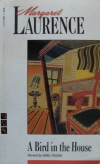
A Bird in the House by Margaret Laurence

A Bird in the House

This is the 4th book in a five-book series that Margaret Laurence wrote about the fictional Manitoba town of Manawaka (based on her hometown of Neepawa). It’s not a “series” in the sense that one normally thinks of a series; the books are only loosely connected–each one has a different main character–and so they really stand alone. There’s no need to read them in order or together.

The 5th book, The Diviners, was given to me as a gift when I was 14. I’d hung onto it and re-read it a few times over the years, and somewhere along the line, I decided I’d like to read the others, so I started picking them up when I saw them in used bookstores (this adds an element of chance to it that I find exciting. YMMV). A Bird in the House was the last of the five that I had yet to read. I found it a few weeks ago.

This is a book that I think I could re-read over and over again. It’s actually not a novel, but eight interconnected short stories. Which is interesting to me, because I’m working on a book like that. The stories center on the childhoood of a girl who grows up to be a writer, essentially depicting the process of how a child becomes a writer. I smirked to (at?) myself in amusement numerous times.

The other books in the series are: The Stone Angel, A Jest of God, and The Fire-Dwellers.

Name Dropping

Back in November, I wrote a post about the annoying overuse of brand names in popular fiction. Well, apparently I’m in good company. Maud Newton posts:

Jessa Crispin hates what she calls “the Emo Boy writers.” (I particularly like her observation that “emo boys namedrop because it’s the only way they know how to explain someone.” Too many contemporary authors replace the individual experience with its pop-cultural echo. Why should anyone read a story if its characters can be evoked solely by reference to punk’s heyday or bad 80’s television?)