Tag Archives: Memoir

Miscellaneous (Mommy)Blogging Quotes

Just some quotes from posts I had bookmarked, which may or may not be useful.

Shirley Jackson might have been a part-time mommy-blogger, had she lived in the internet age. … Life Among the Savages, a memoir of her life raising three small children in Vermont … is a direct ancestor of the current crop of mothering memoirs — someone should put together a history of the genre — and it shares their frequently jokey “if I didn’t laugh, I’d cry” tone, a tone so different from that used in “The Lottery” that I had to check to make sure this was the same Shirley Jackson. The beginning sucked me in completely[.]

Stephany Aulenback

*

The real problem, of course, the real reason why I’m not “squeeing” over BlogHer (ugh, what a word, squee), is that these aren’t really the blogs I read. … BlogHer is a meetup for a particular set of blogging communities, and that’s why people bond and hug and clap and get so emotional. The problem for me is that I read geek blogs and copyright blogs and academic blogs and some politics blogs and some crafts blogs, and those bloggers aren’t at this conference. This conference is for a fairly specific slice of the blogosphere, and I guess it’s not really the slice that I feel at home in.

Jill Walker Rettberg

*

While the first BlogHer conference, in 2005, seemed to be about empowering women bloggers, today, empowerment appears to be about “look how powerful we are, corporations take us seriously and want to give us free swag!” But of course, if blogging becomes mainly about accepting free swag and loving the corporations, well, that’s not empowerment, that’s more like oppression – a slightly more subtle form of oppression, perhaps, maybe willing oppression. It doesn’t bode well for the power of blogging to actually spread the voices of the people, though, if the people are happy to speak for the corporations.

Jill Walker Rettberg

*

Honesty – how truthful do you want to be in your blog? There are plenty of examples of fictional blogs that have presented themselves as real. When readers discovered they were fictional, they felt cheated and became very angry (I’ve blogged about why readers get angry at this. On a smaller scale, most bloggers leave out the ugly bits and maybe play up the good stuff, as in the quote from Lars Tangen in this blog post. I’m not saying you need to be utterly honest (in fact, the more literary blogs get, the less factual truth matters, in my opinion, but you do need to think about this.

Jill Walker Rettberg

*

Dooce.com is now the full time job of both Heather and her husband, Jon. The blog supports an online community and a merchandise store. Heather is the author of a bestselling book, was named by Forbes as one of the 30 most influential women in media in 2009, and just signed an exclusive development deal with HGTV.

In a recent post entitled “Check Up for Self Delusion,” Penelope Trunk, another popular female blogger, recently wrote, “Probably the most accurate representation of women is in the blogosphere. There is no filter here, no need to appeal to both Peoria and Pasadena all at once.” She goes on to compare Dooce.com with an even more popular mommy blog, The Pioneer Woman.

Alaina Smith

*

Probably the most accurate representation of women is in the blogosphere. There is no filter here, no need to appeal to both Peoria and Pasadena all at once. But even the whole of the blogosphere does not represent the female experience particularly accurately.

The Pioneer Woman is largely housewife porn. The men are hot and rugged, just like in a romance novel. The author, Ree Drummond, is running an operation similar to Rachel Ray or Martha Stewart, but she markets herself as a stay-at-home mom, and a homeschooler at that. The whole thing strikes me as totally preposterous. … On Dooce, Heather Armstrong blogs about depression, her kids being difficult, and her parents being Mormon. I love Heather Armstrong. But she’s the gold standard for writing a blog about your life and keeping a marriage together, and she is not, actually, writing about the female experience for married women.

Penelope Trunk

Perfectly Reasonable

The headline of the obituary in the New York Times labelled Salinger a “literary recluse”, which is true enough (though the same paper recently reported that he was a perfectly charming fixture around town, “who arrived early to church suppers, nodded hello while buying a newspaper at the general store and wrote a thank-you note to the fire department after it extinguished a blaze and helped save his papers and writings”). Yet many of his wishes were perfectly reasonable. It is normal not to want journalists appearing on your doorstep, or family members or ex-lovers to publish memoirs about you. However unlikely it is that he ever achieved peace or normalcy, he had every right to seek both.

Bradley Freedman

A wrestling match between hopelessness and something else

[M]y internal life as a writer has been a constant battle with the small, whispering voice (well, sometimes it shouts) that tells me I can’t do it. This time, the voice taunts me, you will fall flat on your face. Every single piece of writing I have ever completed — whether a novel, a memoir, an essay, short story or review — has begun as a wrestling match between hopelessness and something else, some other quality that all writers, if they are to keep going, must possess.

Dani Shapiro

Forms and Shapes and Textures

All my early memories are of forms and shapes and textures. Moving through and over the West Riding landscape with my father in his car, the hills were sculptures; the roads defined the form. Above all, there was the sensation of moving physically over the contours of fullnesses and concavities, through hollows and over peaks – feeling, touching, seeing, through mind and hand and eye. This sensation has never left me. I, the sculptor, am the landscape. I am the form and I am the hollow, the thrust and the contour.

—Barbara Hepworth
in Barbara Hepworth: A Pictorial Autobiography (1978)

Only Moments

Sometimes the most moving, altering moments of life are in fact only moments. Sometimes they are not destined to be novels, essays, or memoirs. Sometimes, there is no bigger picture. There is only the truth, and all that I know of it barely reaches the two-hundred word mark.

April Monroe

Searches for Truths

Members of the OnFiction group have (if I may speak for all of us) been a bit dissatisfied with the idea that non-fiction is true and fiction is untrue. We prefer to see fiction in terms of its subject matter: exploration of how selves make their sometimes problematic ways through the social world.

Uncertainty about what really happened is an issue that rightly exercises historians and journalists. But the deeper issue, raised by [Frederic] Bartlett though not mentioned by [Daniel] Mendelsohn, is that when remembering or, indeed, when trying to make sense of anything for the first time, we are constantly engaged in an “effort after meaning” (Bartlett, p. 20). In his refusal to write an autobiography, Freud wasn’t worrying about truth and untruth, but about truth and lying.

Fiction, then, in which one searches for truths other than those of mere actuality, as if from the inside, may be the real expression of the human effort after meaning.

Keith Oatley

Something that has shifted, profoundly

[C]onfessional memoirs have been irresistible to both writers and readers for a very long time, and, pretty much from the beginning, people have been complaining about the shallowness, the opportunism, the lying, the betrayals, the narcissism. This raises the question of just why the current spate of autobiography feels somehow different, somehow “worse” than ever before—more narcissistic and more disturbing in its implications. And it may well be that the answer lies not with the genre—which has, in fact, remained fairly consistent in its aims and its structure for the past millennium and a half or so—but with something that has shifted, profoundly, in the way we think about our selves and our relation to the world around us.

Daniel Mendelsohn

6 & 7: Anne of Green Gables & The Selected Journals of L.M. Montgomery

Anne of Green Gables by L.M. Montgomery

Anne of Green Gables

Hey! A children’s—and Canadian—classic I actually read as a child. Quel shock!

[Note: If you want to read Anne for pleasure, I don’t recommend this (the Norton) version. It’s great if you’re analyzing the text for an English class (there are lots of assorted extras—essays and such—included), but the footnotes were really weird and distracting. There were all these definitions of common words (e.g. “dinner-time” and “bewitched” !!!) and expressions. I couldn’t figure out who they were targeted at. Surely the target audience of the Norton version (university students) of a book written for 10-year-olds has the sophistication to figure out the gist of words/expressions they’re not familiar with from the context. The only thing I could think of that made sense was perhaps it was aimed at an ESL audience who wouldn’t be familiar with English idioms. But that didn’t really explain including the definitions of words that could be looked up in a dictionary.]

Re-reading a book is often as much about the memories of past readings it’s tied up with as the contents of the book itself. My first encounter with L.M. Montgomery was via a boxed set of the first three Anne books that I received as a 10th birthday gift. Because I actually owned them, I re-read those three books over and over, but my most distinct memory of reading them is the first time: in August heat on the upper bunk of our camper as we made our way home from Ontario where I’d spent the summer.

One odd thing I remember is that whenever I re-read AoGG, I always started with chapter 4. Re-reading the book now I’m not sure why I did that. Maybe I found them too slow-paced or perhaps too focused on the grown-ups (chapter 1 starts with Rachel Lynde!). Another uber-geeky memory: the public library didn’t have the other books in the Anne series so I ordered them through inter-library loan. Don’t ask me how I knew to do this. I must’ve asked about them and the librarian suggested it.

Because they were all library books, I never re-read any of the other Montgomery books until one summer in undergrad when I decided to work my way through her entire oeuvre (holy geek summer project, batman!). So the remainder of the Montgomery books I have date from that summer.

Another weird thing: though once I read the Emily books, I preferred her to Anne (because Emily was the real writer), I don’t have a distinct memory of reading Emily of New Moon for the first time, the way I do with Anne of Green Gables. Probably because I just read it in the usual places (you know: in bed when I was supposed to be asleep, under my desk when I was supposed to be doing schoolwork, on the way home from school when I was supposed to be paying attention to where I was walking…) I do know when it was, though, because I wrote it down in my journal. In the same entry I wrote that was going to be a writer when I grew up. I was 12.

Which leads me to…

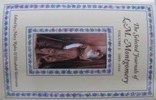
The Selected Journals of LM Montgomery, Volume I: 1889 – 1910, edited by Mary Rubio & Elizabeth Waterston

The Selected Journals of L.M. Montgomery

I was enthusiastic about reading this, the first volume of Montgomery’s journals. I like reading artists’ and writers’ journals/memoirs/biographies just in general, but having read most of Montgomery’s fiction, I was curious to see “behind the scenes” in her writing process and in particular, how her self-representation matched her fictional representation, particularly in the Emily books.

To be clear: Emily writes about writing: her process, her failures, her successes. So, I guess I went into this expecting a real-life version of Emily’s journal (not the same events/people, obviously, but the same style). What I got was cognitive dissonance, because Maud hardly writes about writing at all. Mostly she writes about her friends and relatives, school and work—the everyday stuff that anyone who’s kept a journal has written about. She doesn’t even mention AoGG until she announces that it is going to be published!

While it’s fun to guess at who she modeled various characters after and to recognize stories and anecdotes that she recycled into her fiction, the fact that she doesn’t write more about writing is perplexing. From the beginning, she intended for the journals to be published after her death (because she anticipated that she would by then be a famous writer), and clearly, as the Emily books demonstrate, she knew people are interested in a writer’s writing process. So why isn’t it there?

My theory is this: a few years before she wrote the Emily books, Maud apparently took all her old journals and transcribed them into new notebooks, ostensibly so all her journals would be in books of a uniform size. There is speculation, however, that she didn’t just copy her old journals word for word (as she claimed), but that in fact, she edited them at this time (she was famous by then and knew for sure that her journals would be published). Thus, my (completely unprovable!) theory is that when she did this she excised all the writing-about-writing parts and then used those in the Emily books. I think that she did this because then she could use those experiences as Emily’s without having to deal with Emily = Maud speculation. Of course, that happened anyway ;-).

Links:

4: Roughing It in the Bush

Roughing It in the Bush by Susanna Moodie

Roughing It in the Bush

Roughing It in the Bush is often cited as an early Canadian classic. At the same time, its Canadian-ness has also been questioned. For one thing, Moodie started writing about Upper Canada (now Ontario) in the 1830s, thirty-plus years before confederation (so maybe it’s not an early Canadian book, but a late British North American colonial book). As well, Susanna Moodie was an immigrant who wrote about her experiences from that perspective (so maybe she should be thought of as an English ex-pat writer, not a Canadian writer). Of course, “what does it mean to be Canadian?” is the quintessential Canadian-dilemma, so I think she qualifies on that count 😉 Really, I think she can be thought of as either—or both. Just depends on what you’re looking for.

Roughing It is an account of the middle-class Moodies’ first years in North America. Susanna and her husband John were woefully unprepared for life in the “bush,” which made for lots of good material for Susanna to write about. Although it’s supposed to be non-fiction, it seems pretty clear that the character “Susanna Moodie” is a lot ditzier than the writer Susanna Moodie was, i.e. that the stories were embellished to make them more funny and entertaining. While the writer Susanna Moodie was writing by candlelight and sending her stories and poems to magazines and newspapers (when she could afford stamps), the character “Susanna Moodie” was busy acting clueless and getting into scrapes to provide fresh material.

Which… you know… sounds a lot like a present-day memoir! Actually, my immediate reaction after I finished reading the book was that if Moodie were around today she’d be a blogger. Think about it: the book is a collection of anecdotes and poems and other ephemera, with the occasional chapter contributed by her husband or brother (guest posts!). Throw in a fish-out-of-water scenario, add a dash of hyperbole and a pinch of drama,  and voila! Recipe for a successful personal blog. And of course, she was a mother, so you might even call her the first Canadian mommyblogger 😉

Links: