
[I]t would be terrifying if we, as adults, changed as much as children during those early years. We’d all be awash with anxiety and engulfed by a grief so large it couldn’t be contained because there would no stability and cohesiveness in our lives at all. We would have no moorings, nothing to keep us tethered to this earth.
We count on a high degree of sameness not only in ourselves, but also in the people we care about. … It’s not just the capacity to change, but also the capacity to resist change, that stabilizes our sense of identity, our continuity with the past, and our connections with others.
Monthly Archives: September 2010
Empathy [and] Complicity
Reading narrative requires empathy. The character’s perspective becomes your own, and through this relationship you begin to feel as another person would. …
But stories also require complicity: the reader participates in the action of the story simply by imagining and interpreting it.
16: Not in the Flesh
Not in the Flesh by Ruth Rendell

This was also from the library book sale. Yes, I read two Ruth Rendells in a row. Mysteries are just so cozy and comforting. Even with all the dead bodies 😉
Not in the Flesh had a weird juxtaposition with An Unkindness of Ravens. AUoR was all about typewriters; NitF was all about computers! As in, transferring records to them, getting used to using them, etc. Just kind of funny.
This was also an Inspector Wexford mystery, so had many of the same characters from AUoR. The main plot involves the finding of two long-dead bodies (not at the same time. first one, then later the other). Despite a large cast of quirky characters, the plot in this one wasn’t that difficult to figure out.
There was also a side plot about Somali immigrants and female genital mutilation, but unlike the social issue in AUoR (feminism), which was integrated into the plot, this wasn’t tied into the main plot at all as far as I could see.
That Narrative
It’s a grey ethical area for writers. Memoirists are vampires and thieves, you might say: vampires and thieves with shards of ice in their hearts. However much [Candia] McWilliam may want us to think about her story in terms of the sentences, of course we are also interested in the sense. In a prurient (or perhaps hope-filled) desire to read about how a famous novelist hit the bottle and rock bottom and then somehow got her life together again. Yes, of course that’s a deliberately clichéd version of her story and an unfair reflection of McWilliam’s rich writing. But it would be naïve to suggest the book won’t be read for that narrative.
Sports Double-Header
BC Lions Game at Empire Field:

Did you know the cheerleaders are called the “felions”? I did not know that.
I think they all go to the same weavologist 😉

Vancouver Canadians Game:

They have sushi mascots! (soooo Vancouver!)

15: An Unkindness of Ravens
An Unkindness of Ravens by Ruth Rendell
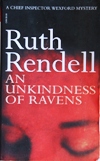
Picked this up at the library book sale earlier this year.
This was my first Ruth Rendell writing as Ruth Rendell book, but I’ve previously read several of her Barbara Vine books: Grasshopper, The Chimney Sweeper’s Boy, Asta’s Book, and No Night is Too Long.
The Unkindness of Ravens was a standard police procedural, featuring a bunch of characters who are apparently regulars, including the main detective, Chief Inspector Wexford. The Barbara Vine books are more dark, psychological thrillers. I think I prefer those, but this was an entertaining mystery nonetheless. I do love police procedurals.
Anyhow, the plot involves a husband who’s vanished (things aren’t what they seem… naturally!) and a group of militant feminists (really!). It was written in 1985, and a typewritten note / typewriter is one of the clues, so there was a somewhat amusing discussion of the idiosyncrasies of typewriters.
A bit of an aside, but that ties into something I was thinking about recently. You know how people always say technology immediately makes a book/movie feel “dated”? You know, in a pejorative way. I don’t think that’s always the case. I think 20-year-old books/movies that were set in present-day and used present-day technology (at the time) don’t feel “dated.” It’s more like… they feel like period pieces. The technology is right for the time period, so it doesn’t stand out particularly. Or, you notice it but in huh, I’d forgotten/didn’t know that kind of way. That’s how this book felt.
Where technology does end up feeling really dated is in books/movies that are supposed to be set in the future. Yeah, 20 years later, that’s almost always hysterical.
Tragic Desperation
Reading someone’s handwriting can be incredibly intimate and revealing, perhaps especially in an age of e-mail and texting. The confines of font streamline and depersonalize emotionality, in contrast with the romance of thoughtful script or the tragic desperation of slanted scrawls.
Now I have a new phone…
…I get to download apps. So far, Retro Camera is one of my favorites:


Coolness!
Landscape
Book-lined rooms were part of our shared domestic landscape. To walk into a house with books was an unspoken promise of conversation that would jump beyond the events of the day. Brightly colored book jackets, waving for attention, were also good companions, a linear museum of handsome typography and graphic design through the decades.
The Birds
So there are these two giant birds down at the Olympic Village:


Apparently they’re sparrows.I don’t think these photos do them justice. They are very large.
 The Remainder Table