Author Archives: Theryn

9: The Thing Around Your Neck

The Thing Around Your NeckThe Thing Around Your Neck by Chimamanda Ngozi Adichie

4 out of 5 stars.

Bought at the Book Shop in Penticton.

Read in June 2014.

View all my reviews

The stories…

  • “Cell One” — Nnamabia, the teenage brother who’s getting into trouble, ends up in jail.
  • “Imitation” — Nkem, the wife who lives in “America”* with her children, while her husband, a Big Man, lives in Nigeria.
  • “A Private Experience” — Chika, who is Igbo and Christian, is helped by a woman who is Hausa and Muslim when they are caught in a riot.
  • “Ghosts” — retired professor at university to check on his pension that never comes, runs into colleague he thought was dead for past 30 years.
  • “On Monday of Last Week” — helicopter parent dad, artist mom, babysitter who gets her hopes up.Books from The Book Shop
  • “Jumping Monkey Hill” — writers retreat in S. Africa, organized by lecherous old man. Story within the story (i.e. workshopped story) is based on real life, but ‘not plausible’ to old man, of course.
  • “The Thing Around Your Neck” — winning the American visa lottery, give and take, and the American bf who thinks he understands it all.
  • “The American Embassy” — the journalist’s wife applying for asylum after her husband flees and her son is accidentally shot/killed by the government agents looking for him.
  • “The Shivering” — the grad student at Princeton who’s visited by a neighbor who she assumes is a student, too. They become friends and she discovers he’s not.
  • “The Arrangers of Marriage” — the new wife whose husband is trying too hard to assimilate and, oops, has failed to mention he’s already married.
  • “Tomorrow is Too Far” — the woman absorbed with guilt over the death of her brother when she was 10.
  • “The Headstrong Historian” — family history from grandmother Nwamgba to granddaughter Grace/Afamenfuna, who becomes a historian, reclaiming the stories that had been suppressed by colonial rule.

I especially liked “Jumping Monkey Hill” and “The Headstrong Historian,” but these stories are all so good. They read so effortlessly, which means the crafting of them was quite the opposite.

(*language tangent: Canadians don’t say “America”; we say “the States” or “the US” b/c Canada is also part of America-the-continent. “American” as a demonym for citizens of US is weird, when you think about it. People from all countries in the Americas are Americans. I’ve seen people on Twitter use “USian”—maybe that will catch on?)

the finish line

The finish line at the end of a career is no different from the finish line at the end of a match. The objective is to get within reach of that finish line, because then it gives off a magnetic force. When you’re close, you can feel that force pulling you, and you can use that force to get across. But just before you come within range, or just after, you feel another force, equally strong, pushing you away. It’s inexplicable, mystical, these twin forces, these contradictory energies, but they both exist. I know, because I’ve spent so much of my life seeking the one, fighting the other, and sometimes I’ve been stuck, suspended, bounced like a tennis ball between the two.

Andre Agassi

So. Real. I don’t think it’s ‘inexplicable’ or ‘mystical’ though. Isn’t it obvious what pushes you away from the finish line? Once you cross it (unless you’re in a position to rest on your laurels for the rest of your life, which most of us are not), you have to find a new goal, start over. Starting is always hard, but it’s even more so when you’ve been focused on a major goal for a really long time. And when you’d like to something different than what’s seen as the natural next step, the decision can be fraught.

I’m not done my dissertation draft, but I’ve officially reached the point at which I would have a 12- to 15-page paper the night before it was due (all-nighters ftw). Which means for the first time in this process I can see the finish line. Realistically, a few more weeks and I will be sticking a spork in it. I’m… relieved. Maybe the thrill will come later, after I’ve finished formatting it (so not looking forward to that), or after the feedback process, or after the defense, or after the official “yes, you are graduating” notice, or… well, let’s just say, I’m not one for counting my chickens before they’re hatched. But a weight lifted this week.

not writing

Many of the successful published writers I hear talk on panels at conferences make it sound as if they are writing machines, as if they haven’t taken a day off from writing in years. Part of my success as a writer was not writing. If I hadn’t spent all those years teaching and reading and editing the work of other writers, I am certain I wouldn’t be the writer, and person, I am today. There are infinite ways to be a writer with a capital W, just as there are infinite ways to tell a story.

Julia Fierro

10: V is for Vengeance

V is for VengeanceV is for Vengeance by Sue Grafton

My rating: 3 of 5 stars

From the Fall 2013 VPL Book Sale.

Read in June 2014.

View all my reviews

So like all the notes I jotted down while reading V is for Vengeance were names of characters and their relationships to other characters. I don’t know. I guess I was having trouble keeping track.

Anyway, I guess the mc who is not Kinsey is Nora. In the prologue (1986, because aykb, Kinsey is stuck in the ’80s), Nora’s son is murdered because gambling debts. In the present, which is 1988, hVPL Fall Book Saleer husband is having an affair with his secretary, and Nora starts up an affair with the crime boss (Dante) whose minions killed her son. Awkward.

Dante runs a shoplifting ring. Kinsey is buying underwear when she witnesses one of his minions shoplifting, and then is almost run over by another minion (there are a lot of minions). Then one of the minions turns up dead. Meanwhile… Kinsey’s landlord Henry has to go to Detroit because his 99yo sister broke her leg tripping over a cat, and his brother William convinces Kinsey to attend the “visitation” for the dead minion. Not that he knows the minion, he’s just obsessed with death or something.

Ok, I’m loling at this description, I mean, it’s all kind of ridiculous, but it was an entertaining kind of ridiculous.

8: Samantha’s Secret Room

Samantha's Secret RoomSamantha’s Secret Room by Lyn Cook

My rating: 3 of 5 stars

Borrowed from the VPL (Central Branch).

Read in May/June 2014.

View all my reviews

After I posted about the children’s book that changed my life, I received a comment with a link to a review that confirmed Samantha’s Secret Room was in fact the book I remembered. I checked the VPL catalog and they had a copy (the 1991 reissue), so I took it out the next time I was downtown. I took copious notes, so WARNING, spoilerific recap to follow. If you don’t want to know the plot of this 50-year-old book, flee now!

SPOILERS * SPOILERS * SPOILERS

Continue reading

Some things I read this month

7: An Untamed State

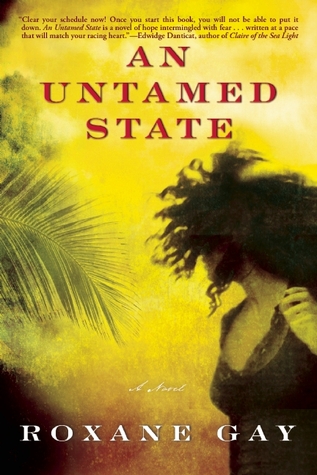
An Untamed StateAn Untamed State by Roxane Gay

My rating: 5 of 5 stars

Purchased at Chapters on Robson.

Read in May 2014.

View all my reviews

Disclaimer: I am such a Roxane-with-one-N fangirl. I read everything she writes. I’m not objective at all when it comes to her writing.

Back in 2012, I read Ayiti, her story collection. An Untamed State grew from the standout of that collection, “Things I Know About Fairy Tales.” When I was looking for that post, I came across this Roxane quote from 4 years ago:

My parents will not consider me a real writer in a way they can truly understand until they can go to Barnes & Noble and find something I’ve written, not in an anthology, but with my name alone on the spine. My writing career is the least relevant thing about me when it comes to my family and friends. It’s not that they don’t care but honestly, they do not care.

Welp. 😉

The opening of An Untamed State is intense. The story goes right into the action, without any build-up. (Aside: take note everyone who likes to begin stories with their MC sitting around thinking to themselves.) Mireille is kidnapped in front of her parents’ house in Haiti. Her husband Michael and son Christophe are in the car with her, but they are not taken. She’s held for ransom because her father is wealthy, but he refuses to pay. Her captors begin raping her repeatedly.

In between these very intense scenes, the backstory is filled in via Mireille’s memories. I liked how this was structured because a) it was realistic (what else would she do alone in a room with nothing to do but escape into her head) and b) it pulled back from the tension a bit so it wasn’t relentless. Although, in its own way the backstory was intense, especially Mireille and Michael’s “fairy tale” romance.

The novel starts where “happily ever after” leaves off, playing off both the sunny Disney versions of fairy tales we’re all familiar with and the dark, twisted original stories that didn’t hesitate to make readers uncomfortable.

There is empathy for all the characters, which I loved, because people are gray and it annoys me when protagonists are portrayed as angelic and antagonists as evil. It’s too simplistic. So characters like Mireille’s father and the various captors are given the opportunity to show their humanity, and Miri is allowed to be flawed. She’s been criticized for being an “unlikable” character but real people are flawed, unlikable, prickly and you still empathize with them. At least, I hope you do? Because you don’t have to be perfect to deserve to be treated decently and not have terrible things happen to you. Honestly, when I think about the fictional characters I like the most, it’s always the ones I empathize with because of (not in spite of) their flaws. I like “unlikable” characters.

The overarching milieu of the story is rich country vs. poor country, rich vs. poor within a country, etc. and the tension between meritocracy, diying yourself to success vs. how much you should help others who can’t/won’t do what you did. But there are so many layers…

The story is in two parts, and in the second part, the After, Miri deals with how she can’t go back to how it was before. Reading this right after Speak was unintentional, but an interesting juxtaposition. Both have main characters who don’t deal with trauma the way society wants them to.

One aspect of the After is karma, or just kindness circling back. Miri was kind to her mother-in-law, Lorraine, when she was sick, even though Lorraine didn’t want her there, and now Lorraine is there for Miri when she needs help, even though Miri doesn’t want the help either. It addresses how sometimes the people who are supposed to be the closest to you (in Miri’s case, Michael) can’t give you what you need. Sometimes it’s someone a step away who is better able to care for you. Maybe it’s more objectivity? That they can see the forest and not be blinded by the trees, everything fraught from the past.

Vacation

Writers on Vacation by Debbie Ridpath Ohi

I don’t think you can expect to keep up your writing routine, whatever that is, when you’re on vacation with other people who are not writers. If you’re on vacation with family or friends, you’re probably crammed into a car or a room with them much of the time, and the times when you’re not they’re going to want you to “do something” with them not “sit and stare at your laptop.” Writing! It’s totally the same as putzing about the interwebs!

When I was a kid, I always used to take my binder of writing projects (mentioned here; all fortunately long-ago destroyed) with me on family vacations—and bring it back untouched. When did I think I was going to write? In the backseat of the car, with my brother poking me? In a motel room with my parents and brother and the TV competing for my attention? In line at an amusement park? It was wildly unrealistic.

You’d think I’d have learned from my youthful experiences, but no. In subsequent years, I kept doing the same thing in whatever its current incarnation was, printing out my current project “to work on” in desktop days, hauling along my laptop in more recent years. Actual writing done on communal vacations: not much.

Back in the day I had the aforementioned binder containing works-in-progress, a journal (my secret book), and my commonplace book. What I didn’t have was what I really needed for those trips: a writer’s notebook.

For a long time, I carried notebooks around with me, but they weren’t writer’s notebooks, they were journals. Journals can be wonderful, but inherent in the format are certain expectations, chiefly, that you will update them on a somewhat regular basis with semi-coherent, narrative entries. Such expectations (even if self-imposed) meant that writing in my journal often felt like a chore at the end of a long day, rather than a respite from excesses of sun and socializing.

I wish it hadn’t taken me so long to discover the beauty of a writer’s notebook. A writer’s notebook contains no expectations, implicit or explicit. You write in it when you want. You write in it what you want. It’s not your work-in-progress, your journal, or your commonplace book—but it might be a bit of all of these, plus your reading log, your to-do list, your address book, and anything else you want to throw in there. It’s a mutt, a messy hybrid. The perfect thing to take on vacation when you know you’re not going to have a lot of time to yourself.

With my writer’s notebook, I never feel stressed about not writing enough on vacation—whatever I end up writing, even if it’s just one word, is just the right amount. After all, you never know where that one word might lead…

Of course, there’s another kind of vacation. The kind you go on alone (or maybe with other writers). It might be a formal writing retreat, or perhaps a solo adventure of another kind, but either way, you get to set the schedule. Which means you can write as much as you want without ever getting the “you’re still on that computer?!” look from anyone.

When I finally finish the dissertation I’m taking a real vacation. Alone. Perhaps I will bring along a story or essay to work on—then again, maybe not. But I will definitely scribble in my writer’s notebook.

Vacation
All I ever wanted
Vacation
Had to get away
Vacation
Meant to be spent alone

(I love how this—the official video—sounds exactly like a crappy old cassette. I mean, how else would you expect it to sound?! 😉 )