Author Archives: Theryn

I Said It First

So last night we had AC360 on and he did a segment on the current annoying trend for everyone and their dog to go into “rehab” to mend their public image after they’ve committed one transgression or another. The thing is, I commented on this a while ago—it’s now almost a rite of passage for celebs and (especially) pseudo-celebs to party a little too much, do a few dumb things, and then go, “Hee hee! I’m off to rehab!”, which seems to trivialize genuine alcoholism, drug addiction, etc. Of course, no one was listening to me because I’m not on TV.

Then just now I’m catching up on my many Bloglines feeds and I run across this Maud Newton post about John Steinbeck, East of Eden and Journal of a Novel, which a number of people seem to have referenced. But wait! Sound familiar? As a matter of fact, I wrote about this first! Yep, I scooped Maud Newton. Oh yes, I did. 😀 Muahahaha.

(Note to self: this writing stuff down business can be very gratifying!)

Sit On Your Fingers

As my co-editors will attest, I am unfailingly polite in my responses to all the questions that we receive at TC, even the silly ones (there are no dumb questions! 😉 ). I know this is the Right Thing To Do, the choice I will not Live To Regret. But of course, there’s always a part of me that’s dying to write what I really think. I don’t, of course. Because I’m mature and all. Unlike, say, our “honorable” (ex-)Minister of State for Mining, Bill Bennett, who wrote this charming response to a constituent (scroll down).

Bwahahahaha. And also, yikes. And that kids, is why you sit on your fingers instead of hitting send. Thanks for the reminder, ex-Minister Bill!

Memory

In their first tutorials, I asked my students what the first news/media event they remembered was. It’s a 100-level class, so some of them are 18. This is some of what they came up with:

Iran-Iraq War (1980-1988)*
Velvet Revolution (1989)*
San Francisco earthquake (1989)*
Gulf War (1990-1991)
Blue Jays win World Series (1992/1993)
Kurt Cobain commits suicide (1994)
Canucks lose in game 7 of Stanley Cup final / riot ensues (1994)
OJ Simpson car chase / trial (1994-1995)
Princess Diana dies (1997)
Y2K (1999)
September 11, 2001
Michael Jackson dangles baby over balcony (2002)
Tsunami (2004)

The students who listed the earliest events (marked with asterisks) all stated that they remembered them because they were there when the event happened (so it was a personal memory as well as being a media event). Mid-90s was what I expected. The more recent events… well, I’m pretty sure that they all can remember further back than 2 years ago. (Some of them even listed stuff that happened this year!) I figure those students just said the first thing that came to mind (rather than their first-ever memory). But… I suppose it is possible that 9/11 is the first big event that some of them remember.

Feel old yet? 😉

3: The Namesake

The Namesake by Jhumpa Lahiri

The Namesake

Another book picked up at The Book Shop last summer. Interestingly, once I started reading it, I realized I’d read part of this as an excerpt in The New Yorker in the summer of 2003 and remembered how much I’d liked it.

This book was awesome. I loved it.

I mean, the main metaphor throughout the book is the main character’s name. Heh. So an obsession with names can be turned into a book. 😉 Another interesting detail: it’s written in present tense, which I noticed on some level but didn’t consciously think about until I was about halfway through the book. And then I sort of went, “Hmm, this pretty much disproves the theory that you can’t carry off present tense in a novel.” So there, haters.

What else? Her descriptions are amazing. Don’t read this book when you’re hungry. What sucked me in right from the beginning, I think, was that this book begins the month/year I was born—the MC’s lifespan exactly matches my own. I guess we’re getting into an era now where I’m going to see this more often, as writers who are my age become established, but it stood out because I’m so used to reading books by older authors (who tend to write about their own generations).

What was unexpected (given the emphasis on the first/second generation immigrant aspect of the story in reviews & such) was how much I identified with the circumstances of the book. I also grew up the child of parents who moved far away from where they grew up. In their case, it was only cross-continent, but our visits were even more infrequent (and shorter) than the ones in this story, so I get that whole tenuous relationship with relatives who are really just names to you, turning friends into family, trying to figure out what/where “home” really is thing.

This book doesn’t have a traditional plot so it isn’t something that’s going to appeal to everyone. I glanced at the Amazon reviews and a lot of the more negative reviews were comments along the lines of “nothing happens,” which is true in a way, but I think misses the point. I will definitely be checking out her collection of short stories, Interpreter of Maladies.

2: Ricochet River

Ricochet River by Robin Cody

Ricochet River

I heard about this book when there was a controversy over the author rewriting certain passages so the book banning crowd would stop trying to prevent its use in schools. I wrote about it here. Now, I can understand the author wanting his book to be picked up for school reading lists. This is a first novel with regional appeal published by a small press in the early ’90s. If schools hadn’t taken an interest in it, it would almost certainly be long out of print.

I, of course, read the original version, not the revised version. Every summer we go to Penticton where there is this great used bookstore called The Book Shop. So many books. You should go! Anyhow, last summer I ran across this book at The Book Shop and I had to get it, if only to see what was so controversial about it.

Sigh. Yeah, I don’t know. People are whack when it comes to sex. There are two sexual passages in this 266-page book. Both are appropriate to the context of this story and these characters and would be perfectly fine for high schoolers to read. As for the drinking & driving and language choices—it’s a period piece. I think all too often people forget how things were in the not-so-distant past. Would be better to use these things as points for discussion rather than getting all revisionist and sweeping them under the carpet.

This is a coming-of-age story set in 1959-60 in a small Oregon town. I liked the West Coasty-ness of it; the setting was very authentic. The narrative voice was engaging. Storytelling (i.e. the characters telling stories to each other) plays a significant role in the book and this is, I think, what sets this story apart from others in its genre, but at times this device bogs the story down. The story itself is a quiet one with no dramatic plot developments—except for the ending. On the one hand, an ending in this vein was inevitable. On the other hand, what happens is perhaps a bit too surreal. But perhaps not. I think the author was going for a sort of magical realism thing, tying the events of the story to the myths & legends of the storytelling. If there had been a tighter linking between the two streams all along it would have both evened out the pacing and made the ending a better fit. Nevertheless, it was a pretty good first novel.

1: The Great Failure

The Great Failure: A Bartender, A Monk, and My Unlikely Path to Truth by Natalie Goldberg

The Great Failure

Hey, look, it’s day 1, and I’ve already finished my first book of the year!

I spotted this on one of the remainder shelves at Chapters last week. Last book purchased; first book read. All the books on my “to be read” pile are jealous. But I figured (a) it would be a quick read, and (b) what more appropriate way to start off than with a remaindered book?

So, it was a quick read obviously. This is a brief memoir of Natalie’s relationships with her father and her Zen teacher and her coming to grips with them being human, i.e. flawed. Essentially, it is about her figuring out whether she is able to admire/love people even when she feels that they have disappointed/betrayed her by their actions (or inaction, in the case of her mother).

I’ve read most of her books. I like her writing books best. This one… well, it was interesting, because I’d read the others. But on its own, I could take it or leave it. Writing Down the Bones was truly a book that changed my life. Wild Mind and Long Quiet Highway were also lovely books. I found her novel disappointing because I like what she writes about—her ideas—more than how she writes. Her writing style is very simple and straightforward to the point that I find it almost clunky. It’s a style that works for a book on writing practice, but, I think, works against her in a narrative. After reading her writing practice books, I had high expectations for her novel, Banana Rose; I suppose I expected that all that writing practice would have led to a tangibly more polished narrative writing style. But it wasn’t. I realized that’s just how she writes.

The Great Failure didn’t resonate with me in the same way as her earlier work did. It’s not that I couldn’t understand where she was coming from; I could. That part was fine. But I think if you’re going to write about how people have disappointed and betrayed you, you also have to turn that around and dig into how you may have disappointed and betrayed others. She touches on this, but she doesn’t dig into it. I also didn’t feel that she was breaking any new ground here; the realization that people—even people you respect and trust—are human/flawed isn’t particularly insightful on its own. I think probably everyone has had to accept (in order to move on) the fallibility of a parent or parental figure at some point in their lives. And I’m not saying that that’s not a difficult thing, but… she wasn’t sharing with a friend; she wrote a book. There has to be something more than that, I think. A deeper insight.

Also, she seemed unable to accept that not everyone has an inner life (well, an inner life of substance), that people are, in general, not really that interested in your interests no matter how close they are to you, and that no one else will ever see the same events from the same perspective as you. In my un-expert opinion, her constant fight against these things didn’t seem very Zen. Once you accept these things, it is much easier to be content.

I wanted to read this because it was a Natalie Goldberg book, but maybe it was a book I just didn’t need to read. Perhaps for someone else, it could be the right book at the right time, the way WDTB was for me.

Festivus Scones

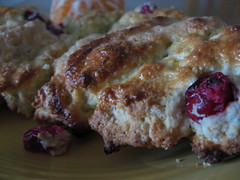
Festivus SconesFor Festivus breakfast, of course.

Combine 1¾ cup flour, 2½ tsp baking powder, 3 tbsp white sugar, and ½ tsp salt. With a pastry blender or two knives, cut in ¼ cup chilled butter until the mixture resembles coarse crumbs.

Stir in 1 cup coarsely chopped cranberries and 1 tbsp grated orange peel.

Lightly blend in ¼ cup milk, 2 tbsp orange juice, and all but 2 tbsp of 2 slightly beaten eggs.

Turn onto an ungreased cookie sheet and pat into a ¾-inch thick circle. Spread reserved eggs over top and sprinkle with sugar. Cut into 8 wedges. Bake 12-15 minutes at 400°F or until golden.

Gingerbread

Gingerbread BearMeasure 3 cups flour, 2 tsp cinnamon, 2 tsp ginger, ½ tsp baking soda, and ½ tsp cloves into a medium size bowl. Stir until well combined.

Beat 1 cup unsalted butter with 1 cup brown sugar until very creamy. Gradually add ½ cup molasses and beat until well blended. Stir in flour mixture until well mixed.

Gather dough into a ball. Roll out ¼-inch thick on lightly floured surface. Cut out dough with cookie cutters. Bake 8-10 minutes at 350°F.