
Graduating … means you have experienced success already. And some of you – and now I’m talking to anyone who has been dumped – have not gotten the job you really wanted or have received those horrible rejection letters from grad school. You know the disappointment of losing or not getting something you badly want. When that happens, show what you are made of.
Secret Book
The first book that comes to mind in answer to the question “what children’s book changed your life?” is not one of the famous ones. It’s the lost-in-the-shadows-of-A-Wrinkle-in-Time Madeleine L’Engle book, Meet the Austins.
However. There is another book, even more obscure. So obscure that I couldn’t remember the title or author or the main character’s name. This is what I did remember: secret book, Christmas tree farm, root cellar. It turns out that was enough (thanks to Loganberry Books and their Stump the Bookseller archives):
Lyn Cook, Samantha’s Secret Room, 1963. Scholastic Canada. Samantha (Sam) lives on a rural property in Canada and gains a penfriend by tying a letter to a christmas tree. The caravan belongs to a cousin who comes to visit for a family reunion. The secret room is in a root cellar.
The weird thing is the phrase “secret book” is actually in the solution for the book above this one and so far I haven’t found it mentioned anywhere else. So, hmm. This is definitely the book I was thinking of, though, so if it’s not the one with the secret book, I would be perplexed.
Anyway. IIRC, the “secret book” was a journal kept in the secret room, and it’s where I got the idea to start keeping a journal in an ordinary notebook (vs. a diary in one of those dated books with a lock that I always failed at). I even wrote “secret book” on the front of my first notebook. Haha. All it was missing was a “keep out. this means you.” I did not have a secret room. (Sadness. I really, really, really wanted a secret room.) I did not even have a secret drawer in my desk. (Moar sadness. Also really, really, really wanted a rolltop desk with secret compartments.) So yeah. My secret book was kept in my desk shoved underneath whatever else was in there. Not too secret.
But it’s that not-so-secret secret book was the notebook in which I first wrote that I wanted to be a writer when I grew up (which I wrote about here). And I kept writing in that book until I filled it up and started a new book and so on and so on. So that’s why Samantha’s Secret Room is the children’s book that changed my life.
This is everything I could find about Samantha’s Secret Room and the author Lyn Cook:
- A review of Samantha’s Secret Room from 1992 (it was re-issued in 1991) in CM: A Reviewing Journal of Canadian Materials for Young People. This review mentions Sam’s journal, but not the secret book:
The story’s events, which are occasionally related via Sam’s journal entries, occur against a backdrop of the daily and seasonal responsibilities of farm life.
The thread tying the book together is Sam’s continuing search for a secret room that belonged to her early nineteenth-century namesake. Sam, whose own secret place to be alone is the root cellar, believes the other hidden space to be located somewhere in their old twenty-room house.
(And now, I’m beginning to think that the secret book is a giant spoiler, i.e. it wasn’t Sam’s book, but the one she finds in secret room #2, and that’s why no one’s mentioning it. I will refrain from mentioning where SR #2 is located, which is something I do remember.)
- It has a Goodreads page. (Just added it. Now I won’t lose it again.) There’s not very much information on it, and only a few reviews, all from people who remember reading it as kids. Lots of 5-star ratings, though.
- erm, apparently there are people who track “the oldest living writers.” ok. Lyn Cook is on this list, dated January 2014. She was born in 1918.
- She’s also on this list of Famous Canadian Women. “May 4, 1918 – Born Lyn Cook (1918 – ) 1st author to have books for youth published after WW ll.”
- She’s listed at A Celebration of Women Writers. “Waddell, Evelyn Cook [aka Lyn Cook; Margaret Culverhouse] (1918 – )” That one had links which led me to…
- A review of a different book by Lyn Cook, The Bells on Finland Street. The intro blurb says:
“Lyn Cook” is the short name for Evelyn Margaret Cook Waddell, who was a presenter for CBC Radio in the 1940s and 1950s. Her weekly half-hour radio programme, “A Doorway to Fairyland,” had child actors voicing the parts of characters in the books she presented. The Bells on Finland Street is her first novel, and was followed by a number of novels for young readers. Because her written work includes publications before 1950, she is on the list of authors to be included in the Canada’s Early Women Writers (CEWW) database, part of the Canadian Writing Research Collaboratory (CWRC), being established at the University of Alberta.
- …and this post from 2012 about a poem Lyn Cook published in the 1940s (using her grandmother’s name, Margaret Culverhouse):
Only two of the authors our project deals with are actually still alive. … children’s author Lyn Cook, otherwise Evelyn Cook Waddell. I telephoned Mrs. Waddell a week or so ago, as I was flying out to Ontario, where she lives. I was unable to meet with her, as she lives farther than I thought from my destination, but we spoke for quite a while about her years as a CBC children’s radio show host, and her life as a mother and children’s author in the 1950s and 60s.
I thought “A Doorway to Fairyland” might be in the CBC’s digital archives (there is lots of cool old stuff there), but nope. I did run across this, though:
Thursday, April 26, 2012: Singer-songwriter Bonnie Ste-Croix traveled the whole country recording her latest album, Canadian Girl, but she always finds her way home to Gaspé. Bonnie shares a book that was a childhood favourite, Samantha’s Secret Room, by Lyn Cook.
An audio clip seemed like an appropriate way to wrap up this post, but it’s not working for me. Well, maybe that’s even more appropriate for an out-of-print almost-but-not-quite-forgotten book.
writing has a pattern
The whole point is that writing has a pattern and life hasn’t. Life is so untidy. Art is so short and life so long. It is not possible to have perfection in life but it is possible to have perfection in a novel.
I subscribe to The New Yorker fiction podcast and one of the recent ones was “Paul Theroux reads Elizabeth Taylor.” Elizabeth Taylor? hmm, weird. Sure enough, there’s another Elizabeth Taylor, an English novelist. This quote is on her Wikipedia page (and elsewhere), but no one seems to cite the original source.
radical revision
For the same reason that most businesses fail slowly (by focusing on small details instead of big-picture stuff), most writers can’t get their work better than a certain level of passable mediocrity because they’re “optimizing” the small stuff before they hit on a project that’s worth optimizing. They approach revision by thinking about word choice and commas and cuts and line breaks, but those things can only make a poem or a novel or whatever 1-5% better. A radical revision that completely rethinks the scope or the flow or what have you could make it twice as good.
6: Speak
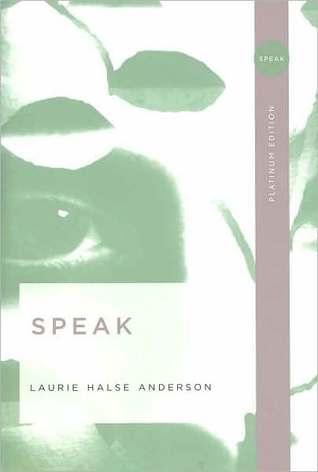 Speak by Laurie Halse Anderson
My rating: 3 of 5 stars
From the Fall 2013 VPL book sale.
Read in April/May 2014.
I picked this up because it was one of those books I’d heard mentioned a lot, but I’d never read it. I wasn’t really sure what it was about—mostly what I’d heard was a lot of compliments without any specifics. So I wasn’t spoiled going in, but I quickly realized there was a Thing and what that Thing was. (I think it was supposed to be a dramatic reveal, but it seemed obvious to me. Perhaps because I am an Old.)
Melinda has just started ninth grade and she doesn’t speak. Well, she does, but as little as possible. No one speaks to her, except the new kid who doesn’t know any better. Melinda is Outcast.
I liked the opening and I have to admit being a bit disappointed when I realized Melinda was being shunned because of this thing she did and not just because. To be clear, the school isn’t shunning her because of the Thing (which no one knows about) but because of something she did in response to the Thing.
There were lots of things I liked about Speak. I liked the narrative voice, and the way the book was structured. The story is quite funny despite the dark subject matter. I totally bought Melinda’s closing down and not telling anyone what happened. Classic introvert response to trauma.
I also thought the characterization of the teachers was really good. Somehow it managed to capture both the kid’s-eye view of them (Melinda’s) and what they were really like at the same time. It made me think about how when you’re a kid you never really think of teachers as real people, having lives and problems of their own. (Teachers: magical robots who are switched on at 9 and shut down at 3. haha.)
 I’m surprised a bigger deal wasn’t made of what is apparently an abrupt and radical shift in Melinda’s personality. I guess it’s supposed to be somewhat lost/covered for by starting high school, her parents’ workaholism and marital issues, the incident that led to everyone hating her, etc. But still. You’d think at least one person would have questioned it (beyond “oh, she’s just being a teenager”).
My main criticism: I had a hard time buying that none of the other students knew what happened, that there were no rumors making the rounds. It did make for a more dramatic catharsis, but… this is high school. There is nothing, nothing that a high schooler loves more than drama. Even if no one witnessed what happened (questionable), I find it hard to believe IT wouldn’t have told a friend or two who told a friend or two and so on and so on. Because he’s THAT GUY. Or if not that, just that people didn’t notice the weirdness between them (he goes out of his way to provoke her) and start speculating why. Especially given his existing reputation that comes into play later in the book. Given that, how did no one put 2+2 together?
Some things I read this month
- Koa Beck, “The Legend of Vera Nabokov: Why Writers Pine for a Do-It-All Spouse” (The Atlantic)
- Kerry Clare, “Rereading Fear of Flying: On Not Being Pregnant in Mid-Air With Isadora Wing” (The Toronto Review of Books)
- Derek Finkle, “The Unpaid Internship Conspiracy” (Story Board)
- Steve Friedman, “Bret, Unbroken” (Runner’s World)
- Laurel Holland, “Finding a Life on the Edge” (Paris Review)
- Linda Holmes, “‘Say Anything’ At 25: Nothing Bought, Sold Or Processed” (Monkey See)
- Leslie Jamison, “How to Write a Personal Essay” (Publishers Weekly)
- Anna Leahy, “Brilliant People’s Schedules: The Real Story for Women Writers” (Huffington Post)
- Ariel Levy, “Thanksgiving in Mongolia” (The New Yorker)
- Niamh Ní Mhaoileoin, “You’ve Got Mail: On the New Age of Biography” (The Millions)
- Sadie Stein, “Lonely Hunter” (Paris Review)
- Richard Samuel West, “The Bill Watterson Interview” (The Comics Journal, from 1989)
5: Brick Lane

My rating: 4 of 5 stars
From the Fall 2010 VPL Book Sale.
Read in April 2014.
Nazneen is born in East Pakistan (now Bangladesh) in 1967. She’s barely alive when she’s born and her mother takes a “what will be will be” approach, leaving Nazneen’s fate to Fate. Nazneen follows this philosophy throughout her life.
When she’s 18, her father arranges a marriage for her with a fortyish man, Chanu, who emigrated to England ~20 years earlier. By this time her mother is dead, and her younger sister, Hasina, has eloped (“made a love marriage”).
Nazneen goes directly from her village to an apartment in London. She only speaks Bengali and when she suggests to Chanu she take English lessons he doesn’t know why she’d want to do that. Fortunately, there are neighbors who speak Bengali, so she does have people to talk to, but at the same time, this serves to further isolate her because these are the only people she interacts with.
Chanu’s neither mean nor kind; he’s more oblivious/narcissistic, simultaneously ridiculous/delusional and fragile—a very discomforting type of character/person to be around. You know, the kind of person who makes you so mad/frustrated you’re constantly on the verge of tearing a strip off them, but you never do because you know if you did, they’d collapse into a blubbering puddle sobbing about how their feelings are so hurt and they can’t understand why you’re being so mean to them.
So Nazneen doesn’t. She keeps all her feelings to herself, pushes them down, buries them. Chanu and Nazneen have a son, who dies when he’s a few months old. After this, there is a chapter of letters from Hasina, chronicling her increasing misfortunes (in spite of which she remains cheerful), that are used to fast-forward the story to 2001.
The cadence of the letters was a bit strange. They’re written like someone writing in English-as-a-second-language but wouldn’t Hasina be writing to Nazneen in Bengali?
 Anyway, by 2001, Nazneen and Chanu have two daughters. Over the years, Nazneen has picked up English from TV and listening to her daughters. Her daughters are her tie to the outside world and a visible reminder that time is passing. But otherwise not much has changed. Chanu is still making plans that will never come to fruition. The neighborhood gossips are still gossiping and the neighborhood loan shark is still loan-sharking.
But then something does change. Chanu borrows money from the loan shark to buy a sewing machine (and a computer). Nazneen learns to sew, and starts taking on sewing jobs. And she begins an affair with the young man, Karim, who brings her sewing work.
Most of this book is sad. Not maudlin Nicholas-Sparks-sad, but bleak. Let’s be honest: I think I would have hated this book if I read it when I was younger. I would have been so frustrated by Nazneen. But now…
Near the end of Brick Lane, Nazneen thinks of Karim:
She had seen what she wanted to see. She had looked at him and seen only his possibilities. Now she looked again and saw that the disappointment of his life, which would shape him, had yet to happen. (355)
That reminds me of how a while ago during a class discussion on gaming, I said something like games are fun because you get to win, which doesn’t happen that often in real life—and my students just stared at me. And I was like, oh yeah, oops! They’re 18, 19. High school graduation and university acceptances are still fresh. (Winning!) Everything is still possible.
Which is to say, I think you’ll appreciate this book more if you’ve experienced some of life’s disappointments first.
Anyway, as I approached the end, I wondered how Ali was going to wrap it up — horribly sad? implausibly happy? — but it was neither. The ending was… hopeful. Loved it. I actually think it makes the book—and considering my usual feeling toward endings is “meh” that’s saying a lot.
work worth doing
“I can tell you what I believe is the secret to a happy life,” [Sandra Day O’Connor] said.
“What’s that, Justice?” I asked. … “What’s your secret?”
“Work worth doing,” she answered firmly.
“What about relationships?” I asked. …
“No,” she said. “Work worth doing, that’s all you really need.”
—The Secret to Happiness, in Three Words,
According to Justice Sandra Day O’Connor
you don’t have to go very far
LTM: What do you say when people make excuses for not traveling?
PT: It’s like people who say, “I don’t have time to read.” It’s just an excuse, and it’s a pretty lame excuse. I can understand why someone might not have enough money to travel to distant places, but you don’t have to go very far to travel. You can find difference, and something to see, anywhere.
LTM: What do you bring with you wherever you go?
PT: I really wouldn’t go anywhere without a book to read. Also a notebook and a pen.
Not-so-elusive Beavers
 The Remainder Table