
The concepts seem a little fuzzy at times, but the overarching thesis is that it is time to rethink the common wisdom of how to achieve success: sleep four hours a night, work 20 hours a day, see your family rarely and never admit the need for downtime. … The answer? To create a movement that embraces the idea that physical and spiritual wellness — from meditation to exercise to good nutrition — are integral to, not separate from, a successful life. … Another answer: To build workplaces where empathy and kindness are rewarded, in the somewhat corny terminology of the speakers, where a go-giver is as desirable as a go-getter.
16: Forty Stories
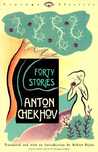 Forty Stories by Anton Chekhov
My rating: 5 of 5 stars
Bought new (at Chapters).
Read in June 2013.
I’ve read Chekhov stories before, but never a whole book of them. I picked this up a while ago; I don’t remember the exact impetus, but I’m going to guess that it was probably something I read whilst blog/twitter-grazing.
So it was sitting on my to-read shelf. Meanwhile, I read that Frank O’Connor book, with its offensive chapter on Katherine Mansfield, and The Sky is Falling, in which the narrator was obsessed with Chekhov. That was it. The time was right to read this. I’ve long wanted/planned to read more Chekhov because he’s always described as being a big influence on Katherine Mansfield, whose work I love.
Trivia: both Chekhov and Mansfield died young of tuberculosis. A cause of death I realize wasn’t unusual back in the day, but hey! thank science that same fate won’t befall you, present-day-writers!
The stories are arranged in chronological order, starting in 1880, when Chekhov was 20 years old—nice from a writer-reader standpoint because you can see how his writing progressed. A lot of the early stories are very short, flash fiction length. The later stories are longer, more developed. His early work tended toward punchlines (I’m not usually a fan of this style of short story, but some of these were ok. I liked “The Threat” :)), but got more subtle as he grew as a writer.
It includes the well-known stories, of course: “Death of a Government Clerk,” “The Huntsman,” “The Lady with the Pet Dog.”
Some of the other titles I made note of:
- “Joy,” in which a young man gets mentioned in the newspaper for drunkenly falling under a horse. He’s thrilled because he thinks he’s famous. (This one just seems so… prescient, ya know?)
- “Who is to blame?” in which a tormented kitchen kitten grows up to be a sleek outdoor cat… who’s afraid of mice.
- “Sleepyhead,” in which a young nursemaid’s sleep-deprivation leads to tragedy.
I noticed he seemed to have a fondness for the name Pelageya. I looked it up and it means “open sea.” (doh! pelagic!) Cool name. I think I’ll steal it. Now I just need a character to give it to…
four, maybe five hours of pure work
The common advice is, if you are a designer, you should be designing all day. Or making pottery, translating, illustrating, or writing all day.But here in the real world, you should shoot for four, maybe five hours of pure work. That is, writing from scratch, designing from a blank page, translating raw text, building brand new code, illustrating out of thin air.That’s all the human brain can muster. The holics who say they ‘work’ eighteen hours a day aren’t actually ‘working’ all that time. Most of that will be foof like paperwork, email, phone calls, tinkering, fiddling, meetings. Of the ‘real’ work, the devilishly painful work, four hours is all you can do.
June-ish update
- Sorted out Zotero/Scrivener, imported lists.
- Read qualitative coding manual.
- Chose coding methods
- 1st cycle:
codes – initial (descriptive)
categories – themeing the data - 2nd cycle:
themes/concepts – focused
theory – theoretical
- 1st cycle:
- Updated lists.
- Pulled all page 69 hard copies, ready to mark up! [first coding pass, DONE]
- Categories: memory/time; religion; the corporeal body; (im)migration; family.
- Page 69 paragraph/sentence analysis (106 to go!)
- Chapter analysis (proper nouns + communication technology – 51 to go!)
For writers who’ve asked: “Why didn’t my sub make the final cut?”
This month at Absolute Blank, I discuss some common reasons shortlisted submissions get chopped: “‘You Shortlisted My Submission… Why Didn’t it Make the Final Cut?'”
$3 a word
Last week, I read this article in The Atlantic: “How Junk Food Can End Obesity” by David H. Freedman. It’s basically an extended rant against people who dare suggest we choose to eat healthier, less-processed foods.
He argues, for instance, that a McDonald’s smoothie is a better choice than a fancy-pants one because it a) takes less time to make, b) contains fewer calories, and c) is cheaper. He does note, however, that the McDonald’s smoothie “contains artificial flavors and texture additives, and … is pre-mixed.” Yum?
(I suggest that if your smoothie consists of ingredients other than milk and fruit and takes longer than 30 seconds to make from scratch, you’re doing it wrong. But that’s just me. I make my own.)
Anyway, that’s not what this is about. That’s just the set-up. This morning I read a critique of that article: “The Atlantic: How junk food can end obesity” by Paul Raeburn. At the end of the critique is this tidbit that caught my attention:
At the going rates for stories in national magazines, Freedman probably was paid around $30,000 for his 10,000-word story.
Is that a typo? Can that be for real? $30k for any 10k story seems… wow. That’s… a lot. I am actually shocked. I guess I’m just used to writers being paid nothing. Or maybe I’ve just been a grad student for too long. I mean, $30k? That’s an annual salary for some people. Just saying. On the one hand, I’m annoyed because the article was silly (good link-bait though, so I guess it’s a win for The Atlantic), but on the other hand, I realize it’s time to stop undervaluing my madwordskillz and time to start aspiring to $3 a word.
15: The Sky is Falling
 The Sky Is Falling by Caroline Adderson
My rating: 4 of 5 stars
From the Fall 2012 VPL book sale.
Read in May/June 2013.
This story takes place in two time periods: 1983-84 and 2004.
In 1983: Jane Z. is a second-year UBC student originally from Edmonton. She spent her first year living at her aunt’s in Burnaby, but now she wants to live closer to campus. She ends up moving into a communal house in Kitsilano. Her new housemates are Sonia, Pete, and Dieter. They are into peace and anarchy and protesting. They, esp. Sonia, think there is going to be a nuclear war and everyone is going to die.
I have to interject here and say this story totally reminded me why/how I spent my high school years thinking nuclear war was an inevitability. To the point I didn’t worry much about long-term consequences not because I thought I was invincible, but because I thought we were all going to be vaporized sooner or later. It’s weird, how this doesn’t get mentioned much, if at all, anymore. So when I started reading this book and realized that’s what it was about (in part), I was hooked. Well, that and the fact it’s set in Vancouver 😉
Jane is taking Russian and reading Chekhov*, so her housemates assume that she’s Russian (they’re in love with this idea, of course), but she’s actually not. She just had a professor in first year who encouraged her to continue on in his department, and in classic “I can’t decide what to major in” fashion, she floated into Slavic Studies.
In 2004: Jane is now 39. She’s married to Joe, who’s a doctor, and has a 15yo son, Joe Jr. She works as a freelance copy-editor.
One morning there is a story in the newspaper about Sonia being released from prison after serving a 20-year sentence for her part in an attempted bombing in 1984. This gets Jane thinking about the events of twenty years ago, although it turns out that she never really stopped thinking about them. Her whole life has basically been haunted and shaped by how she remembers what happened in the spring of 1984.
I don’t want to say any more about the plot, but I was impressed by how the ending of this one worked out. It felt like all the pieces fell into place but at the same time Adderson resisted tying up all the loose ends.

*Because of all the Chekhov discussion, I decided that would be my next read.
Adventures in Home Improvement
My apartment has these terrible light “fixtures” in the hallways. By “fixture” I mean there isn’t actually a fixture. They’re meant to have a large globe light bulb in them. Except a) they don’t and b) I’ve never a seen a globe light bulb of that size in a store (little ones, sure, but not giant ones) to replace the regular-size bulbs they do have.
So anyway, one day I’m procrastinating, staring at the ceiling, and instead of coming up with the plot of the Great Canadian Novel, I come up with an idea for dealing with those oh-so-classy bare light bulbs.
At the next opportunity, I head to Ikea where I serendipitously find exactly what I’m looking for (the Renate shade, $5). Still, I don’t know if it will actually work until I try it.
Home again, where I do try it… and it does work! Perfectly. Behold, the upside-down lampshade solution:

While it’s kind of embarrassing this didn’t occur to me sooner, I thought I’d post it for anyone else who might have a bare light bulb dilemma.
p.s. Sorry about the hideous popcorn ceiling. I know all you HGTV stainless steel/granite people are probably scarred for life 😉
ordinary can be extraordinary
Hey, that’s my line.
I wonder if there is any room for the ordinary any more, for the child or teenager — or adult — who enjoys a pickup basketball game but is far from Olympic material, who will be a good citizen but won’t set the world on fire. … Ordinary and normal smack too much of average. It seems that we all want to live in Garrison Keillor’s mythical Lake Wobegon, where all children are above average. … Most people … have talent in some areas, are average performers in many areas and are subpar in some areas. The problem is that we have such a limited view of what we consider an accomplished life that we devalue many qualities that are critically important. … How do we go back to the idea that ordinary can be extraordinary? How do we teach our children — and remind ourselves — that life doesn’t have to be all about public recognition and prizes, but can be more about our relationships and special moments? … Some people may fear that embracing the ordinary means that they are letting themselves and their children off easy. If it’s all right to be average, why try to excel? But the message isn’t to settle for a life on the couch playing Xbox (though, yes, playing Xbox is O.K. sometimes), but rather to to make sure you aspire to goals because they are important to you, not because you want to impress your parents, your community or your friends.
the risk that something unfinished will be published
“The peculiarity of being a writer,” [Joan] Didion says, “is that the entire enterprise involves the mortal humiliation of seeing one’s own words in print.” (Just by making this statement Didion clearly inserts herself, the writer, into the story.)
Yet even worse than publication, she says, is the risk that something unfinished will be published.
omg. this. so much this.
Just tried to track down the article this piece is about [Joan Didion, Life and Letters, “Last Words,” The New Yorker, November 9, 1998, p. 74] and was foiled. None of the databases go back far enough (seriously what’s up with databases that only go back to 2002?). Will have to go to the VPL and track down the print version. SFU has its old issues on microfilm. Microfilm! How… 20th century.
ETA: So I actually went to the library and found the old New Yorkers in the stacks, located the right volume, and… some asshat who’s apparently never heard of a photocopier had torn out this essay. #fail
 The Remainder Table