
“We think almost every product is better when you can experience it with the people you care about so over time we expect almost all of these products should naturally become social.” – Mark Zuckerberg
Whether or not you think almost every product — TVs, cars, pets, refrigerators, running shoes — is better when it’s “social,” will probably determine your gut feeling about Facebook’s long-term prospects.
Imagine
I love bike shots when shot from behind. The sense of sailing through the city is easier to relate to when it’s not personalized with someone’s face.
If I shot this from the front I would feel like “Wow, that guy’s having fun.” When shot from the back I can more easily imagine myself in that position.
Project 366 – Week 33
225/366
for the first time since
June I have no excuse to
wake in the wee hours
226/366
what is it about
grading that makes me want to
stuff food in my face?
227/366
waiting for so long
and finally, official
word. I guess it’s true!
228/366
stick a fork in it
I’m done! like dinner — all I
have left are cliches.
229/366
mini-vacay: booked.
I’ve earned a break. Time for rest
and relaxation.
230/366
humidity: high
like running in a sauna
and that is ok.
231/366
wake to filtered light
yesterday’s heat still lingers
temperature rising.
Project 366 – Week 32
218/366
when I was a kid
I’d spend all summer reading
outside just like this
219/366
a holiday, the
Olympics, summer weather,
+ confetti cake
220/366
dear writers, there are
many topics besides death—
please investigate
221/366
a week of silence
and on the last day: questions
so predictable
222/366
greatest invention
since sliced bread: the file box cart
wheeling my grading
223/366
Olympic viewing
interrupted by grading
of final exams
224/366
the grading motto:
faster, faster, faster! a
timed and judged event
Mini-Nano Challenge – Day 1
And we’re off!
The Mini-Nano Challenge is to write 5,000 words in 30 days (or 167 words per day). It’s 1/10th of NaNoWriMo. Easy-peasy, right? Well, word-count-wise, anyway. My personal goal is to actually write a complete story, as opposed to just writing 5,000 words of… something bigger… that I just abandon like an unfinished freeway on the 30th. Hmm, I just thought of that, but yes. That’s what my fiction writing is like. Unfinished freeways. I need to build more side-roads.
Anyway. Today’s word count: 180 words.
Project 366 – Week 31
211/366
Canada knows how
to cover the Olympics:
14 hours live #win
212/366
indignant walker
trails sidewalk bicyclist: “that’s
illegal, y’know.”
213/366
last day of July.
thinking: I made it. thinking:
what did I forget?
214/366
tangle of bodies.
“anybody got morphine?”
afternoon chaos.
215/366
stepping outside in
to the heat, one foot in front
of the other. run.
216/366
feels so good to be
almost caught up on reading
TC submissions
217/366
it’s a miracle!
an August long weekend with
real summer weather
11: Vij’s: Elegant and Inspired Indian Cuisine
 Vij’s: Elegant and Inspired Indian Cuisine by Meeru Dhalwala
My rating: 4 of 5 stars
Purchased at The Book Warehouse, when I thought it was going out of business (but then it didn’t).

I think Vij’s is probably the most-talked-about Vancouver restaurant. So basically I bought this because of their reputation and because I love Indian food. nomnomnom.
Vikram Vij and Meeru Dhalwala are the husband-and-wife owners of Vij’s. The preface (written by Vij) and the introduction to the recipes (by Dhalwala) shares the background of the restaurant and their relationship.
The book is a nice large format, with lots of colorful photographs. The large macros of the food are mouthwatering and the smaller photos interspersed throughout give a good feel for the restaurant. The first section discusses ingredients (I always appreciate when cookbook authors do this), followed by “basics” such as garam masala, ghee, masala, paneer. I happen to have some black cardamom, which is a key ingredient in their garam masala (p. 26) so guess what I’m going to be making?
The recipe section starts off with appetizers. There’s a mix of vegetarian and meat dishes. The mains are divided into meat (beef, lamb, goat, pork), poultry, fish and seafood, and vegetables (these are vegetarian mains, not side dishes). I want to try the original chicken curry (p. 92) — with homemade garam masala, of course.
There’s plenty of eggplant (the Warm Eggplant, Onion and Tomato Salad appetizer on p. 43; Eggplant, Tomato and Green Onion Curry on p. 131 — definitely will be making this; Oven-roasted Eggplant and Butternut Squash Curry on p. 136 and more!) to keep eggplant lovers like me happy.
After the mains, there’s a section of sides (including cucumber raita, various chutneys, potatoes, rice, chapattis) and finally desserts and drinks, including the all-important chai recipe. I’m addicted to chai.
The introductions to each section and the recipe head notes are well-written and informative. Don’t be intimidated by the length of the ingredients lists—it’s mostly spices. With respect to the actual food elements, there are few obscure ingredients; it’s mostly basics like chicken, tomatoes, onions, yogurt. Overall, the recipes are inspiring and don’t look difficult to make.
One possible lie: They claim that even people who don’t like Brussels sprouts like theirs. I don’t know about that… 😉
One drawback: it’s a paperback, so if you’re referring to it while cooking, you’ll need to put something heavy on top so it won’t flip closed.
10: The Art of Dramatic Writing
 The Art of Dramatic Writing: Its Basis in the Creative Interpretation of Human Motives by Lajos Egri
My rating: 5 of 5 stars
This was recommended by Bellman. Well, actually she recommended the companion book (The Art of Creative Writing), but I couldn’t find it in the library—it was lost or stolen or something—and this book seemed to be the more famous, easier to find, one.
I actually got this from the UBC library first—an original edition—but I had it out for so long I decided to buy a copy. So this one’s a paperback from Chapters. Which is fine, yet lacking the coolness factor that the one from the 1940s did.
[digression]
It’s kind of wonderful that UBC still has 70-year-old books out on the shelves. I don’t mean by publication date–sure there are lots of reprints floating around–I mean objects that have actually physically been there for 70 years. That same book you just pulled off the shelf was taken out by drama students in the 1940s! When you think about it, library books like that are kind of amazing. It’s not like a work of art that’s mostly looked at but rarely touched. Or a book people have decided is worth preserving and placed under glass. That 70-year-old book has been taken out, stuffed in bags and backpacks, probably treated with less than the greatest care, maybe even taken on faraway journeys! and yet somehow every time it made it back to the shelf and it’s still there, still intact, mixed in with all the young whippersnapper books. There’s an aura about books like that. You wish they could talk, tell you where they’ve been, who they’ve been with. And at the same time you can’t help wondering how much longer that experience will exist—all the books have been relegated to movable shelves in the basement.
[/digression]
Oh, wait. One more thing about the original version. It had two additional appendixes that aren’t included in the reprint: “How to Market Your Play” and “Long Runs on Broadway.” It’s obvious why these weren’t included, yet they did add a certain je ne sais quoi to the book.
Moving along! This isn’t the kind of book you just read straight through. It’s more of a chapter here and there kind of book, one that will be great to dip back into now and again, when I need help with a sticky plot problem.
Egri’s key concept is the premise. This is your story’s purpose, theme, goal, thesis, central idea, what have you. It’s a succinct statement, usually one line, that encapsulates the point you’re making. For example, the premise of Romeo and Juliet, according to Egri, is: “great love defies even death.” What Egri argues is that your story should prove your premise.
This book was amazing because it solved My Biggest Problem. I was so excited, I immediately posted about at TC:
| Posted: Fri Oct 28, 2011 10:52 am Post subject: Re: My Biggest Problem | |||
|
|
|||
I debated over which thread to put this in (daily writing thread? this month’s AB thread? Art of Creative Writing thread?), but I was pretty sure I’d mentioned My Biggest Problem with Novel Writing somewhere here before, and so I searched for that and aha!
Well, thanks to Bellman, I’ve been reading The Art of Dramatic Writing and in one sentence (one! sentence!) on page 106 Lajos Egri has solved My Biggest Problem: “The premise is a tyrant who permits you to go only one way — the way of absolute proof.” Problem. Slayed. So, now that My Biggest Problem has been solved, I need to work on my premises! Thanks, Bellman |
|||


If the book offered nothing else, that would be enough. But there’s more! If you’re the kind of writer who has difficulty with plotting, this is the book for you.
Internal Monologue
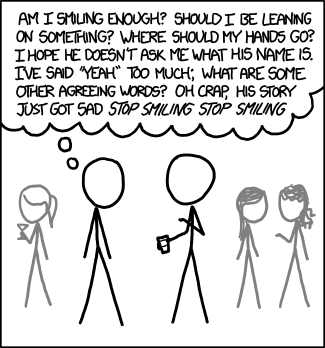
I finished reading Quiet last weekend. So much to blog about! In the meantime, today’s xkcd…
9: Quiet
 Quiet: The Power of Introverts in a World That Can’t Stop Talking by Susan Cain
My rating: 5 of 5 stars
Bought new (that’s new as in not-used and new as in new release) at The Book Warehouse. I wanted to read this as soon as I heard about it and then Bellman recommended it, so I was sold.
Watch The Power of Introverts video here.
Susan Cain is a former lawyer. Yes, yet another lawyer-turned-writer. They’re everywhere, I tell you. Did I ever mention my theory (developed at law school) that law students fall into three groups: the ones who are in it for the money/prestige, the ones who are in it because they want to change the world, and the ones who really want to be writers. Because it seemed like every time I turned around someone was whispering, “well, actually, I write. I’m working on a screenplay/romance novel/fill-in-the-blank.”
What was so good about this book was not that I had a sudden epiphany that I’m an introvert while reading it. Obviously I know I’m an introvert. What was so good was the argument that it is just as good to be an introvert as it is to be an extrovert, that introversion is not something that needs to be fixed.
Realizing that that’s how I’ve always been made to feel: like I’m broken. Realizing that the reason everything is so hard, why some things never get any easier regardless of how many times I do them, is because those situations force me to be fake extroverted. Realizing that not everyone is exhausted by being “on.”
It explains why I had such an aversion to Dale Carnegie and that How to Win Friends and Influence People book. He epitomizes the ‘extrovert ideal.’ (That thing where a person you’ve just met uses your name in every sentence? Ahhhhh! That is the worst. Never do this to me. I will insta-hate you.)
She unpacks the difference between introversion (preference for environments that are not overstimulating) and shyness (fear of social disapproval). You can be introverted and shy, but you can also be introverted and not-shy (ditto with extroversion).
The framing of introversion as a preference for lower stimulation environments (rather than a dislike of being around people) is helpful. It’s not the people per se, it’s that too much is going on when there are a lot of people around. It explains why I prefer to run without music, for example, when most people (going by what I’ve read on running forums anyway) claim they’d die of boredom without music.
A lot of hay is made about the difficulty introverts have with public speaking. I’ve never had a real problem with public speaking where said speech is something pre-planned (I wanted to be an actor when I was a teenager). What makes me an introvert is how I feel afterward (exhausted, need to recharge). This explains, I think, why I was fine with doing the mandatory public speaking we had to do in English class, but was never interested in pursuing it further.
What makes me super-stressed are situations where I’m expected to speak without having a chance to think about it. Talking on the phone. Q+A sessions. Interviews. Making an off-the-cuff speech. There’s a example that deals with someone like that (Esther in chapter 5). It goes back to being overstimulated (overwhelmed), which interferes with attention and memory (a-ha!).
Quiet helped me to make connections between various traits I hadn’t thought of as being connected to introversion. Like a dislike of multitasking and a desire to avoid conflict. I kept having these “oh, so that’s why I like/dislike that” or “oh, so that’s why X is easy and Y is hard” moments. Better late than never. I feel like more attention should be paid to this when people are choosing careers. Because, sure an introvert can act extroverted, but who wants to be exhausted and depleted all the time? Seriously: I wonder how many people are unhappy for the basic reason that they’re an introvert doing an extrovert job or vice versa?
 The Remainder Table