Category Archives: Reading

6: Star Gazing

Star Gazing: Charting Feminist Literary Criticism by Andrea Lebowitz
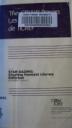
06_img_2146.JPG

This was mentioned in my Methods class. At only 69 pages, it’s closer to a booklet than a book, but as far as the yearly book tally goes, it counts!

I got a few good ideas for my thesis from it.

On collaborative work:

[A]nother constant of feminist literary criticism is the success of collaborative work. Feminist literary criticism has put to rest the cliche that good writing must be the work of one person. (p. 6)

And the Other:

[F]eminists have questioned the binary opposites of our culture which see so many things as opposed and mutually exclusive … This type of thinking sees one thing as ‘other’ and inferior to its binary opposite. (p. 7)

Oh, and interestingly: Lebowitz writes that “the two most important precursors” to feminist literary criticism are Virginia Woolf and Simone de Beauvoir. A Room of One’s Own and The Second Sex “have formed the basis of feminist literary critics’ thinking about gender and writing.” (p. 11) I guess this is not particularly surprising, but what’s interesting about it is that I went through that whole de Beauvoir / Woolf phase and I’ve read AROOO and parts of TSS (it’s long!). I mean, it’s sort of vindicating that some of the stuff I read during that time fits with what I’m doing now. Now that everything is starting to tie together, it feels like there really is a point to it all.

Once I wrote up a list of “books that changed my life.” Meet the Austins (the book that hooked me on Madeleine L’Engle) was on it, as was Writing Down the Bones (the book that got me started writing again). Also on the list: de Beauvoir’s Memoirs of a Dutiful Daughter.

But I digress. On alternative/indie press:

[Feminists] have created alternative publishing and distribution networks and have founded many presses, journals and magazines. Some of these address an academic audience, while others speak for and from alternative cultural spaces. (p. 15)

On the novel:

[A]re there limits to what stories the novel can tell? … Does its structure, plot, narrative and closure keep women from writing stories other than the old familiar plots? (p. 19)

vs. “sub-literary” forms:

[L]etters, diaries, journals, sketches … have been widely used by women … studies into secondary forms have raised another fundamental question about evaluation. Why are some forms seen as superior? Conversely what makes a form inferior? (p. 20)

[I]dentity is not determined and fixed once and for all, but is rather in process. More fluid and fragmentary forms may offer ways of expressing this condition. … In autobiography and life writing more generally, the author is often not expressing a life already shaped and complete as she is using the writing as a way to express and make a life. (p. 21)

[I]t is not sufficient to use the old forms for new knowledge. We cannot simply reverse male stories, literary forms or critical criteria. Rather, language and form have become places for revision and experimentation. Most notably the private, fragmentary and intimate forms of expression have found a place alongside the public, completed and logical modes of expression. (p. 41)

Ooh. Well, that gives me something to chew on for a while.
5: Reasons for Moving

Reasons for Moving (manuscript) by Stephanie Eden Lenz

Reasons forย Moving

This is the second novel my close personal friend* and co-editor Eden has completed.

She finished her first novel, Whited Sepulchers, in July 2000 (that date makes me =-O). She started RFM shortly thereafter and she was also shopping WS around for a while, but then she had two kids and the books went on the backburner.

Lately she’s been re-editing WS in preparation for sending it out again. In January, she picked up RFM and finished the first draft in 16 days. 60+k in just over two weeks. Bravo! It’s so good to see her writing fiction again. She’s going to write an editorial about the experience for the March issue of TC.

I need to re-read WS (it’s on my List), but from what I recall, RFM is very different in content and style.

RFM is set in the early ’90s in a college town in Pennsylvania. The narrator, Seth, who is 20 at the time of the story, was an abused child who left home after a traumatic event some three years earlier. Since then, he’s been hitchhiking around the country and doing what he has to to get by. He winds up on this college campus and, finding he blends in with the students, starts following them to classes. It’s winter and basically he’s looking for a warm place to hang out. He ends up following a girl to a small poetry writing seminar where the instructor spots him before he can escape. Soon he’s writing poetry, rooming with the classmate he followed that first day, and perhaps most surprisingly, setting down some roots. Through both the poetry and the personal connections he makes, he finally starts to work through his traumatic past, stop the destructive cycle he’s been on since he left home, and begins to look toward the future for the first time in his life.

*Is that phrase trademarked yet? ๐Ÿ˜‰

4: The Orchid Thief

The Orchid Thief: A True Story of Beauty and Obsession by Susan Orlean

The Orchid Thief

I picked this up at the VPL Book Sale (for $1, I think). It’s the book that the movie Adaptation was based on. Adaptation is a weird and wonderful movie, so I was curious about the book.

As the sub-title indicates, this is a true story, an expansion of an earlier New Yorker article. Of course, the book has none of the meta-ness of the movie (which is all about the difficulty in adapting the book to a screenplay). The story starts out being about John Laroche—the orchid thief—who is on trial for taking endangered orchids from a state preserve, but grows into a story about Florida orchid enthusiasts in general and their passion for the plants. Passion is the overarching theme.

I have to say this is a rare instance where I liked the movie better than the book.

Orlean’s a really good writer—her descriptions are vivid—and this is the type of New Yorker article that I’d really enjoy, but the book gets a bit wandery. It’s like she wanted to include every orchid and every character she met and I started to suffer from sensory overload about midway through the book.

The movie has more of a cohesive narrative—but, heh, now I can see where the difficulty in adapting it to a screenplay came from. So, haha, ironically, reading the book will probably make my next watching of the movie even more entertaining! So I guess it was pretty awesome on that level.

3: The Namesake

The Namesake by Jhumpa Lahiri

The Namesake

Another book picked up at The Book Shop last summer. Interestingly, once I started reading it, I realized I’d read part of this as an excerpt in The New Yorker in the summer of 2003 and remembered how much I’d liked it.

This book was awesome. I loved it.

I mean, the main metaphor throughout the book is the main character’s name. Heh. So an obsession with names can be turned into a book. ๐Ÿ˜‰ Another interesting detail: it’s written in present tense, which I noticed on some level but didn’t consciously think about until I was about halfway through the book. And then I sort of went, “Hmm, this pretty much disproves the theory that you can’t carry off present tense in a novel.” So there, haters.

What else? Her descriptions are amazing. Don’t read this book when you’re hungry. What sucked me in right from the beginning, I think, was that this book begins the month/year I was born—the MC’s lifespan exactly matches my own. I guess we’re getting into an era now where I’m going to see this more often, as writers who are my age become established, but it stood out because I’m so used to reading books by older authors (who tend to write about their own generations).

What was unexpected (given the emphasis on the first/second generation immigrant aspect of the story in reviews & such) was how much I identified with the circumstances of the book. I also grew up the child of parents who moved far away from where they grew up. In their case, it was only cross-continent, but our visits were even more infrequent (and shorter) than the ones in this story, so I get that whole tenuous relationship with relatives who are really just names to you, turning friends into family, trying to figure out what/where “home” really is thing.

This book doesn’t have a traditional plot so it isn’t something that’s going to appeal to everyone. I glanced at the Amazon reviews and a lot of the more negative reviews were comments along the lines of “nothing happens,” which is true in a way, but I think misses the point. I will definitely be checking out her collection of short stories, Interpreter of Maladies.

2: Ricochet River

Ricochet River by Robin Cody

Ricochet River

I heard about this book when there was a controversy over the author rewriting certain passages so the book banning crowd would stop trying to prevent its use in schools. I wrote about it here. Now, I can understand the author wanting his book to be picked up for school reading lists. This is a first novel with regional appeal published by a small press in the early ’90s. If schools hadn’t taken an interest in it, it would almost certainly be long out of print.

I, of course, read the original version, not the revised version. Every summer we go to Penticton where there is this great used bookstore called The Book Shop. So many books. You should go! Anyhow, last summer I ran across this book at The Book Shop and I had to get it, if only to see what was so controversial about it.

Sigh. Yeah, I don’t know. People are whack when it comes to sex. There are two sexual passages in this 266-page book. Both are appropriate to the context of this story and these characters and would be perfectly fine for high schoolers to read. As for the drinking & driving and language choices—it’s a period piece. I think all too often people forget how things were in the not-so-distant past. Would be better to use these things as points for discussion rather than getting all revisionist and sweeping them under the carpet.

This is a coming-of-age story set in 1959-60 in a small Oregon town. I liked the West Coasty-ness of it; the setting was very authentic. The narrative voice was engaging. Storytelling (i.e. the characters telling stories to each other) plays a significant role in the book and this is, I think, what sets this story apart from others in its genre, but at times this device bogs the story down. The story itself is a quiet one with no dramatic plot developments—except for the ending. On the one hand, an ending in this vein was inevitable. On the other hand, what happens is perhaps a bit too surreal. But perhaps not. I think the author was going for a sort of magical realism thing, tying the events of the story to the myths & legends of the storytelling. If there had been a tighter linking between the two streams all along it would have both evened out the pacing and made the ending a better fit. Nevertheless, it was a pretty good first novel.

1: The Great Failure

The Great Failure: A Bartender, A Monk, and My Unlikely Path to Truth by Natalie Goldberg

The Great Failure

Hey, look, it’s day 1, and I’ve already finished my first book of the year!

I spotted this on one of the remainder shelves at Chapters last week. Last book purchased; first book read. All the books on my “to be read” pile are jealous. But I figured (a) it would be a quick read, and (b) what more appropriate way to start off than with a remaindered book?

So, it was a quick read obviously. This is a brief memoir of Natalie’s relationships with her father and her Zen teacher and her coming to grips with them being human, i.e. flawed. Essentially, it is about her figuring out whether she is able to admire/love people even when she feels that they have disappointed/betrayed her by their actions (or inaction, in the case of her mother).

I’ve read most of her books. I like her writing books best. This one… well, it was interesting, because I’d read the others. But on its own, I could take it or leave it. Writing Down the Bones was truly a book that changed my life. Wild Mind and Long Quiet Highway were also lovely books. I found her novel disappointing because I like what she writes about—her ideas—more than how she writes. Her writing style is very simple and straightforward to the point that I find it almost clunky. It’s a style that works for a book on writing practice, but, I think, works against her in a narrative. After reading her writing practice books, I had high expectations for her novel, Banana Rose; I suppose I expected that all that writing practice would have led to a tangibly more polished narrative writing style. But it wasn’t. I realized that’s just how she writes.

The Great Failure didn’t resonate with me in the same way as her earlier work did. It’s not that I couldn’t understand where she was coming from; I could. That part was fine. But I think if you’re going to write about how people have disappointed and betrayed you, you also have to turn that around and dig into how you may have disappointed and betrayed others. She touches on this, but she doesn’t dig into it. I also didn’t feel that she was breaking any new ground here; the realization that people—even people you respect and trust—are human/flawed isn’t particularly insightful on its own. I think probably everyone has had to accept (in order to move on) the fallibility of a parent or parental figure at some point in their lives. And I’m not saying that that’s not a difficult thing, but… she wasn’t sharing with a friend; she wrote a book. There has to be something more than that, I think. A deeper insight.

Also, she seemed unable to accept that not everyone has an inner life (well, an inner life of substance), that people are, in general, not really that interested in your interests no matter how close they are to you, and that no one else will ever see the same events from the same perspective as you. In my un-expert opinion, her constant fight against these things didn’t seem very Zen. Once you accept these things, it is much easier to be content.

I wanted to read this because it was a Natalie Goldberg book, but maybe it was a book I just didn’t need to read. Perhaps for someone else, it could be the right book at the right time, the way WDTB was for me.

2006 Books Read – #15

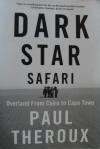
Dark Star Safari by Paul Theroux

Dark Star Safari

I started reading this back in September (or was it August?). At any rate, once school started, that reading usurped this reading (as it so often does) and here we are. I’m on vacay now and I finished it!

The front/back cover quotes give a rather upbeat impression of the book’s contents, but as is so often the case with cover blurbs, they are off the mark. “Rollicking entertainment.”? I think not, Publishers Weekly. Now, it’s true that Paul Theroux cracks me up in a way that he really shouldn’t. I mean, I’m constantly rolling my eyes and groaning at his sexism, but that’s part of the reason he amuses me, I guess (he’s also snarky and observant). Anyhow. So, all throughout this journey, he’s working on this “erotic short story,” the fact of which is hilarious. It’s such a counterpoint to the situations he finds himself in while traveling by bus/train/boat/etc. from Egypt to South Africa. At the same time, it’s the ribbon that ties the whole thing together, because this trip was for him a return to Africa. In the ’60s, he spent two years in the Peace Corps, teaching in Malawi. To understand this book, you really have to read his “novel” My Secret History first. In brief, the main character, Andre Parent (bwahaha), a fledgling writer, joins the Peace Corps as a teacher (sound familiar?) and spends his time in Africa having a lot of sex with local girls.

Well, it was the ’60s. Now it’s the ’00s. So the trip is a reflection on what has changed and what hasn’t and whether it’s better or worse or just is what it is. It gets you thinking about the havoc that colonialism has wrought (and is still wreaking, really), not just in Africa, but all over the world. And it gives you just an inkling of an idea of just how complicated it all is, how many facets there are, how so much depends on who you are and how you’re looking at the situation—and how difficult (if not impossible) it is for outsiders to understand anything. His observations about the effects of foreign aid (both money/other donations and workers/volunteers) are thought-provoking.

Overall, I found it thoughtful rather than rollicking. Often sad, but always affectionate. Not recommended unless you’ve read some of his other work (including MSH). I’d think it would be just an eccentric travelogue without the context.

2006 Books Read – #14

Claire’s Head by Catherine Bush

Claire's Head

I bought this because I really enjoyed Rules of Engagement.

Like RoE, Claire’s Head deals (in part) with the dynamic between sisters. I don’t have a sister, so reading about sister relationships is kind of like exploring a foreign country for me. Which is to say, strange, but at the same time, interesting.

The story is primarily an exploration of pain and how we live with it. Claire and her oldest sister Rachel suffer from migraines. Middle sister Allison does not. (Is it a cliche that the middle kid is the prosaic one? Is it meant to be?) The sisters lost their parents in a freak accident some years earlier, so there is also an element of grief involved.

Essentially the plot is as follows: Rachel disappears. Claire travels the world looking for her. Allison does not join her. Claire’s personal and work relationships suffer the more time she spends away. She also suffers from increasingly devastating migraines.

The descriptions of Claire’s pain can be hard to read and I was relieved to get through the book without triggering any psychosomatic headaches.

I didn’t find CH quite as compelling a story as RoE. The mystery is pretty straightforward. But of course, a twisty plot is not the point here, and as an exploration of what it’s like living with chronic pain, particularly pain in one’s head—which is different from other pain, because you can’t distance yourself from it—it’s superb.

2006 Books Read – #13

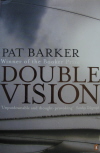
Double Vision by Pat Barker

Double Vision

The trouble was, Kate thought, Alec had always thought of himself as a good man. That made him sound smug and horrible, which he wasn’t, but he did tend to assume that in the war of good and evil he’d always be on the right side, whereas Kate couldn’t help thinking real adult life starts when you admit the other possibility. ‘We’re all a bit like that, aren’t we?’

Ah, that’s why I love Pat Barker. Even if this book had nothing else to recommend it, it would be worth reading just for that bit.

Barker’s writing is eloquent and unfussy. She’s really readable. Lovely writing, no distractions.

There are two main characters in this book: a burned-out war journalist who is grappling with the death of his photographer friend, and the photographer’s wife, a sculptor, who is not only dealing with the death of her husband, but also recovering from a bad car accident. Their lives intersect when the journalist returns home to work on a book about his experiences. A romantic relationship does develop, but not between these two characters.

It’s an absorbing story on the surface level. But it also—as is typical for a Barker novel—explores complex questions about war and violence.

This isn’t my favorite Barker book, but it’s the best book I’ve read this year.

2006 Books Read – #12

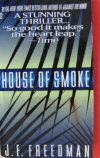
House of Smoke by JF Freedman

House of Smoke

When we were visiting the parental units earlier this summer, they had a box of books by the door ready to go out. Mom asked if I was interested in anything. I poked through the box and grabbed a Paul Theroux novel. She encouraged me to take this one as well.

This is a okay detective story, but nothing special. I kept getting ahead of the plot, which… I’m not sure why that is. I never used to be much of a plot-guesser. Maybe I’ve just read too many detective novels and I know all the elements.

The lead is a female ex-cop turned PI with Issues (her ex beat her, she’s lost custody of her kids). My main quibble is that it was obvious to me that this was a male writer writing a female character. He kept having her do either a) things guys think all women do (like wear sexy pink panties under her police uniform. WTF?) or b) things guys want women to do (like the requisite f/f “but I’m not a lesbian!” “me neither!” sex scene). Also, she inevitably had to be rescued by a dude. Arggh.

So yeah. Somewhat exasperating, but an acceptable beach read. Totally the kind of thing you’d pick up in the little new/used bookstore just off Main Street in the resort town you’re spending your vacation in to read at the beach. You know what I’m talking about. Which, come to think of it, is probably exactly where it originated ๐Ÿ˜‰