
“We think almost every product is better when you can experience it with the people you care about so over time we expect almost all of these products should naturally become social.” – Mark Zuckerberg
Whether or not you think almost every product — TVs, cars, pets, refrigerators, running shoes — is better when it’s “social,” will probably determine your gut feeling about Facebook’s long-term prospects.
Category Archives: The Interwebs
Internal Monologue
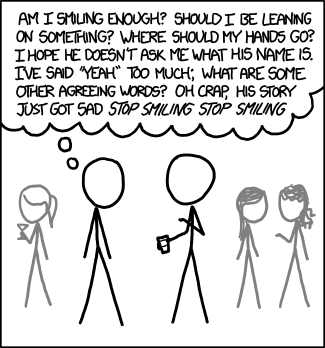
I finished reading Quiet last weekend. So much to blog about! In the meantime, today’s xkcd…
6: Haters
 Haters by Alisa Valdes-Rodriguez
My rating: 2 of 5 stars
An actual remainder table book. I picked it up because I remember her from the Evil Empire’s writing class back in the day (she was alisavr). I’m not sure why exactly I remember her (and her username!) when most of those people have vanished from my memory; she wasn’t involved in the foofaraw (aside: that isn’t spelled at all like I guessed it was). I think she was a just a presence in the chats. And well, there was that resignation letter. I think that stuck in my mind. Anyhoo.
Since 2003, Valdes (since she published this she’s dropped the Rodriguez) has published seven novels, with an eighth forthcoming next year. Haters, published in 2006, was her fourth.
Haters is a young adult novel. Valdes’s writing is fine, if a little heavy on the brand-name dropping, and there are lots of good elements here, but the story didn’t completely come together for me.
The core plot is your standard fish-out-of-water scenario: the story opens with 16-year-old Paski and her dad moving from New Mexico to California for his work. Paski’s main interest is bike riding (refreshingly uncliched).
One of the problems I had was with where the story started. There were a few chapters at the beginning with Paski in New Mexico before the move. I guess this was meant to show her “before” life, but there was a lot of detail about her grandma and her bffs and the boy she liked—enough that I kept waiting for this info to come back into play later in the story, but it mostly didn’t. So basically the opening felt like a warm-up to the story and I think a good editor would have lopped it off, said ‘your story starts here’ (on the road, arriving at the new home), and anything from the opening that was essential could be added in flashbacks.
The “omg my dad is so embarrassing” routine that was a constant thread throughout the book felt strained/forced. A little of this is fine—of course, all teenagers find their parents embarrassing—but there are degrees of embarrassing and Paski’s dad is not a schlumpy dork who wears polyester floods and a pocket protector and hasn’t updated his music collection in twenty years. He’s a comic book artist whose series has been optioned for a movie—hence the move to LA. He’s also 38 years old. And again, I realize 38 seems ‘old’ to a 16-year-old, but there’s kinda-sorta-old and there’s old-old, and yes! teenagers can tell the difference. My parents were a year or two older than that when I was that age and I distinctly remember friends commenting on my ‘young’ parents. And they weren’t the originators of a popular comic book series. I feel like it would have worked better to roll with her dad being geeky-cool (which he clearly is) rather than handling it like he’s an accountant or something.
My overall impression was that Valdes was trying to cram too many tropes into one story. It’s a mean girls story (the ‘haters’ of the title) and it’s also a paranormal. Oh, didn’t I mention? Yes, Paski’s psychic. She has premonitions. Was this necessary? Or was it just done to capitalize on the fact that everything’s paranormal these days? So, there’s a psychic sub-plot with the next-door neighbors, as well as the requisite one at school. There’s also the conflict with her dad over moving (and him being soooo embarrassing). There’s also a motocross racing plot. And, of course, the hottest boy in school who just happens to be dating the meanest girl in school plot. Because no one ever falls in lust with the second-hottest boy in school. 🙄
5: Ayiti
 Ayiti by Roxane Gay
My rating: 4 of 5 stars
maybe even 4.5?
I ordered this one from Amazon:
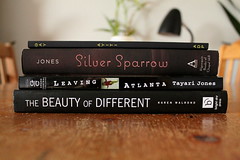
I’ve been a Roxane (with one N!) Gay fan ever since I discovered her. She goes to see All the Movies and writes the most amazing posts about them. Ayiti is her first book.
“Ayiti” is the pronunciation of Haiti in Haitian Creole. So these are stories of and about Haiti, Haitians, and the Haitian diaspora. Roxane’s parents immigrated from Haiti (to the US) and they still spend part of their time there.
Ayiti is a collection of short fiction and nonfiction. Some of the stories are flash length, some longer. At just over 100 pages, it isn’t a long book, but it is a powerful one. Her writing style is at once matter-of-fact and layered with sensory detail. It has a deceptively simple look, I think. There’s so much buried in it once you start digging.
My mother always told me: back away slowly from crazy people; they are everywhere.
“Voodoo Child” (21)
Ha!
The story I thought was the standout of the collection was “Things I Know About Fairy Tales,” about a woman who is kidnapped for ransom. I think this was the favorite of a lot of readers and is the one she’s expanding into a novel. Rather than telling you how strong this story is, I will show you:
What you cannot possibly know about kidnapping until it happens to you is the sheer boredom of being kept mostly alone, in a small, stifling room. You start to welcome the occasional interruption that comes with a meal or a bottle of water or a drunken captor climbing atop you to transact some pleasure against your will. You hate yourself for it, but you crave the stranger’s unwanted touch because the fight left in you is a reminder that you haven’t been broken. You haven’t been broken.
“Things I Know About Fairy Tales” (38)
I could keep picking out bits that I liked, but let’s just say: it’s all good. This is an intense book. Perhaps it’s good that it’s short because you can only hold your breath for so long.
For accompanying musical atmosphere, check out Roxane’s Book Notes at Largehearted Boy.
*
P.S. In “All Things Being Relative” she compares Michigan’s Upper Peninsula with Haiti. Which reminded me, one of the reasons I first noticed her, even before I’d read much of her writing, was that she went to Michigan Tech. Back whenever that was, she was still a doctoral student there. Michigan Tech is my dad’s alma mater. When I was a kid, he’d get these alumni mailouts, advertising their youth summer programs. One of them was a writing camp. Oh, how I wanted to go to that. I was always way too chicken to ask, though I honestly don’t know what answer I was more afraid of: yes or no. Both, maybe. Anyway, whenever she mentions the Upper Peninsula, it always reminds me that if different roads had been taken, that’s where I might have ended up.
Mysteries of Vernacular
Not my only option
The alternative to Facebook and mobile apps is not a pure, ideal world where everything is free and your privacy is always assured. I’m aware that the free platform I’m using to write this blog is owned by an enormous information corporation whose privacy practices are not always stellar. But it’s not my only option. There are alternative applications that serve the exact same purpose, and will produce the same results. This blog is free for anyone, anywhere, on any device. You don’t have to buy a special device, or join Blogger, or register your personal data to access it.
I love it when…
…people get noticed for saying things I’ve been saying forever 🙂 See, e.g., this post:
(Aside: I hate the use of “in real life” to mean offline/in person. Online communication is real life, too.)
This is why you should listen to me, people. We’re always ahead of the curve here at The Remainder Table 😉
In other news, writing stuff down. It’s a Good Thing.
Life Satisfaction

It’s Marshall McLuhan’s 100th bday…
…today (or would’ve been if he hadn’t died in 1980!).
I just want to say, ahem, when I chose media ecology as one of my comps areas, no one was talking about Marshall McLuhan. Now? He’s trending. Yes, I am prescient. 😉
This video is awesome. (It’s from a CBC program called Explorations and aired May 18, 1960.)
(via The Georgia Straight)
Quest for a bargain
As a result [of online bookstores], our lives, and our engagement with the world around us, slowly become more insular. We get challenged less, so believe in what we believe with more fervor. Something akin to intellectual torpor sets in as we keep returning to the same shelves in the marketplace of ideas. And we, as a society, are worse off for it, another stroke of damage from his secular religion of ours, the quest for a bargain.
 The Remainder Table