
I am a bad blogger. Or what could be more kindly termed an indifferent blogger. I only turn up when the fancy takes me and if I were being paid by the hour for this, then my family would be living on jam sandwiches.
Category Archives: Writing
Regardless of what story you believe
Personality is not who you think you are, it’s who you are. Some people think by definition that we are the experts on our personality because we get to write the story, but personality is not the story – it’s the reality. So, you do get to write your own story about how you think you are, and what you tell people about yourself, but there still is reality out there, and, guess what? Other people are going to see the reality, regardless of what story you believe.
Someone is Wrong on the Internet!
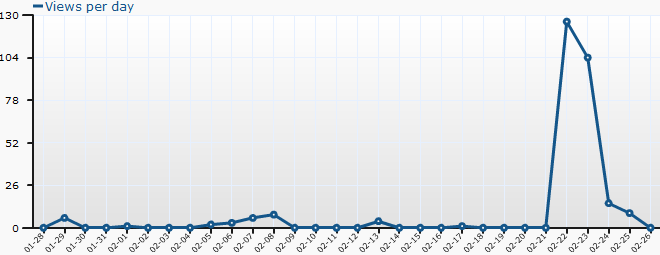
I wanted to post this screenshot of my stats to illustrate a couple things:
- My blog has never seen so much traffic. I see all is back to normal, now, though, and I can go back to talking to myself 😉
- Even though I had 250+ visitors in two days, only four people commented. And one of those people I know. So three people who’d never been to my blog before said something. This isn’t a complaint; it’s an observation. Way more people just read than read and comment; if you’ve ever looked at your site stats you know this to be true.
Perhaps the strangest and most interesting thing about #creepythesis is the way people talked about it, about me. As if I was never going to see what they said. (More on this later.) As if Twitter were a private chatroom.
Which it most definitely is not.
While you were following #creepythesis on the weekend, an SFU staffer who monitors Twitter was following keywords of interest to him. You know, like SFU.
(You see where this is going, right?)
#creepythesis may have blown up and burned out faster than ’70s child star, but whether anyone actually intended to follow through on the twitterstorm is moot, because said staffer-who-was-monitoring-SFU-tweets emailed the dean about it anyway.
Anyhow. This isn’t about me, per se. It’s more a heads up for the next time someone is wrong on the internet.

This is fair warning that I am totally turning #creepythesis into a paper. I’ll be posting some of my initial thoughts as I have time. I’ll tag everything with #creepythesis, so you can just follow that if you want to keep apprised but don’t want to read my other posts.
Somebody Somewhere
I just love this story:
[O]ne week ago today, when the snow was thick and the sky was gray (again), I received the loveliest surprise: an email from a woman who’d been on the editorial staff at Quarterly West 15 years ago, when QW published my little flash piece, “In Theory.”
Currently teaching college workshops in creative writing, she wrote: “I have managed to always keep a copy of that issue close-by so as to teach it, but somewhere in one of my moves, I misplaced my copy.” She wondered if I had a spare I could send.
Who knew? You see, you might think your work falls into a pool and just lies at the dark bottom of the pond like littering leaves, rotting away, but somebody somewhere might have been teaching it for 15 years! You just gotta keep the faith.
Stories have formed us all
I was reminded of Carolyn Heilbrun yesterday when someone mentioned writers who committed suicide.
What matters is that lives do not serve as models; only stories do that. And it is a hard thing to make up stories to live by. We can only retell and live by the stories we have read or heard. We live our lives through texts. They may be read, or chanted, or experienced electronically, or come to us, like the murmurings of our mothers, telling us what the conventions demand. Whatever their form or medium, these stories have formed us all; they are what we must use to make new fictions, new narratives.
—Carolyn Heilbrun
Writing a Woman’s Life (1988, p.37)
Good For You
I do worry a little that the modern age has taken the failure stage out of the creative process. Now if you can’t get your manuscript published, it’s because the publishers are cowards, can’t see your genius, and you can self-publish it (and then send out slightly crazed emails to critics). There is a lack of humility, a failure to recognize that getting knocked on your ass is actually good for you.
A Necessary Thing
I often need to remind myself that I need to hear failure out, because by failing at doing an easy thing, a groupthink thing, a thing one has been taught to do for one’s career, one might be encouraged to make or do or be something more original and true. Because failing as an artist is a necessary thing, a thing I wish I could more easily accept.
Tweaking it a bit and trying again
I don’t think [querying every single agent in the publishing industry at the same time is] very good strategy on the part of the author. If you didn’t get it quite right the first time and you’ve sent it to everyone in publishing, you just lost your chance at tweaking it a bit and trying again. If you rush the submission process you lose the ability to evaluate and adjust as you go. … Going at a steady pace can be frustrating and tedious, but it gives you time to research agents and personalize, to keep working on new material, and to give yourself time to look at your query and opening with fresh eyes.
[S… this is the quote I was talking about. Kind of apropos in more ways than one this week!]
#creepythesis
I woke up yesterday morning to find my thesis had its own twitter hashtag.
I’m not going to launch into a defense. Readers are free to think my writing is crap, skim it, interpret it differently than I intended, etc. That’s the nature of writing. I just wanted to acknowledge that I’ve seen the reaction.
On the bright side (!), more people probably read my thesis yesterday than read most people’s theses ever 😉
The synopsis is the story
If you can’t write a concise synopsis, your novel’s not ready. Once upon a time I wrote a novel. I tried writing a synopsis to send along with my query letters, but I had a difficult time with it and I never finished. At first, I thought: Who cares? What’s so important about a synopsis anyway? It’s the story that counts. So I queried only agents who didn’t require a synopsis. Know what happened? Nothing. Form rejections. It seems so obvious to me now, but what I didn’t understand back then was that the synopsis is the story. If you are having trouble writing a synopsis, step back and take another look at the story you’re trying to tell. Are there pieces missing? Did you start it in the right place? Is your arc arched enough? Is your ending satisfying? When the story is ready, writing the synopsis should be easy-breezy-lemon-peezy.

