Category Archives: Reading

Should a writer be invisible?

As an actor, [Philip Seymour] Hoffman says that his job is to be invisible. The idea is that when you are watching in Capote, you are to believe that you are watching Truman Capote himself. He believes that he has “done his job” as an actor when you forget that he is actor.

Well, I think that, as a writer of fiction, I want the reader to forget about me all together. As you are reading The Untelling, I want you to think that Aria is a real person. I have to wonder that knowing too much about the author can detract from that possibility.

Hmm. I don’t need to know anything about a writer; I enjoy reading plenty of writers whom I know little to nothing about. For example, I adore Pat Barker but know zip about her beyond the bio blurb that appears on her books. And that’s fine. At the same time, if a writer I like chooses to share more of his/herself, I’m interested. In particular, I’m interested in process (the same goes for artists, actors, etc.). If you’ve read a lot of a particular writer’s fiction, it can be really fun / interesting / instructive to read a memoir/autobiography and see where the ideas came from. Conversely, what’s happening now is that I’m finding writers I might otherwise never have heard of via their blogs—and subsequently adding their books to my “to read” list. I figure if I enjoy their blog-writing, then I’ll probably enjoy their novels.

I may be unique (though I somehow doubt it) but reading a writer’s personal writing doesn’t make his/her characters less real for me. I always view fiction as an alternate reality. It’s kind of like keeping up with friends/relatives that live away. They’re there and you’re here and sometimes you visit. Maybe it’s because I do write that I can separate writer and character and allow for them both to be real. I know my characters aren’t me. They have their own lives. They do and say things I’ve never done. Yet, it’s not like I’m telling them what to do and say. It’s more like I know. Not all at once, but as I write, the story unfolds, as if I were watching it. Which makes them feel real to me. So if my own characters—who I know are creations of my imagination—can on some level be real, then there’s no reason why someone else’s characters can’t also.

I think the concern here stems from the same root as the memoir craze: the general public’s apparent need for stories to be factual. Writers start to worry that if readers realize their stories are (gasp) made up, then they (the readers) won’t find them believable. What is that about? I do not know. Mayhap we need to start a movement to make fiction cool again. Fiction: not that there’s anything wrong with that.

Another thing I’ve said in the past: if a book is well written, you’ll forget that you’re reading. You’ll forget about the words on the page. You’ll forget that someone typed those words. You’ll forget who that person is. Not forever, but for the duration. If you are hyper-aware that you. are. reading. a. book… then the writing is crap. In other words: write well and nothing else (including what you do or don’t know about the writer) should matter. If it does, then it’s the reader who has a problem, not the writer.

2006 Books Read – #3

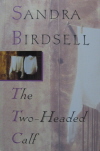
The Two-Headed Calf by Sandra Birdsell

The Two-Headed Calf

This was a collection of short stories. Some were loosely connected (same town, characters from one story mentioned in another, that sort of thing) while others weren’t connected except via geography (they were all set in the prairies, mostly Manitoba). I don’t know if I liked that. I think maybe I like it better when the stories in a collection are either all separate or all connected. I never really thought about that before, but it occurred to me here. I guess the mixture makes it seem kind of “well, this is what I had on hand…”

These stories were very readable, but they didn’t wow me. I’m not sure why (the back cover had kudos from writers who do wow me–Alice Munro and Michael Ondaatje and Jane Urquhart, which is probably why I picked it up in the first place). Maybe I’m just prairied out. Perhaps I shouldn’t have read two Manitoba-based books in a row. I thought it was a good segue. On second thought, I don’t think that’s it. I think I just didn’t connect with the characters. I’m sure others would find them appealing, I just wasn’t having those “yes!” moments that you do when writing really resonates.

2006 Books Read – #2

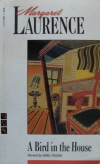
A Bird in the House by Margaret Laurence

A Bird in the House

This is the 4th book in a five-book series that Margaret Laurence wrote about the fictional Manitoba town of Manawaka (based on her hometown of Neepawa). It’s not a “series” in the sense that one normally thinks of a series; the books are only loosely connected–each one has a different main character–and so they really stand alone. There’s no need to read them in order or together.

The 5th book, The Diviners, was given to me as a gift when I was 14. I’d hung onto it and re-read it a few times over the years, and somewhere along the line, I decided I’d like to read the others, so I started picking them up when I saw them in used bookstores (this adds an element of chance to it that I find exciting. YMMV). A Bird in the House was the last of the five that I had yet to read. I found it a few weeks ago.

This is a book that I think I could re-read over and over again. It’s actually not a novel, but eight interconnected short stories. Which is interesting to me, because I’m working on a book like that. The stories center on the childhoood of a girl who grows up to be a writer, essentially depicting the process of how a child becomes a writer. I smirked to (at?) myself in amusement numerous times.

The other books in the series are: The Stone Angel, A Jest of God, and The Fire-Dwellers.

Name Dropping

Back in November, I wrote a post about the annoying overuse of brand names in popular fiction. Well, apparently I’m in good company. Maud Newton posts:

Jessa Crispin hates what she calls “the Emo Boy writers.” (I particularly like her observation that “emo boys namedrop because it’s the only way they know how to explain someone.” Too many contemporary authors replace the individual experience with its pop-cultural echo. Why should anyone read a story if its characters can be evoked solely by reference to punk’s heyday or bad 80’s television?)

Miscellany

One of the better “suggestions for writers” lists that I’ve seen: Being Able to Write: Lessons from Other Writers, New and Well-Seasoned.

As always, I need to work on numbers 3, 9, and 14:

3. Schedule your writing.
9. Always carry a writing notebook.
14. Send out your best work, and send it out religiously.

*

This post on lit mags made me wonder how many writers read literary journals/magazines.

I wonder how it is that such amazing work is left to collect dust in the few bookstores that carry them, or kept insulated in the academic world. If books are the showy muscles of the literary world, then journals are the blood: hidden, self-renewing, and essential.

Since we started TC, I don’t spend near as much time reading other literary journals as I used to. We keep talking about reviving Conundrums to Guess and journal reviews was one of the ideas. It would be a good exercise to read one journal a month and review it. Would be great if a bunch of TCers did this. Perhaps a use for the wiki Bellman was testing?

*

Check out Debbie Ohi’s new comic: Will Write for Chocolate 🙂

2006 Books Read – #1

Purple Hibiscus by Chimamanda Ngozi Adichie

Purple Hibiscus

I picked up this book because I recognized the author’s name. Back in the day, she posted at The Site Where the Snarkers Met (as Amanda Ngozi). I remembered her writing & that I liked it, so when I heard about this book that was enough to send me to the bookstore looking for it.

So. I liked it. It was an easy read, meaning the writing didn’t tax my brain, which is precisely what I needed. It was interesting, in that it was set in Nigeria, so I got some insight into another part of the world. Always good. And I think it was quite perceptive; I related a lot to what the story had to say about family. I’d read more by this author.

Worth a Read

How to Do What You Love

I especially liked this part:

Some people are lucky enough to know what they want to do when they’re twelve, and just glide along as if they were on railroad tracks. But this seems the exception. More often people who do great things have careers with the trajectory of a ping-pong ball. They go to school to study A, drop out and get a job doing B, and then become famous for C after taking it up on the side.

Jumping from one sort of work to another is an odd thing. Sometimes it’s a sign of discipline, and sometimes it’s a sign of laziness. Are you dropping out, or boldy carving a new path? You often can’t tell yourself. Plenty of people who will later do great things seem to their friends and family and even themselves to be disappointments early on, when they’re trying to find the work they love.

Kids who know early what they want to do seem impressive, as if they got the answer to some math question before the other kids. They have an answer, certainly, but odds are it’s wrong. If you read autobiographies (which I highly recommend) you find that a lot of the most successful people didn’t decide till quite late what they wanted to do. And not because they were indecisive, or didn’t know themselves. It takes a long time to just to learn what different kinds of work are like.

I have this line — “I always admired the ones who were sure.” — I think I wrote it in one of my paper journals. Anyhow, it has stuck in my head, which makes me think it would be a good first line. For Jas, perhaps.

Books Read May – December 2005

The brevity of this list reminds me of how prolific a reader I used to be. In grade seven, my teacher had us start a list of books read at the back of one of our notebooks. I think it was more of a suggestion than an assignment because I don’t remember anyone else keeping up with it. But I did, and by the end of the school year, I had read ~120 books. I remember being so thrilled when I hit 100. Anyhow, the school year being approximately 10 months, that’s about 12 books / month. Or a book every 2.5 days.

Okay, so I can still read a book in two days. Or one, even. But these days I seem to spend a lot of my time reading Stuff That Is Not Books. Like blogs. Or submissions. 🙂

  1. Saints of Big Harbour by Lynn Coady n
  2. The Chimney Sweeper’s Boy by Barbara Vine n#
  3. A Child’s Book of True Crime by Chloe Hooper n+
  4. Wide Open by Nicola Barker n+#*
  5. Ripley’s Game by Patricia Highsmith n#
  6. Time Off for Good Behavior by Lani Diane Rich n+
  7. A Girl Named Zippy by Haven Kimmel m+
  8. Take the Cannoli by Sarah Vowell e+#
  9. Geographies of Home by Loida Maritza Perez n+
  10. Liza’s England by Pat Barker n#*
  11. For Rabbit, With Love & Squalor by Anne Roiphe e#
  12. Letting Loose the Hounds by Brady Udall s+#
  13. The Digital Sublime by Vincent Mosco nf+
  14. The Real World of Technology by Ursula Franklin nf+
  15. Under Technology’s Thumb by William Leiss nf+
  16. The Small Details of Life by Kathryn Carter nf+
  17. The Extraordinary Work of Ordinary Writing by Jennifor Sinor nf+#
  18. Reading Between the Lines by Betty Jane Wylie nf+

Cheese Puffs, Part 5

(Parts One, Two, Three & Four)

Impressions of TOFGB:

The first sentence reads awkwardly. It tries to cram too much information in. The bit about being an account executive, etc. should have been a separate sentence. “The court date fell on the Friday of what had been a very bad week for me.” was enough information for the first sentence, though, even at that the construction seems off.

Paragraph 1 establishes that the protagonist has a regular guy, oops, chick job, that she hates because (a) she thinks selling airtime is bad and (b) because she sells airtime people treat her like crap. I’m really not sure why asking people if they’d like to advertise on TV would inspire such venom. Because we’re told that the job is bad, rather than shown why it’s bad, I can’t sympathize with the narrator. I have no context to do so.

With its references to pantyhose and a skirt, paragraph 2 lets us know that the narrator is a woman. (In the part I snipped out, there was also a reference to having cramps, which… yeah. Woman’s in a bad mood; she must have cramps. Sigh.) I guess the reference to putting runs in not one, but two pairs of pantyhose, and the spilling of coffee on the favorite (not just any) skirt, is supposed to endear the reader to the narrator by imbuing her with a lovable klutziness. Me: *groan* I suppose every woman has, at some point in her life, put a run in a pair of pantyhose, so the reader is supposed to identify with this detail, but honestly, without something more (how the run got there, for example), it’s just not all that interesting.

She drives a car she self-describes as “crappy” even though it’s her own damn fault that it’s crappy because she doesn’t maintain it. (She doesn’t seem surprised by the fact the car needs a jump, so this probably isn’t the first time it hasn’t started. It probably needs a new battery, which is not a major fix, nor a major expense.) Then she needed to get male assistance to start her car—implying stereotypical female helplessness with things mechanical. Yes, to jumpstart a car, you need a second car and a set of jumper cables. But why did it have to be a nephew who helped out? Why not a niece? Why not the landlady herself?

After all this, she tells us that she’s in a bad mood. Yes, we got that.

The Mother Teresa reference seems a tad cliched, too easy. Like something you’d put in the first draft as a placeholder. Or in a blog entry. In a novel, I want to read something more original.

Now that we’ve established that grrrl power doesn’t extend to car maintenance, we get into the lawyers are evil rant. Full disclosure, I read this right after I graduated from law school, but at the same time, all-lawyers-are-evil is trite, trite, trite. Please. Some lawyers are evil, some are Mother Teresas (heh), and the vast majority lie somewhere in between. Just like any. other. profession.

Then readers are told that the HG&E executives are “sleazeballs”. Why are they sleazeballs? (And no, just the fact that there was an accident doesn’t automatically make them sleazeballs.) We’re told that the defense lawyer is evil by extension, because if you’re representing “sleazeballs” then you must be one yourself. Never mind the fact that everyone is entitled to representation.

The protagonist nicknames the defense lawyer “Pencil Face”, because why should he get a real name? He’s a weasel. He’s cross-examining her, the evil, evil, man. Doing his job? Bah. Craziness. He should just agree with her, say “no further questions” and sit down. Right.

When that doesn’t happen, our narrator gets so mad at being cross-examined, at the defense lawyer having the temerity to try to discredit her, that she attempts to punch him.

Okay. So there’s a certain amount of humor in this scenario. Who hasn’t been in a situation where they wanted to punch someone, but didn’t? What would happen if you did? That’s the premise of this book. And it isn’t a bad one.

But here’s the thing: after she attempts to punch the defense lawyer, she hits her head, and ends up in a coma. When she wakes up, she decides to change her life, since it’s clearly out of control. Great. So what do you think would be first on this list? How about clearing up the assault charges she’s facing after attacking the defense lawyer? Well, that would be a fine idea–if there were any! She’s not charged with assaulting the defense lawyer, which I mean, come on! She tried to punch a lawyer in a courtroom in front of a judge! Honestly, I just couldn’t get past this. I know it’s supposed to be a light romantic comedy and all, but you don’t go around punching officers of the court and then just walk away tra-la-la. This needed a resolution. How about some community service?

Overall impression: I found the protagonist irritating and the plot development is unrealistic. It’s not just that it verges on the absurd. A comedy of the absurd can work. It’s the giant plotholes. It also relies too heavily on stereotypes and clichés as shortcuts. I’m as fond of a cliché as the next person, but in a novel I want to see fresh writing.

Thinking: the old “show” vs. “tell” axiom was really apparent here.

Which brings me back to where I started: fluffy books are about turning off your brain and being taken for a ride. As long as you don’t think about them too much, they’re fun. Sure, they fall apart the minute you start thinking, but the point is: most readers aren’t thinking. They’re in it for a good time.

The problem is that when you write, you read as a writer. Before I wrote in a serious way, I could (and did) read anything. And now, I simply can’t. The minute I get that “I. am. reading. a. book.” feeling, I’m done. On the other hand, I’ve quite enjoyed several movies/TV shows based on books that I just know that I could not get through (Sex and the City, for example). And I think partly it’s that the acting/directing adds nuances to the characters and plot, but also that because it’s a different medium, I’m able to sit back and be entertained in a way that I can’t with a book.

So two points to conclude. There’s nothing wrong with creating and consuming pure entertainment. Not everything has to have a deeper meaning or greater purpose. But the fact remains that not all books are of equal merit, and fluffy book writers, being writers, have to know that.